Clear Sky Science · en
Intraplanar percolation and interplanar bridge enables layered matrix for high-performance negative electrode
Why Better Batteries Matter
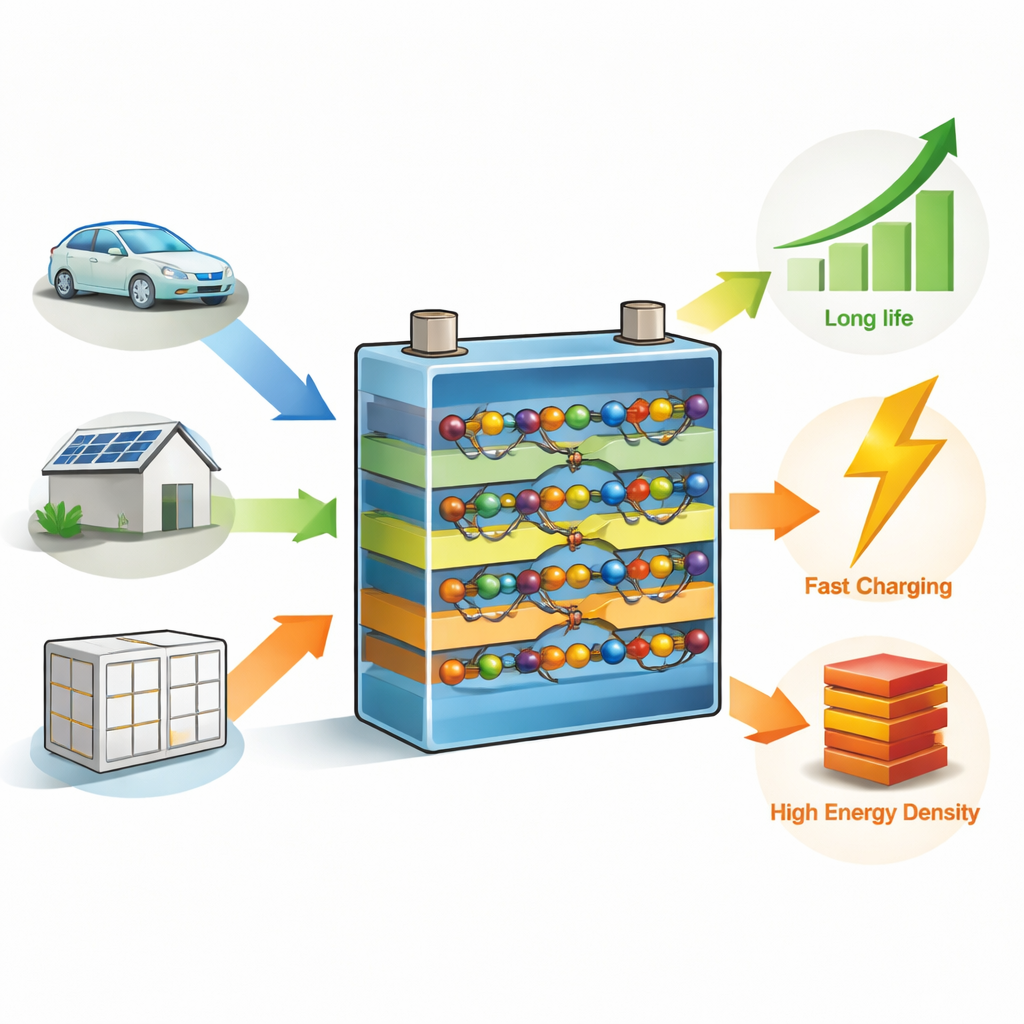
From smartphones to electric cars and backup power for solar panels, modern life leans heavily on rechargeable batteries. But today’s batteries struggle to deliver everything we want at once: high energy, very fast charging, long life, and safe operation in hot summers and cold winters. This study introduces a new way to build the negative electrode—the part of a lithium-ion battery that stores and releases lithium—that could bring us closer to durable, fast-charging batteries suitable for demanding uses like electric vehicles and large-scale energy storage.
A New Way to Stack Atoms
Most commercial lithium-ion batteries use electrode materials arranged in flat atomic layers, a bit like sheets of paper in a stack. These materials can hold a lot of lithium, but lithium moves mainly along the flat planes, which slows charging and can build up stress that damages the structure over time. Other materials with three-dimensional pathways let lithium move faster but sacrifice how much charge they can store or suffer from structural instability. The authors propose a hybrid approach: a layered material that contains both in-plane tunnels for lithium motion and “bridges” between layers that keep the structure pinned and stable. This design aims to combine high capacity, fast ion transport, and exceptional mechanical robustness in one material.
A Layered Material with Built-In Tunnels and Bridges
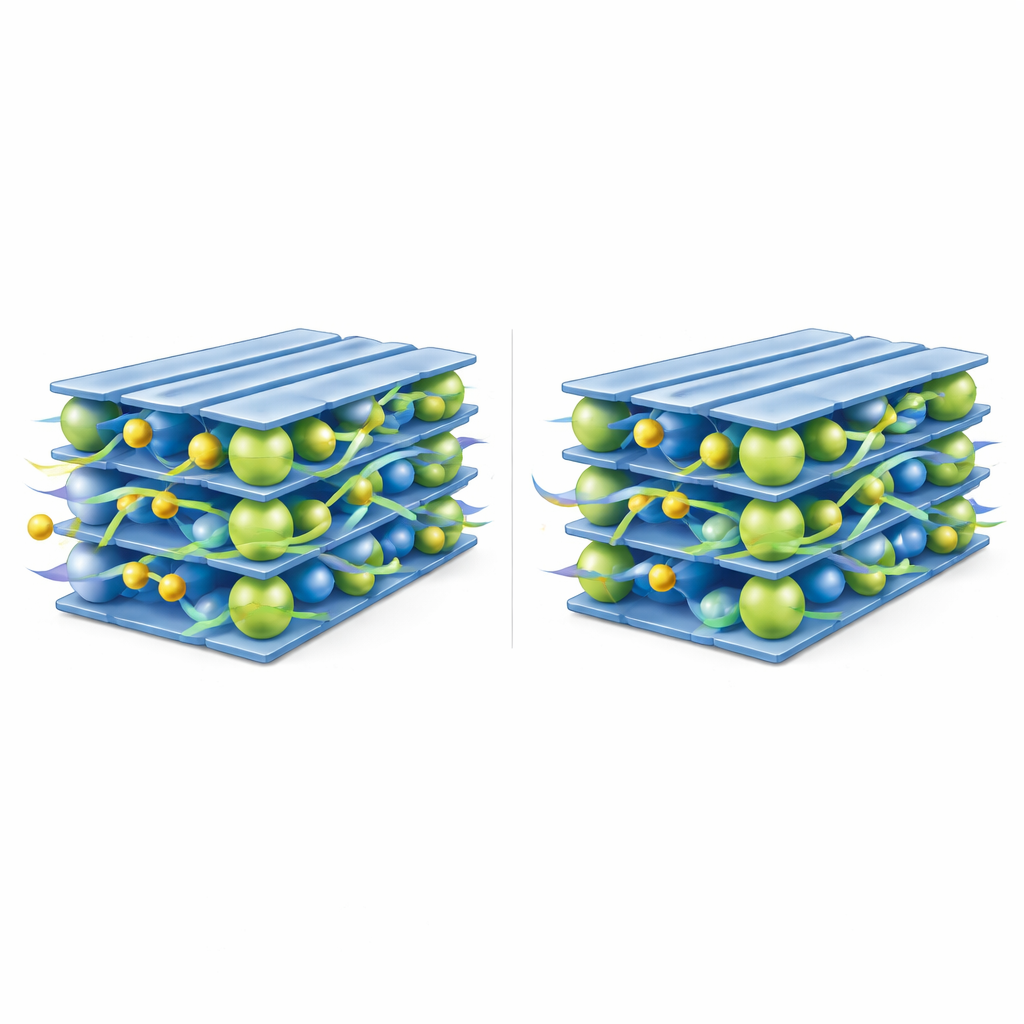
To test this design idea, the team focused on a compound called K3V5O14 (KVO), built from inexpensive potassium and vanadium. Inside KVO, the active layers consist of vanadium and oxygen units arranged so they naturally form many open, pentagon-shaped tunnels. These tunnels act as highways for lithium ions to move within a layer. Between the active layers sit larger potassium-based units that behave like rigid pillars or rivets: they push the layers slightly apart to make room for lithium while also tying the stack together. This architecture creates a three-dimensional network of paths for lithium to move while providing space to accommodate lithium without swelling or cracking.
Fast Charging, Long Life, and All-Weather Operation
When used as a negative electrode, KVO stores much more charge than common commercial materials like graphite or lithium titanate, while working at a voltage that helps avoid dangerous lithium metal deposits. It retains about 377 milliampere-hours per gram at a gentle charge rate and still keeps significant capacity even when charged and discharged very quickly. In repeated cycling tests, the material holds on to most of its capacity after tens of thousands of cycles—far beyond what most commercial electrodes can manage. It also performs well at high temperatures (60 °C) and low temperatures (−10 °C), and full batteries built with KVO on the negative side and a commercial positive electrode deliver substantially higher energy than cells based on traditional lithium titanate.
How It Stays So Stable
To understand why KVO remains so durable, the researchers used a suite of advanced techniques, including X-ray and neutron scattering, electron microscopy, and computer simulations. They found that as lithium moves in and out, the vanadium atoms switch reversibly between different oxidation states, allowing each vanadium atom to participate in storing more than one electron without permanently distorting the structure. Measurements show that the overall crystal framework changes its volume by only about a tenth of a percent during operation—a “zero-strain” behavior that minimizes cracking and mechanical fatigue. At the surface, the material naturally encourages the formation of a thin, lithium fluoride–rich protective film that is chemically robust and helps lithium ions move in and out smoothly over many cycles.
A General Recipe for Future Electrodes
To test whether this design approach was unique to KVO, the team created several other materials with similar layered–tunnel–bridge architectures. These cousins also showed high capacity, fast charging, long life, and very small structural changes when cycling. That suggests the researchers have identified a general structural recipe rather than a one-off curiosity. By deliberately combining in-plane tunnels for easy ion motion with interlayer pillars that hold the framework rigid and provide extra space, material designers may be able to build a new family of battery electrodes that better satisfy the growing demands of electric transport and renewable energy storage.
What This Means for Everyday Technology
In plain terms, this work outlines how to build battery materials that can charge quickly, last for many years of heavy use, and keep working reliably from winter cold to summer heat, all while remaining relatively safe. The specific compound KVO is a strong early example, but more importantly, the study offers a blueprint for discovering and tuning similar materials. If these ideas can be translated into large-scale, low-cost manufacturing, future batteries in cars, devices, and grid storage systems could become more durable, faster to recharge, and better suited to supporting a world increasingly powered by renewable energy.
Citation: Ma, S., Yan, W., Wu, S. et al. Intraplanar percolation and interplanar bridge enables layered matrix for high-performance negative electrode. Nat Commun 17, 2567 (2026). https://doi.org/10.1038/s41467-026-69387-z
Keywords: lithium-ion batteries, negative electrode materials, fast charging, zero-strain structures, vanadium-based compounds