Clear Sky Science · en
Inferring latent behavioral strategy from the representational geometry of prefrontal cortex activity
Hidden plans inside the thinking brain
When you follow a recipe or keep track of a changing shopping list, your brain must constantly update what to remember and what to discard. Scientists know we can use different internal "plans" to do this, even when our outward behavior looks the same. This study asks a deceptively simple question: by looking directly at brain activity, can we figure out which hidden plan an animal is using to keep things in mind?
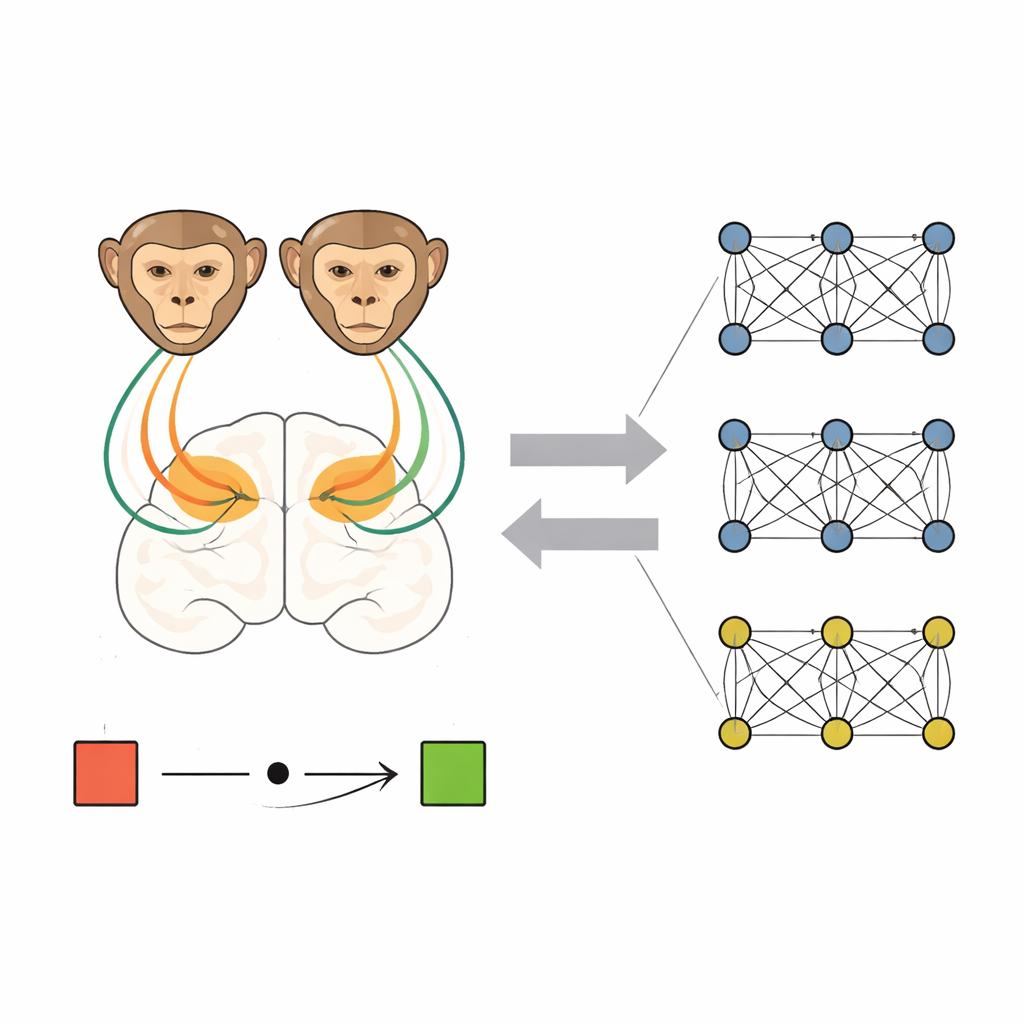
Two ways to keep track of the last thing
The researchers trained two monkeys to perform a challenging eye-movement task that probed working memory—the mental scratchpad we use to hold information briefly. On each trial, the animals stared at a central dot while a red square appeared at one of four locations, then disappeared. After a short delay, a second item appeared: either another red target or a green distractor at a different location. After a second delay, the central dot vanished, cueing the monkey to move its eyes to the location of the most recent target. Sometimes that was the second item; other times, it required ignoring the distractor and returning to the first target’s spot.
Silent swapping versus constant updating
Human studies suggest at least two broad strategies for such tasks. In one, called "retrieve at recall" in technical work, the brain quietly stores several items in separate internal compartments without deciding which one matters. Only when a cue appears does it pull out the relevant item and place it into a special "readout" format that can guide behavior. In the other, a "rehearse and update" style, the brain always keeps the currently important item in that readout format, actively revising it whenever new information arrives. Outwardly, both strategies can yield the same correct eye movement, so behavior alone cannot reveal which is being used.
Building digital brains to read real ones
To crack this problem, the team compared real neural activity in two regions at the front of the brain with the activity of computer models trained to use each strategy. They recorded from neurons in the lateral prefrontal cortex, long known for its role in holding information in mind, and the prearcuate cortex, which helps plan eye movements. In parallel, they trained many recurrent neural networks—artificial systems whose activity unfolds over time—to perform the same task. Some networks were forced to behave like "retrieve at recall" systems, keeping their output uninformative until the final moment. Others were forced to behave like "rehearse and update" systems, with outputs that immediately reflected the current target and changed as needed.
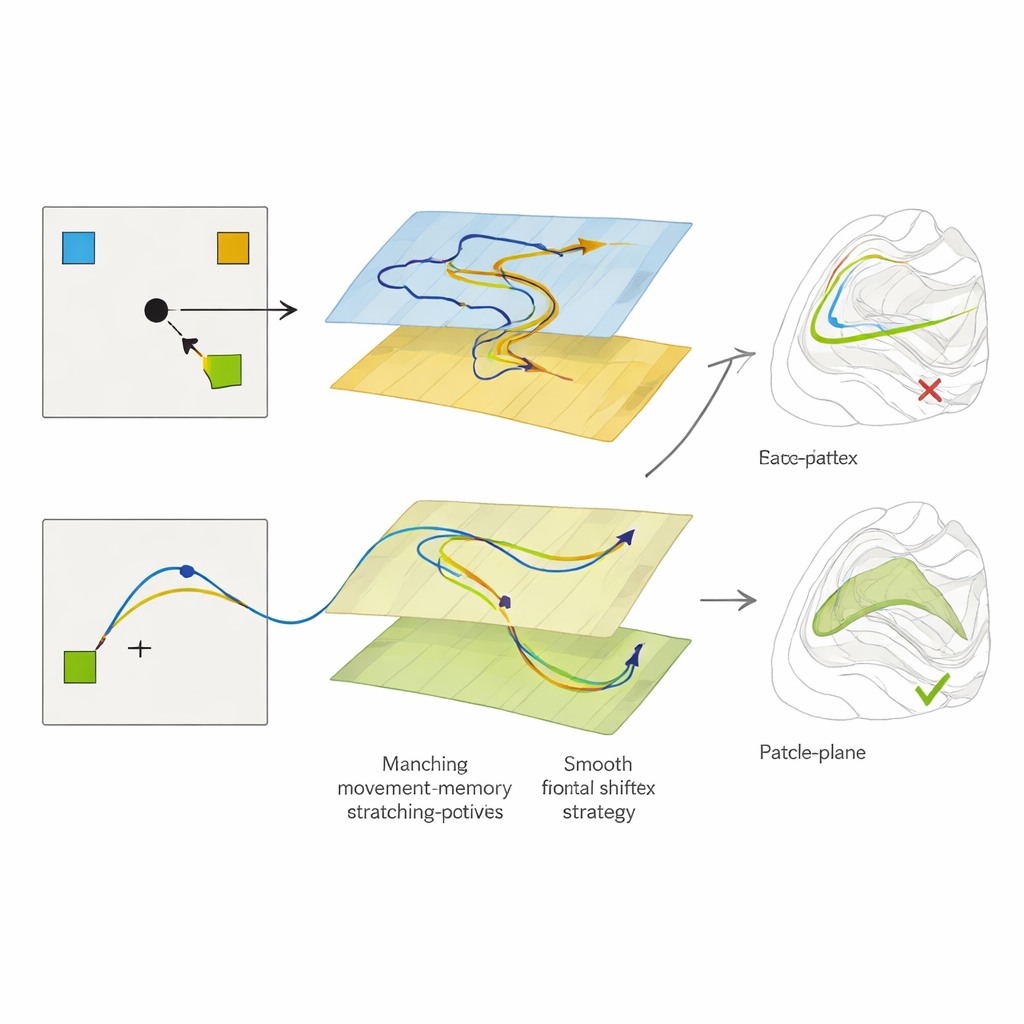
Reading the shapes of thought
Rather than focus on individual cells, the authors examined the overall "shape" traced out by population activity in an abstract space, a bit like plotting the path of a flock rather than each bird. In the recall-style networks, the pattern of activity for a remembered location occupied one set of directions during the first delay, then rotated into a different set just before the response—evidence of transferring information from a hidden store into a readout format. In the update-style networks, the same directions carried the location information across both delays, with smooth drifts only when the relevant target changed. The crucial test was whether the monkeys’ prefrontal activity resembled one pattern more than the other.
Monkeys reveal their quiet strategy
Across multiple measures, both brain regions lined up with the rehearse-and-update style. The population codes for location were stable over time, changed little when a distractor appeared, and occupied nearly the same "plane" of activity throughout the trial. Decoders trained on one delay could reliably read out locations from the other, just as in the update-style networks. In contrast, the signatures of rotation and code-morphing seen in the recall-style networks were largely absent from the neural data. This suggests that, in this task, monkeys keep the currently important location in an active, continuously updated state, rather than storing options silently and selecting later.
Why this hidden choice matters
The work shows that we can infer an animal’s latent mental strategy not from behavior, but from the geometry of its brain activity compared with that of carefully designed artificial networks. For everyday life, it hints that our brains may often favor an ongoing, rehearsal-based approach when keeping track of the latest relevant item, at least in simple settings. More broadly, it opens a path to studying how such internal plans are learned, how they change with experience or fatigue, and how different brain regions cooperate to carry them out—even when, to an outside observer, all that is visible is a single quick flick of the eyes.
Citation: Qian, Y., Herikstad, R. & Libedinsky, C. Inferring latent behavioral strategy from the representational geometry of prefrontal cortex activity. Nat Commun 17, 2850 (2026). https://doi.org/10.1038/s41467-026-69380-6
Keywords: working memory, cognitive strategy, prefrontal cortex, neural networks, decision making