Clear Sky Science · en
Rhythmic sampling of multiple decision alternatives in the human brain
How the Brain Juggles Many Choices
Whether we are choosing a meal, picking a movie, or deciding when to cross a busy street, our brains must sort through several options without getting overwhelmed. This study explores how the brain quietly shifts its inner “spotlight” of attention between different choices, and finds that these shifts follow a rhythmic pattern—like a hidden mental beat—that helps us weigh and compare options efficiently.
The Hidden Beat Behind Everyday Decisions
The researchers asked volunteers to perform a visual task that mimics real-life decisions with more than two options. Participants saw three patterned patches on a screen, each with a different contrast. Sometimes they had to pick the brightest patch, sometimes the dimmest—rules that were revealed only after the patterns had appeared. This setup forced people to inspect and compare the same physical stimuli under different goals, much like evaluating the same set of groceries under different budgets or diets.

Watching the Brain’s Secret Spotlight
To track how attention moved between the three patches, the team used magnetoencephalography (MEG), which measures tiny magnetic fields produced by brain activity with millisecond precision. They first ran a separate “localizer” task to map how the visual cortex responds when a single patch appears at one of the three positions. Using these maps, they built a decoding model that could, during the main decision task, infer both where the person’s covert attention was pointed (the “locus”) and how strongly they were attending overall (the “strength”), even while the eyes stayed fixed in the center.
A 10th-of-a-Second Cycle of Focus and Exploration
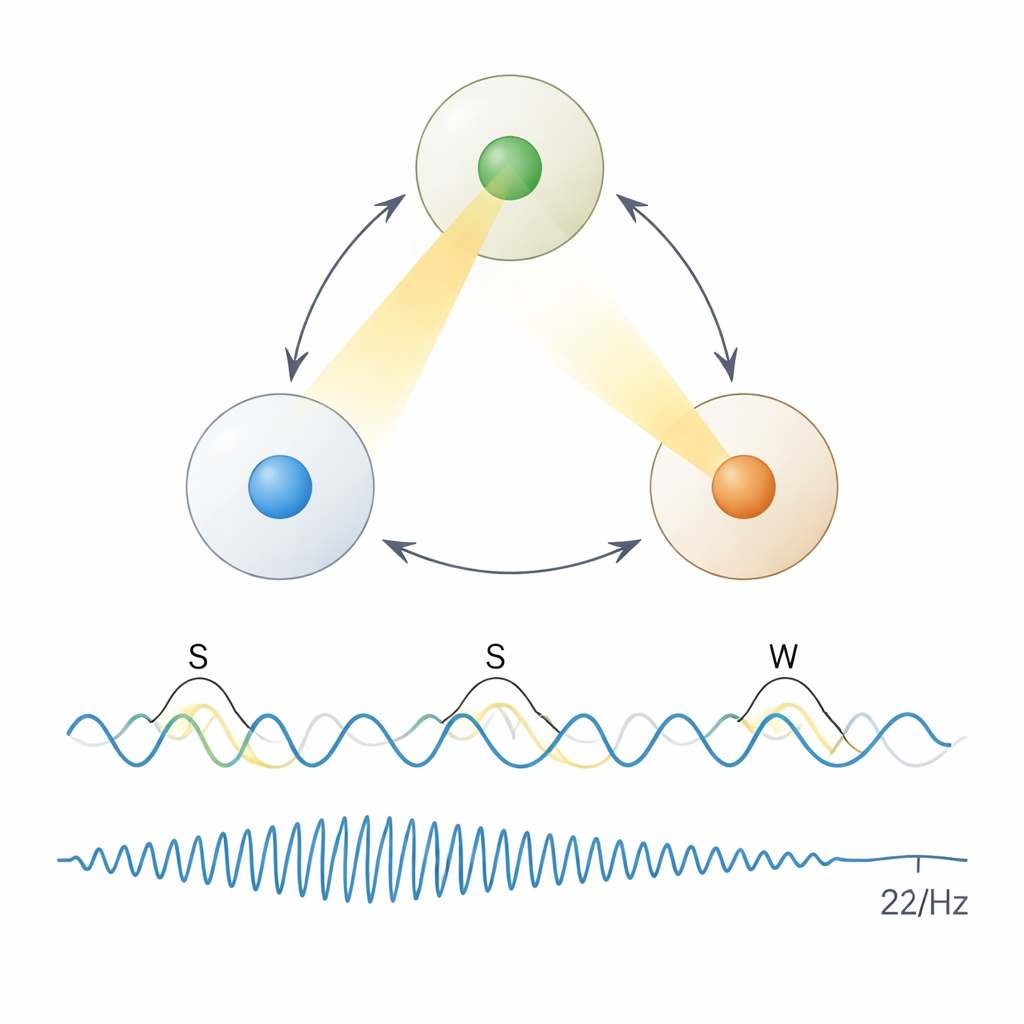
Analyses of these decoded attention signals revealed that attention strength was not steady. Instead, it pulsed rhythmically at roughly 11 times per second. When this internal rhythm was at its peak, attention tended to stay locked onto the same option, favoring deeper processing of that choice. When the rhythm dipped to a trough, attention was more likely to jump to another option, enabling comparison. The timing between successive attention “events”—moments when attention was strongly focused on one patch—clustered around intervals that matched this 11 Hz cycle. Importantly, trials with stronger rhythmic fluctuations, especially in this frequency range, were associated with more accurate choices, indicating that this hidden beat is behaviorally meaningful.
Two Modes of Attention Sharing One Rhythm
The team distinguished between “stay” events, when attention refocused on the same option, and “switch” events, when it jumped to a different one. Both types repeated rhythmically but were offset by about half a cycle, suggesting two complementary modes within a single oscillatory framework—one for in-depth evaluation, one for exploration. Just before switches, attention showed faster, higher-frequency fluctuations, and each switch appeared to reset the main 11 Hz rhythm, as if the system were starting a fresh cycle of evaluation on the newly attended option. Eye-tracking showed that small eye movements tended to precede switches, but their timing and pattern could not fully explain the covert attention rhythm, underscoring that internal shifts of focus are not simply eye movements in disguise.
Why This Matters for Real-World Choices
These findings suggest that the brain resolves the conflict between “thinking harder about one option” and “checking out the others” by weaving them into different phases of a fast, ongoing cycle. In practical terms, your brain does not examine all options in parallel or in a smooth, continuous way. Instead, it rapidly and rhythmically samples one option, then another, then returns, using peaks of the cycle to deepen processing and troughs to switch. This rhythmic sampling may underlie how we make complex choices in cluttered, information-rich environments and helps explain why attention and decision quality can fluctuate over fractions of a second.
Citation: Siems, M., Cao, Y., Tohidi-Moghaddam, M. et al. Rhythmic sampling of multiple decision alternatives in the human brain. Nat Commun 17, 1587 (2026). https://doi.org/10.1038/s41467-026-69379-z
Keywords: attention, decision making, brain rhythms, multialternative choices, neural oscillations