Clear Sky Science · en
Laser-stimulated 4D printing of magnetostrictive Fe-Co-V
Metal Parts That Can Change Shape on Demand
Imagine an airplane wing, a ship antenna, or a protective shell that can gently bend itself into a new form when hit by a light beam—no hinges, no motors, and no wires. This study shows how to make such "living" metal parts by combining advanced 3D printing with a special class of magnetic materials and a carefully aimed laser, opening paths to smarter aerospace and marine hardware.
From Static Metal to Shape-Shifting Pieces
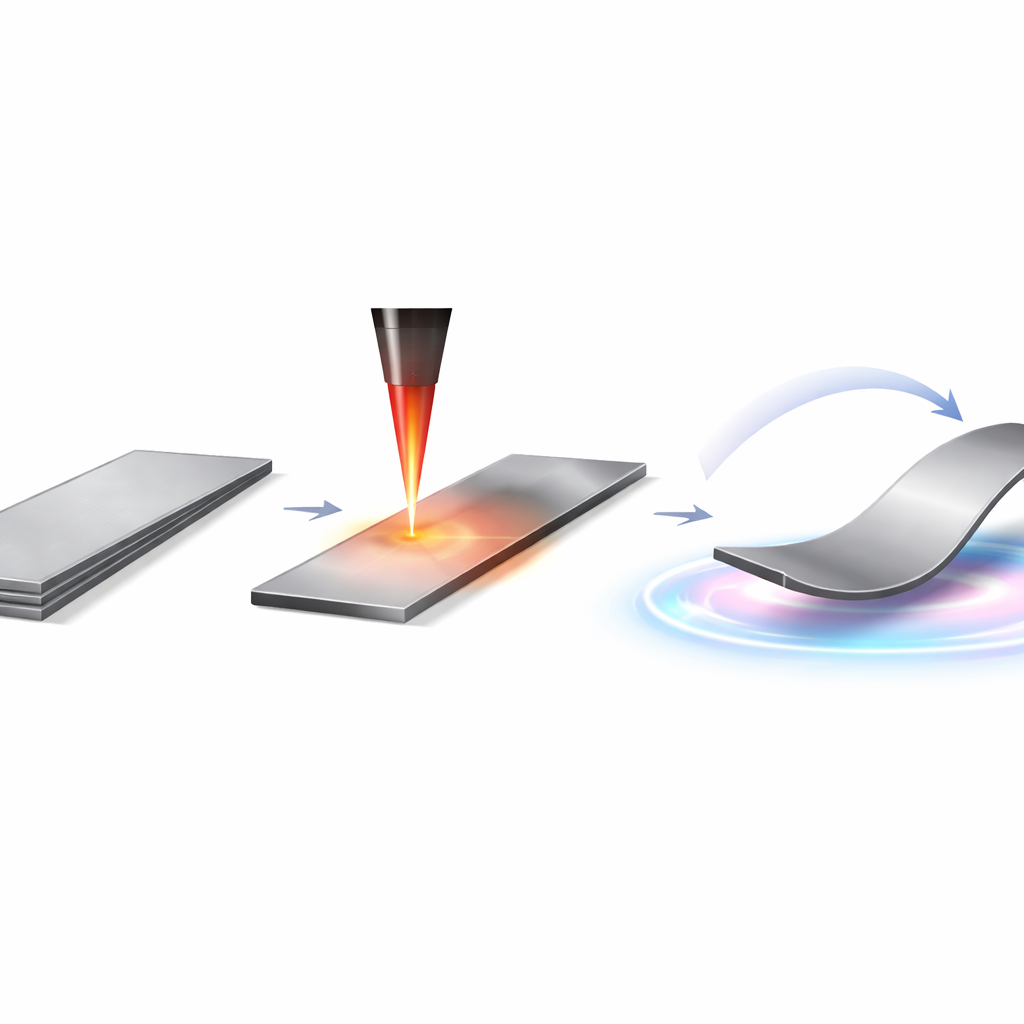
Traditional metal parts are frozen in the shapes they are cast or machined into. Here, the researchers work with magnetostrictive Fe–Co–V alloy, a metal that slightly stretches or shrinks when exposed to a magnetic field and can also turn stress into magnetic changes. Using laser powder bed fusion, a common metal 3D-printing method, they first create flat or gently curved "starter" pieces in two dimensions. These pieces are strong, heat-resistant, and magnetically responsive, but they do not yet perform large, visible movements. The team’s key idea is to treat these printed parts as programmable blanks that can be reshaped later.
Writing New Shapes with a Laser
After printing, the same kind of laser is used in a very different way—not to build the part layer by layer, but to scan along selected surface regions. This scanning heats narrow tracks, creating steep temperature and stress gradients through the thickness of the metal. As the hot zones cool unevenly, internal stresses are permanently rearranged, and the part bends or twists where the beam has passed. By changing how fast the laser moves, how powerful it is, which areas it visits, and how many times it rescans, the team can dial in different final shapes and stiffnesses from the same original design. They demonstrate simple folds, graded bending along a gear-like pattern, and more complex forms that mimic bat wings, closing flowers, and a human hand making a gesture.
Linking Shape Change to Magnetic Behavior
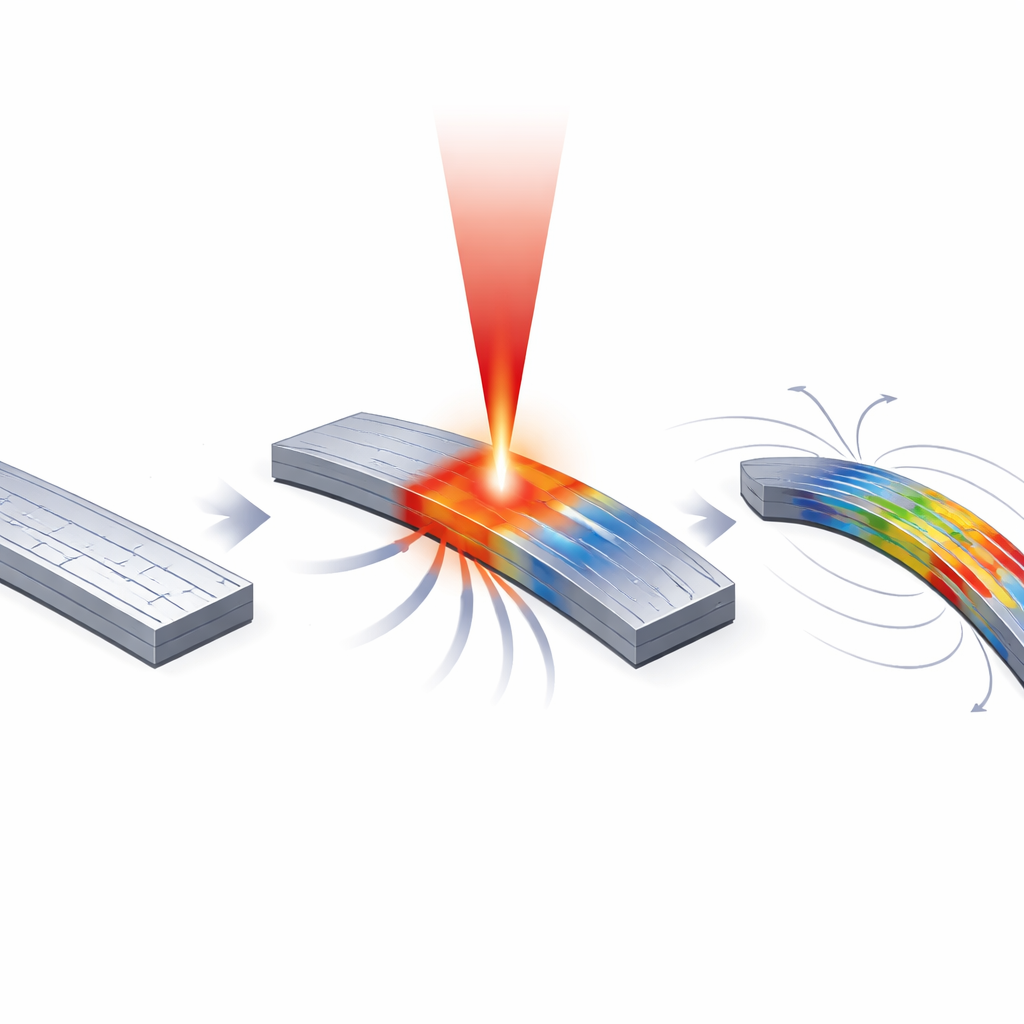
This reshaping step does more than just curve the metal. At the microscopic level, the heating and cooling slightly rearrange the alloy’s crystal lattice and the tiny magnetic regions inside it. Tests show that laser-stimulated parts exhibit smoother surfaces, fewer defects, and more orderly distributions of elements than the as-printed pieces. As a result, when a magnetic field is applied, the reshaped samples show larger magnetostrictive strain—meaning they change length more strongly and predictably—without losing their high-temperature magnetic stability. The material keeps its strong magnetization and coercivity, but now responds more efficiently to magnetic fields, which is crucial for sensors, actuators, and energy harvesters.
Guarding Electronics from Invisible Noise
Modern aircraft, vehicles, and electronics must be shielded from stray electromagnetic waves that can disturb sensitive circuits. The authors test their shape-morphing samples as shielding panels across a wide range of high frequencies used in radar and communication. Both before and after laser treatment, the panels block and absorb a large fraction of incoming waves, with total shielding effectiveness commonly above tens of decibels. After laser stimulation, however, subtle changes in surface roughness, oxide layers, and internal structure make the shielding behavior more tunable. In some bands the reshaped parts absorb more effectively, while in others they reflect more, suggesting that a single printed part could be reconfigured for different electromagnetic environments by adjusting its post-processing.
Why This Matters for Future Machines
By combining 3D printing, targeted laser heating, and magnetically active metal, this work turns ordinary-looking metal plates into components whose shape and performance can be programmed after fabrication. The same Fe–Co–V piece can be printed once and later bent, stiffened, or magnetically optimized by shining a laser along chosen paths. This overcomes the usual limit of magnetostrictive materials, which typically produce only tiny motions, and bridges the gap between microscopic magnetic changes and large, useful deformations. For a layperson, the take-home message is that we are learning to "write" functions into solid metal with light—creating future aircraft skins, antennas, sensors, and energy harvesters that can adapt themselves in service rather than being locked into a single, unchanging form.
Citation: Li, G., Yang, Z., Zheng, A. et al. Laser-stimulated 4D printing of magnetostrictive Fe-Co-V. Nat Commun 17, 2592 (2026). https://doi.org/10.1038/s41467-026-69378-0
Keywords: 4D printing, magnetostrictive alloys, laser powder bed fusion, smart materials, electromagnetic shielding