Clear Sky Science · en
Oxygen depletion in biomolecular condensates is dominated by macromolecular density
Invisible Pockets Inside Living Cells
Inside our cells, many chemical reactions depend on a steady supply of oxygen. But cells are not simple bags of liquid: they contain tiny droplet-like compartments, called biomolecular condensates, that form without membranes. This study asks a deceptively simple question with big implications: do these droplets change how much oxygen is available inside different parts of the cell, and if so, why? The answer turns out to challenge prevailing ideas about how small molecules behave in these crowded microenvironments.
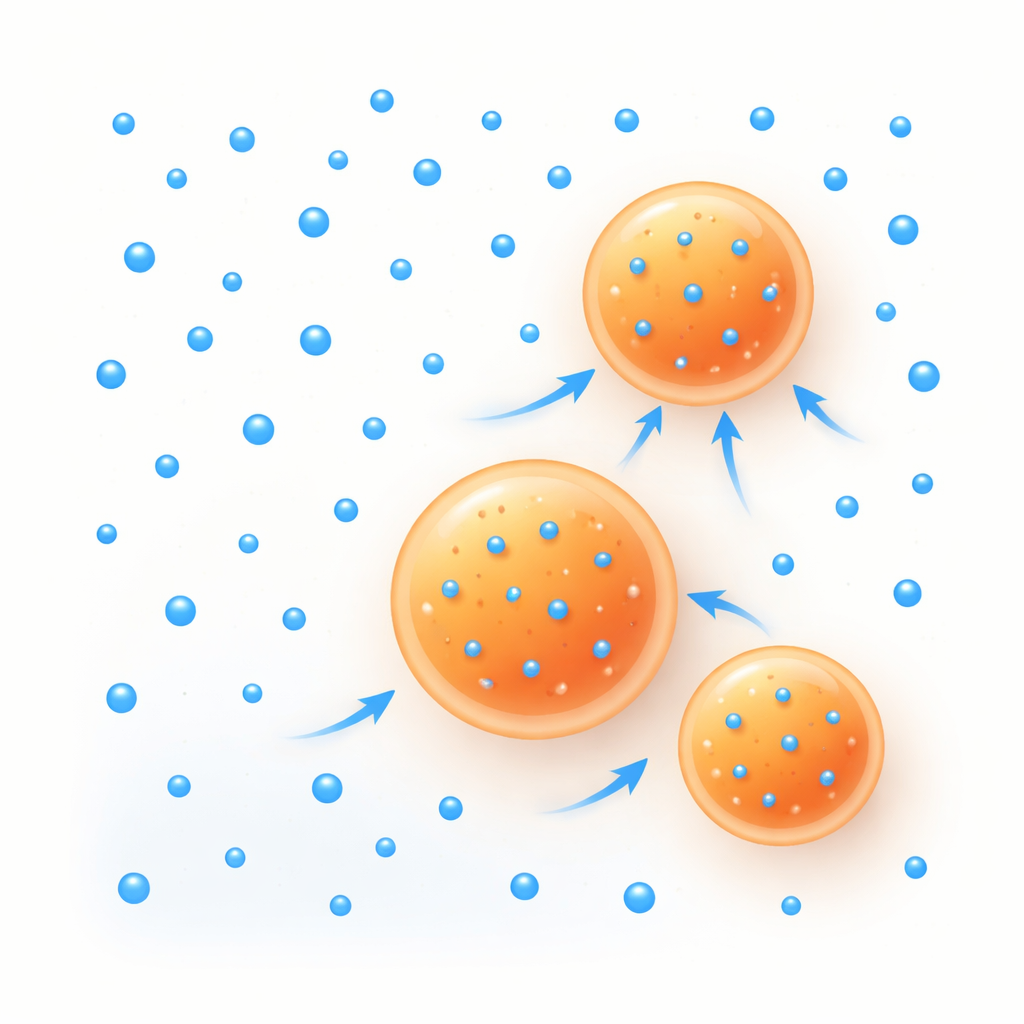
Droplets Without Walls
Biomolecular condensates are soft, liquid-like clusters of proteins and nucleic acids that assemble and dissolve on demand. They help organize biochemistry by concentrating some molecules and excluding others, even though they lack a surrounding membrane. Previous work showed that many small metabolites and drug-like compounds are drawn into these droplets, typically because the interior behaves a bit like an oily solvent compared with the watery cell fluid. Oxygen, however, is a special case: it is a small gas molecule that fuels respiration but also drives damaging side reactions. Whether condensates enrich or deplete oxygen could therefore influence how efficiently enzymes work and how much oxidative damage occurs near or inside these droplets.
Measuring Oxygen in Tiny Compartments
To probe oxygen levels inside condensates, the researchers built a simple but tunable model system using artificially designed, floppy proteins that readily form droplets in salt solution. They first created large, macroscopic phases by spinning samples in a centrifuge and then inserted hair-thin electrochemical microelectrodes to directly read oxygen concentrations across the boundary between the protein-rich and protein-poor layers. These measurements revealed that oxygen levels drop when the probe enters the protein-dense phase: the droplets partially exclude oxygen instead of soaking it up.
Lighting Up Oxygen With Special Dyes
Because electrodes disturb small droplets, the team turned to phosphorescence lifetime imaging microscopy, an optical method that uses special dye molecules whose glow lasts shorter when more oxygen is present. By tracking the glow lifetime inside and outside individual droplets, and carefully correcting for how the droplet environment alters the dye’s baseline behavior, they could infer oxygen concentrations without physically disturbing the condensates. Across a range of conditions, the optical data agreed with the electrode measurements: oxygen is consistently lower inside the condensates than in the surrounding solution. Computer simulations using a coarse-grained molecular model backed this picture, showing that oxygen spends relatively little time inside the dense protein regions.
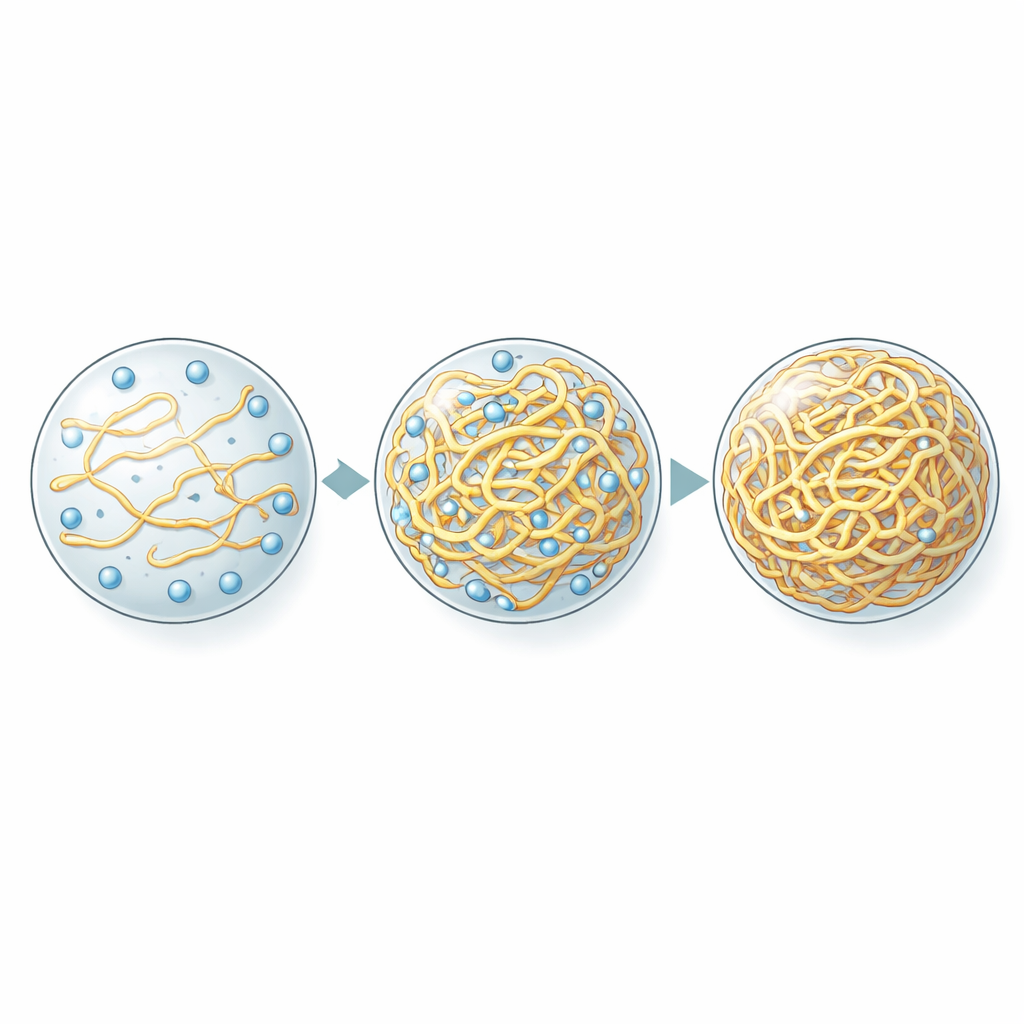
Density, Not Greasiness, Sets Oxygen Levels
The obvious suspect for controlling oxygen uptake is hydrophobicity—the “greasiness” of the droplet interior—which had previously been identified as the key factor for how many other small molecules partition into condensates. To test this, the authors systematically altered the protein sequences to change both the number of repeat units and their hydrophobic character, then measured oxygen inside the resulting droplets. Surprisingly, oxygen levels did not track with how oily or watery the droplets were. Instead, they correlated strongly and inversely with how much protein was packed into the dense phase. Variants that formed more crowded condensates held less oxygen, even when they were less hydrophobic overall. Other small, oily dyes behaved differently: they still preferred more hydrophobic droplets, confirming that oxygen was breaking the usual rules.
New View of Nanoscale Oxygen Gradients
These findings lead to a revised view of how condensates shape their chemical surroundings. For small molecules that do not strongly stick to the scaffold proteins, the sheer density of macromolecules becomes the dominant factor: the more volume the proteins occupy, the less room remains for dissolved oxygen. This means that cells can generate oxygen gradients over nanometer to micrometer distances simply by forming or dissolving condensates, or by changing how tightly packed these droplets are. In practical terms, the work suggests that membrane-less organelles can subtly tune the availability of oxygen for nearby reactions—potentially speeding some up, slowing others down, or protecting sensitive components—through a physical crowding effect rather than through specific chemical binding.
Citation: Garg, A., Brasnett, C., Marrink, S.J. et al. Oxygen depletion in biomolecular condensates is dominated by macromolecular density. Nat Commun 17, 2603 (2026). https://doi.org/10.1038/s41467-026-69376-2
Keywords: biomolecular condensates, oxygen partitioning, macromolecular crowding, phase separation, cellular microenvironments