Clear Sky Science · en
The effects of a second pregnancy on women’s brain structure and function
Why this matters for parents and the curious mind
Pregnancy is often described as life changing, but this study shows that the change runs deeper than we might think: it reshapes the brain itself. Scientists already knew that a first pregnancy alters the structure and activity of the brain. This new work asks a question many parents will find compelling: what happens to the brain when a woman becomes pregnant a second time? Are the same regions remodeled again, or does the brain adapt in new ways to the demands of caring for more than one child?
Looking inside the brain before and after pregnancy
To answer this, researchers followed 110 women over time. Some became mothers for the first time, some were expecting their second child, and others did not become pregnant during the study. Before anyone conceived, all participants underwent detailed brain scans using several MRI techniques. The scans were repeated in the early months after birth, and for a subset of mothers again about a year later. This allowed the team to track how gray matter (the brain’s processing tissue), white matter (the wiring that links regions), and resting brain activity changed across pregnancies and how these changes related to mood and bonding with the baby. 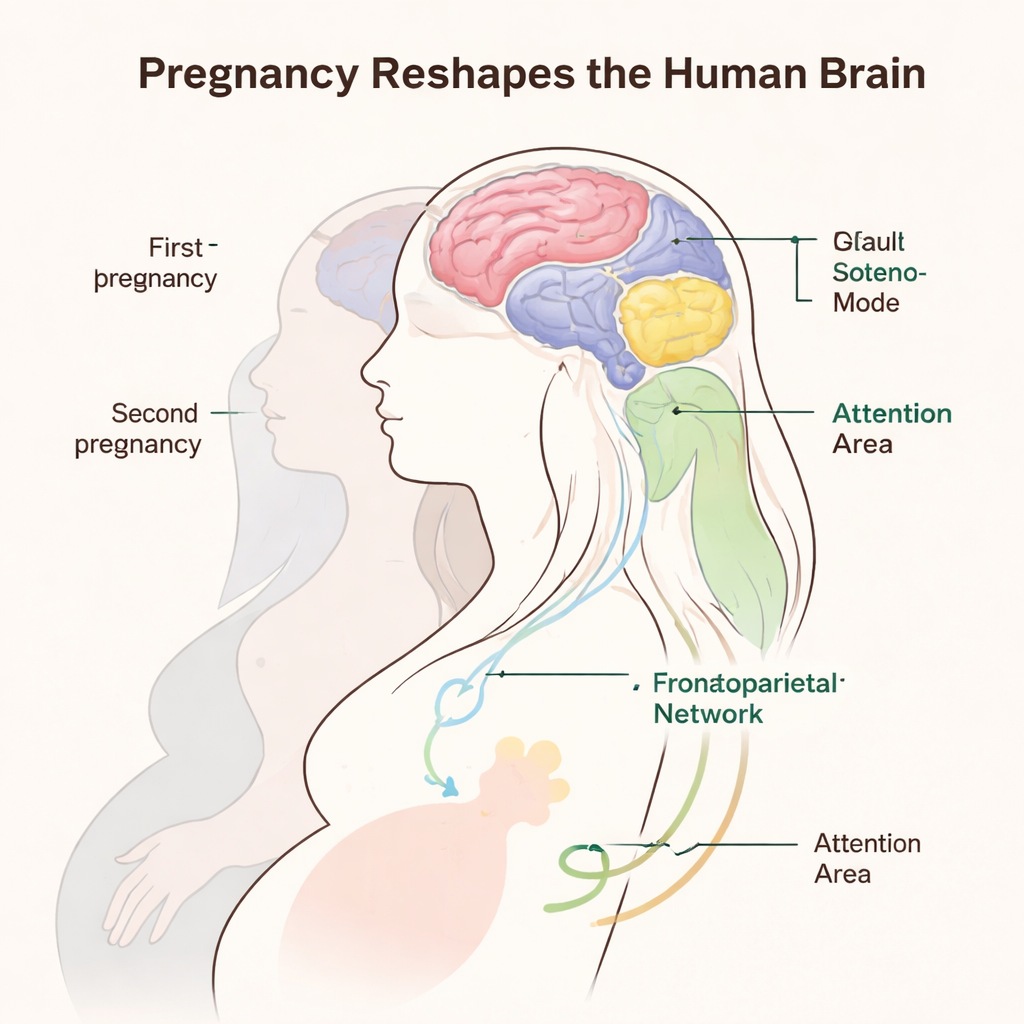
Similar reshaping, but a smaller makeover the second time
Both first-time and second-time mothers showed widespread reductions in cortical gray matter volume compared with women who did not become pregnant. These changes were not signs of damage, but are thought to reflect a fine-tuning of brain circuits, much like what happens during adolescence. In first-time mothers, the affected areas covered more of the brain and the changes were slightly larger than in mothers going through a second pregnancy. Many of the overlapping changes occurred in so-called “introspective” networks: regions involved in self-reflection, understanding others, and complex thinking. The pattern was so distinctive that, using only the pre- and post-pregnancy brain scans, a computer could correctly tell whether a woman had gone through her first or second pregnancy in most cases.
Different networks for first and second-time mothers
When the researchers looked more closely at where the changes occurred, a clear division emerged. For both pregnancies, the default mode network and frontoparietal network—systems linked to self-perception, social understanding, and higher reasoning—were key targets of change. However, during a first pregnancy these networks were affected more strongly and across larger areas, and their internal communication increased only in first-time mothers. This suggests that the brain undergoes a major “first-time mother” reorganization in regions that may support tuning in to the baby and reshaping the sense of self, and that a second pregnancy refines rather than repeats this process in a milder way.
Preparing the brain for juggling more children
By contrast, some brain changes were unique to second-time mothers. These were mainly in the somatomotor and attention networks, which help control movement, respond to the outside world, and stay focused on goals. In these women, the corticospinal tract—a major pathway carrying motor and sensory signals—showed signs of strengthened structure that persisted up to a year after birth. This pattern suggests that a second pregnancy may especially sharpen brain systems that help a mother coordinate actions, divide attention, and respond quickly to multiple demands, such as caring for a newborn while also looking after an older child. 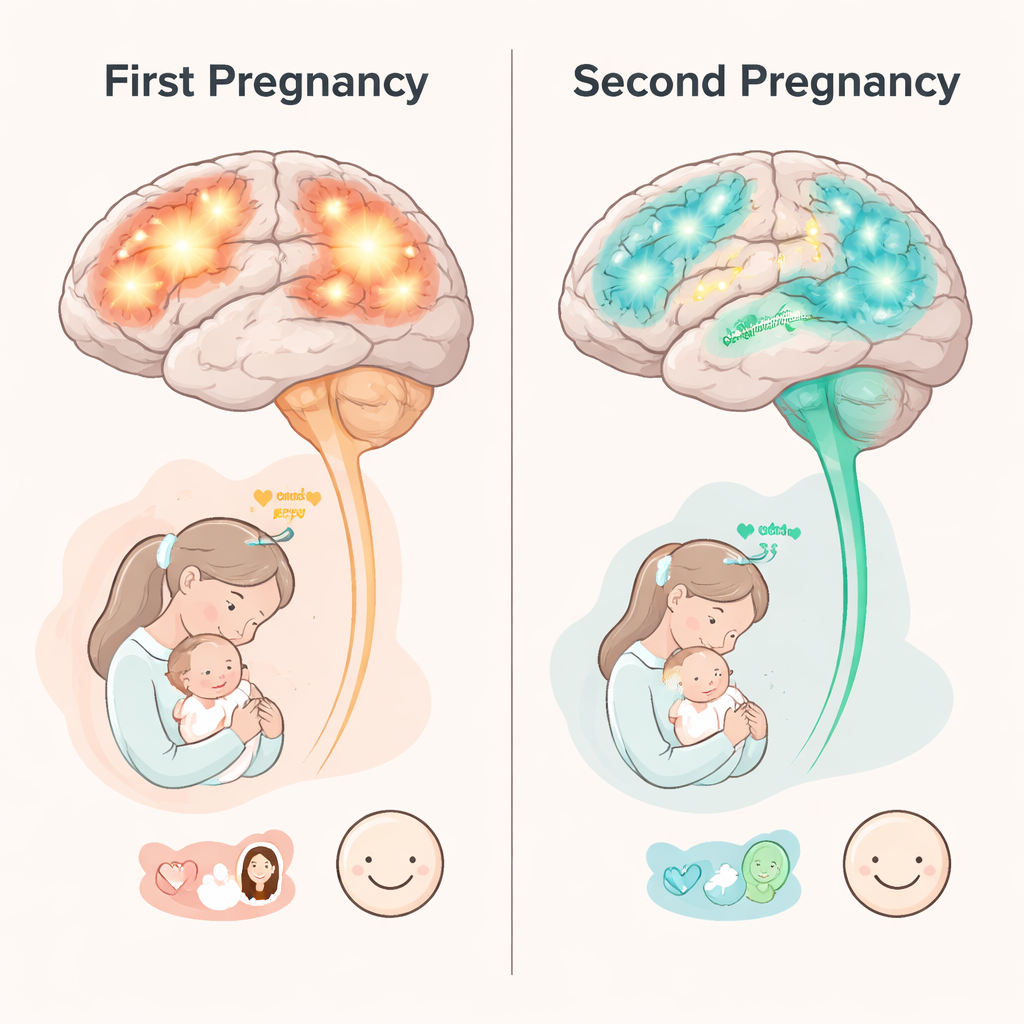
Links to bonding and mental health
The study also found that the degree of brain change was related to how mothers felt and behaved. In both first and second pregnancies, women who showed stronger structural changes tended to report better bonding with their infants and fewer difficulties in the mother–infant relationship. Brain changes were also tied to symptoms of depression and general distress. In first-time mothers, these links were more evident in the postpartum period, while in second-time mothers they appeared more strongly during pregnancy itself. This pattern hints that the same brain adaptations that support caregiving might also influence vulnerability or resilience to peripartum depression.
What this means for understanding the maternal brain
Taken together, the findings show that a second pregnancy is not simply a repeat of the first for the brain. Both pregnancies leave a lasting imprint on gray matter structure, white matter wiring, and resting activity, but they emphasize different neural networks. The first pregnancy seems to bring a major overhaul of brain systems for self-understanding and social connection, laying the foundation for maternal behavior. A second pregnancy appears to fine-tune those systems while more strongly reshaping networks for movement and attention, perhaps to meet the challenges of caring for multiple children. In short, each pregnancy contributes its own unique chapter to the story of how a woman’s brain adapts to motherhood.
Citation: Straathof, M., Halmans, S., Pouwels, P.J.W. et al. The effects of a second pregnancy on women’s brain structure and function. Nat Commun 17, 1495 (2026). https://doi.org/10.1038/s41467-026-69370-8
Keywords: pregnancy and the brain, maternal neuroplasticity, second pregnancy, mother–infant bonding, women’s mental health