Clear Sky Science · en
iMOE: prediction of second-life battery degradation trajectory using interpretable mixture of experts
Why second lives for car batteries matter
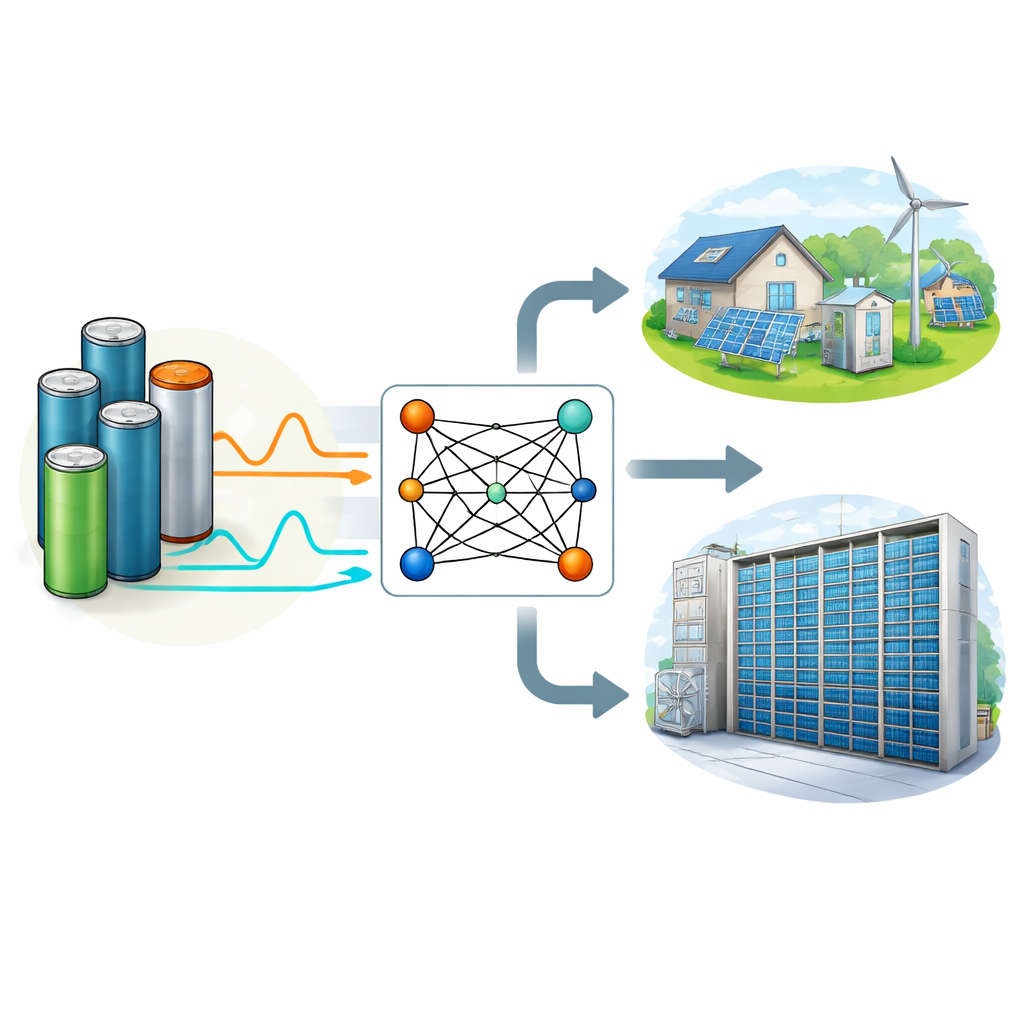
As millions of electric cars reach the end of their first life, their batteries still hold a surprising amount of usable energy. Giving these "retired" batteries a second life in backup power systems or village microgrids could cut costs and waste worldwide. But there is a catch: nobody really knows how fast an individual used battery will keep wearing out, and guessing wrong can lead to failures, fires or wasted investments. This study introduces a new way to forecast how a second‑hand battery will age using only a quick, non‑destructive check, potentially changing how we reuse batteries at scale.
From car to grid: a prediction problem
Today, assessing a retired car battery is slow, expensive and often destructive. Traditional methods either dismantle cells for lab testing or cycle them through full charge–discharge tests that can take days per pack. Many advanced sensor techniques are still confined to research labs. On top of that, second‑life uses such as home storage or off‑grid systems may put batteries through very different patterns of charging, discharging and temperature than they saw in a vehicle. Because battery wear depends strongly on its past and future use, most existing data‑driven models fail when they lack years of historical data or when the new operating conditions change. The challenge is to look at a battery once, under whatever charge level it happens to have, and still forecast its future health under new conditions.
A quick health check instead of a full medical history
The authors propose an approach called an interpretable mixture of experts, or iMOE, that aims to do exactly that. Instead of demanding long records, the method uses signals that are easy to collect in the field during a single controlled charge. Technicians partially charge the battery from whatever state of charge it arrives with and then let it rest. From the way voltage changes during this short charge and the following relaxation, the model extracts a handful of physically motivated features that reflect internal resistance, polarization and how much usable lithium remains. These condensed clues, together with a description of the planned future use pattern—such as charge and discharge rates and temperature—form the input to the prediction system.
Many specialists, one combined forecast
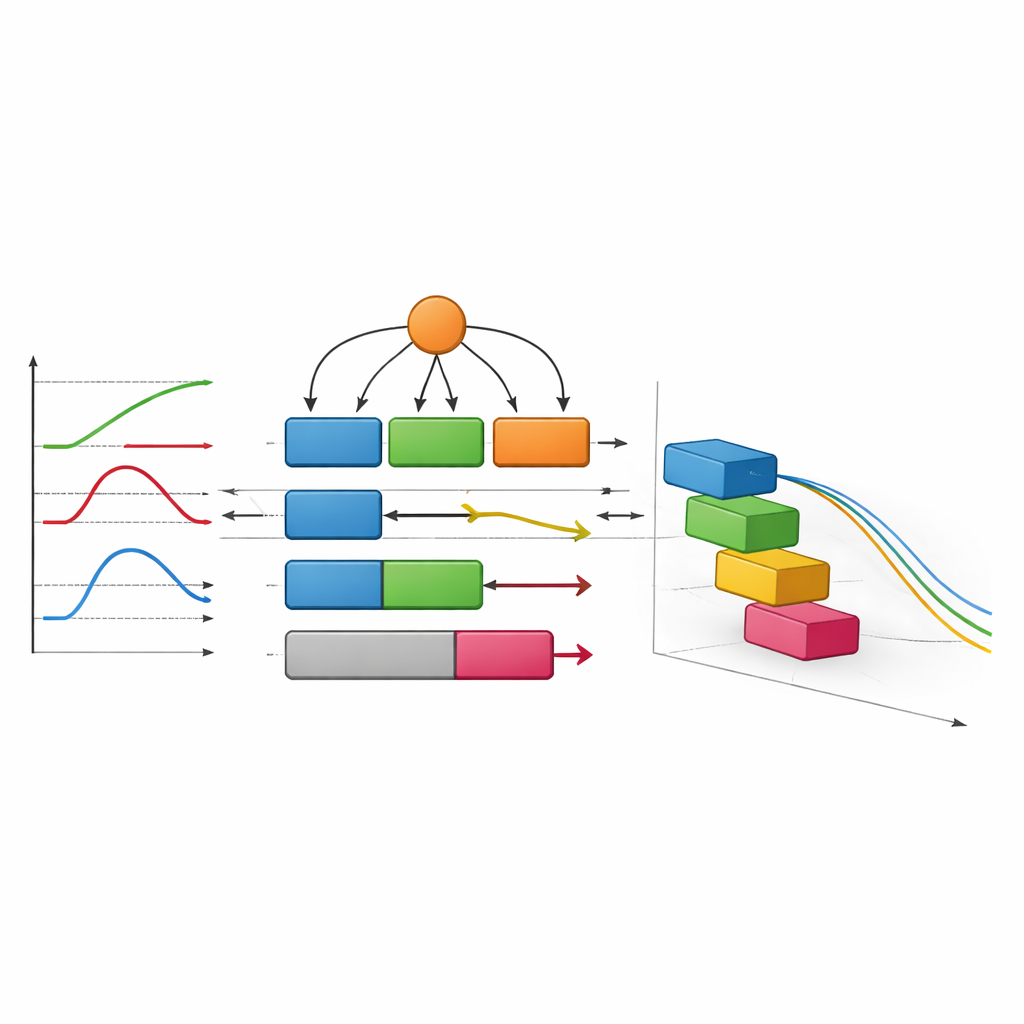
Inside iMOE, these inputs are processed by a set of virtual "experts," each tuned to a typical pattern of battery wear. Some resemble early‑life behavior dominated by protective film growth on electrodes, others capture mid‑life thickening of that film, and still others represent late‑stage processes such as lithium plating and loss of active material. A routing module examines the physical features and decides how strongly to weight each expert for the battery at hand, effectively classifying its dominant degradation mode without ever seeing its history. The weighted combination of expert outputs forms a short‑term trend of how capacity is likely to change next.
Looking ahead through many charge–discharge cycles
The short‑term trend alone is not enough; how harshly the battery will be treated in its second life also matters. To address this, a second module, a recurrent neural network, takes the trend together with the planned future load profile—cycle by cycle charge rate, discharge rate and temperature—and rolls the prediction forward over dozens to hundreds of future cycles. Tested on three large datasets covering 295 commercial cells, 93 operating conditions and more than 84,000 cycles, iMOE consistently predicted entire future capacity trajectories with errors typically below 1–3 percent, even when future conditions were random or when batteries had deeply aged under unknown past use. It also ran faster and more efficiently than leading time‑series forecasting models while using less training data.
Seeing inside the black box
Unlike many machine‑learning systems, iMOE is designed to be readable by battery scientists and engineers. By examining how the router assigns weights to different experts across the life of a cell, the authors show that the model naturally separates early, middle and late degradation stages, aligning with known physical processes. Batteries retired at higher health tend to be routed to certain experts, while heavily worn batteries activate others. When the researchers deliberately disturbed specific physical features or forced the router to use the wrong experts, prediction errors rose, underscoring that the system is not just fitting curves but is tied to meaningful internal behavior.
What this means for future energy systems
In plain terms, this work presents a way to tell, in milliseconds and without a long test, how a used battery is likely to age in its second job. That capability could let recyclers, grid operators and project developers sort large volumes of retired cells into safe, suitable roles—such as long‑lasting stationary storage versus short‑term uses—or send high‑risk packs directly to recycling. While the method still relies on statistical links rather than full physical causality and assumes that rough future usage plans are known, it marks a step toward smarter, safer and more economical battery reuse, helping stretch the value of the materials already mined and manufactured.
Citation: Huang, X., Tao, S., Liang, C. et al. iMOE: prediction of second-life battery degradation trajectory using interpretable mixture of experts. Nat Commun 17, 2549 (2026). https://doi.org/10.1038/s41467-026-69369-1
Keywords: second-life batteries, battery degradation prediction, machine learning for energy storage, mixture of experts, lithium-ion battery health