Clear Sky Science · en
Atomic faulting drives exceptional toughness in low thermal expansion chromium alloys
Metals That Stay Still When Things Heat Up
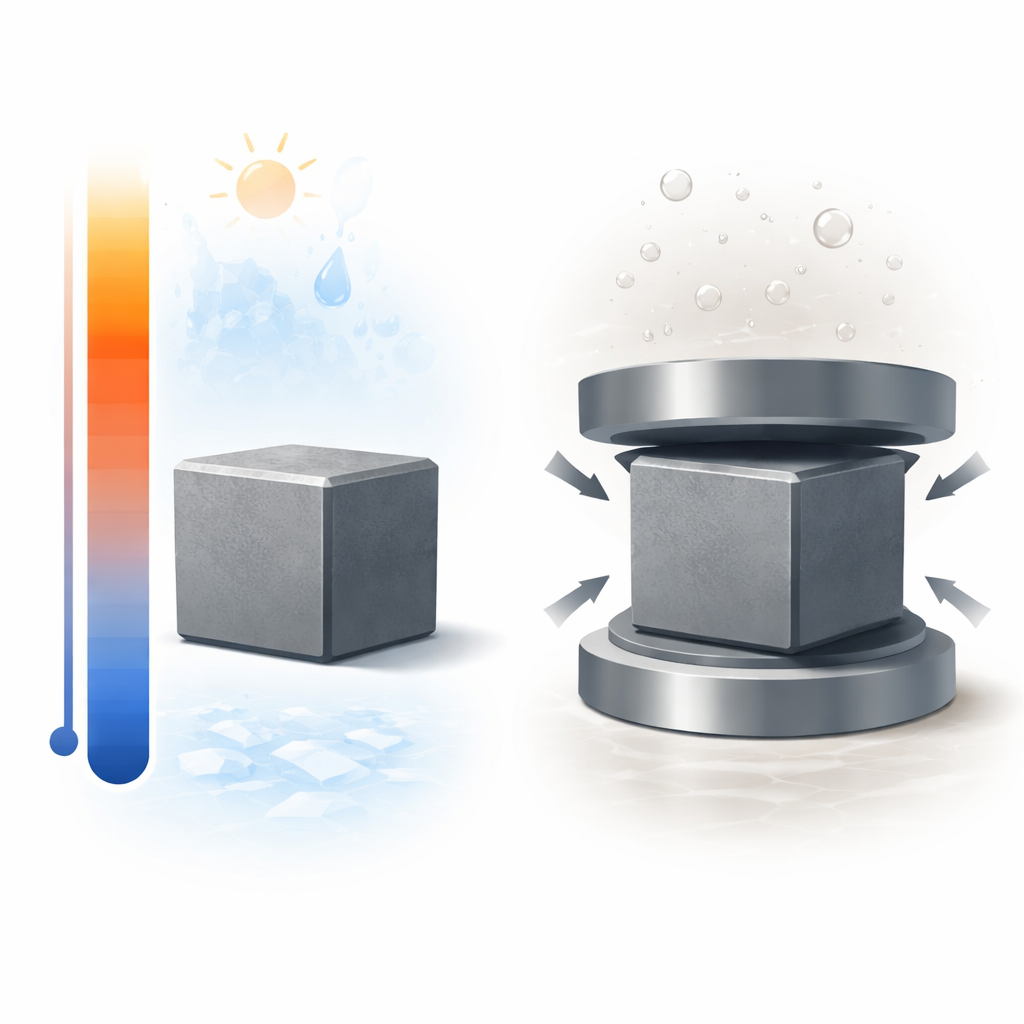
Modern technologies—from space telescopes to semiconductor factories—depend on metal parts that keep their shape as temperatures swing and forces mount. Yet most metals either expand as they heat or crack when pushed too far. This study shows how a specially designed chromium alloy can do both things at once: barely change size with temperature while resisting fracture far better than expected, offering a new blueprint for ultra-stable components in extreme environments.
Why Ordinary Chromium Falls Short
Chromium is a workhorse element, valued for its hardness and natural resistance to rust. Unfortunately, pure chromium and many of its alloys are notoriously brittle. Their atomic bonds are so strong that the tiny defects—dislocations—that normally let metals bend instead struggle to move, causing cracks to form prematurely at grain boundaries. At the same time, engineers seeking “zero thermal expansion” materials—which barely expand or contract as temperatures change—often end up with compounds that are too fragile or chemically vulnerable for real-world use. Chromium’s corrosion resistance makes it attractive for demanding settings such as seawater or harsh chemical environments, but only if its toughness can be dramatically improved.
A New Alloy That Stays Steady and Tough
The researchers created a family of chromium-based alloys by adding small amounts of iron, germanium, and boron, carefully tuning composition until they found a standout: Cr96Fe4Ge1.3B1. In this material, the main body of the alloy keeps a body-centered cubic crystal pattern whose magnetic behavior changes near room temperature. As it cools, the atomic magnetic moments line up in opposite directions in neighboring layers, a pattern called antiferromagnetism. That magnetic ordering subtly pulls the crystal lattice inward just enough to counteract the normal tendency to expand with heat, yielding a very low thermal expansion over a temperature window relevant to precision instruments. Remarkably, even with this delicate balance, the alloy can absorb unusually large amounts of mechanical energy before failing, making it both dimensionally stable and mechanically robust.
Hidden Layers That Stop Cracks
Microscope and diffraction studies revealed that the secret to the alloy’s toughness lies in a natural two-phase structure. Within the chromium-rich matrix, thin plates of a compound called Cr2B form along grain boundaries. These plates act like built-in reinforcements: they break up large grains into much finer ones, which raises the strength, and they also form strong, boron-enriched interfaces with the surrounding metal. Atom probe measurements showed boron atoms clustering along these boundaries, where quantum calculations indicate they strengthen the interface by enhancing bonding between atoms. When the alloy is compressed, the chromium matrix yields first, but stress is quickly shared with the Cr2B plates, preventing any single region from carrying the entire load and helping to delay catastrophic cracking.
Atomic Faults That Protect the Metal
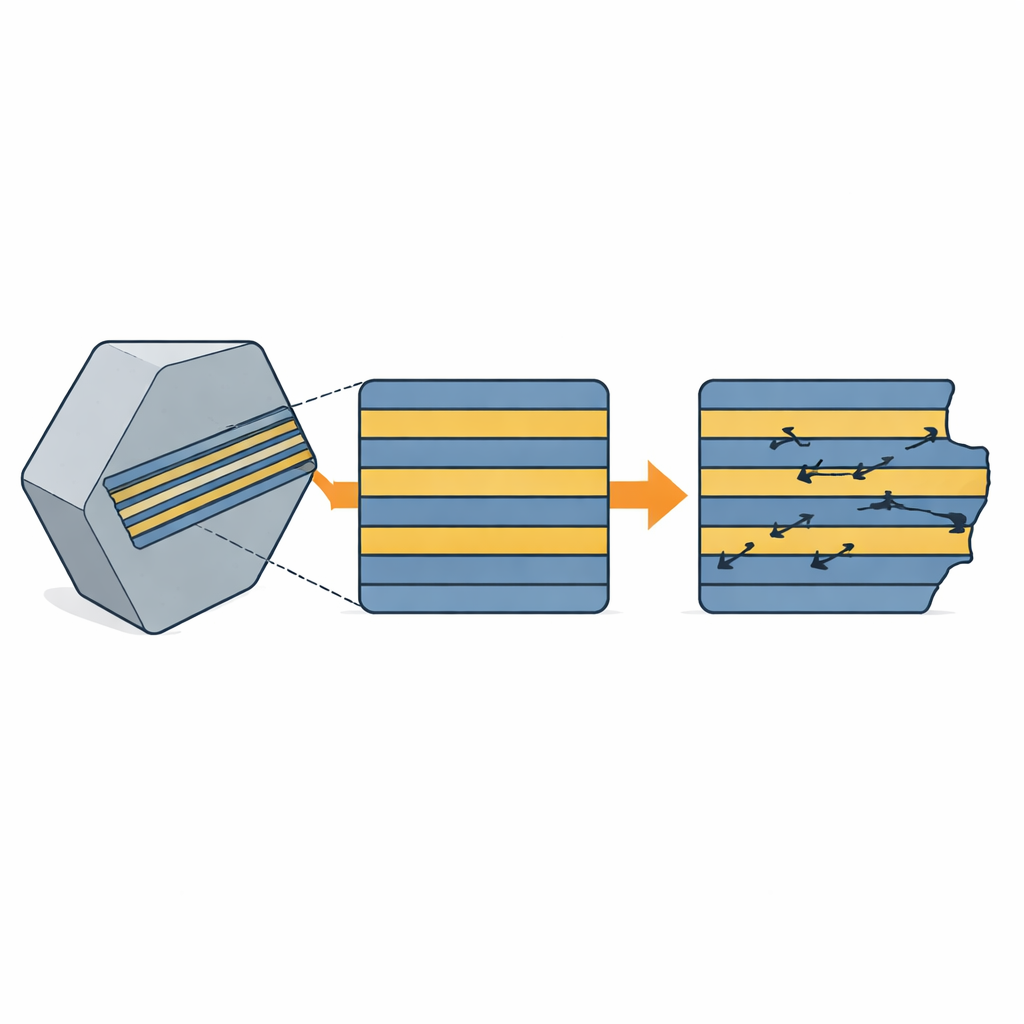
Under higher strains, the Cr2B plates themselves begin to deform in a surprisingly gentle way. Instead of shattering, they develop countless tiny “stacking faults,” where rows of atoms in certain layers slip slightly relative to one another. Detailed imaging shows that these slips mainly occur between alternating layers rich in chromium and boron, rather than between chromium-only layers. Electronic structure calculations reveal why: while individual chromium–boron bonds are strong, the combined bonding between these mixed layers is weaker overall than between purely metallic layers. This makes it easier for selected planes to slide in small increments, acting like nanoscale shock absorbers that spread and dissipate stress. As these faults multiply, they give the alloy exceptional work-hardening ability, allowing it to resist further deformation without suddenly failing.
What This Means for Future Devices
By weaving together careful chemistry, magnetic effects, and controlled atomic faulting, the authors show that chromium alloys do not have to choose between stability and toughness. Their design achieves very low thermal expansion near room temperature, strong resistance to corrosion, and a toughness far surpassing many traditional low-expansion materials. For non-specialists, the key message is that engineers can now envision metal components—such as precision mounts, mirrors, or frames—that hold their shape across temperature swings while enduring heavy loads and harsh environments. This work points toward a new generation of alloys where the way atoms slip and rearrange at the smallest scales is deliberately engineered to protect devices at the largest scales.
Citation: Yu, C., Wu, H., Zhu, H. et al. Atomic faulting drives exceptional toughness in low thermal expansion chromium alloys. Nat Commun 17, 2435 (2026). https://doi.org/10.1038/s41467-026-69365-5
Keywords: low thermal expansion alloys, chromium alloy toughness, stacking faults, boron-modified metals, precision structural materials