Clear Sky Science · en
eQTL in diseased colon tissue identifies potential target genes associated with IBD
Why this research matters for gut health
Inflammatory bowel diseases (IBD) such as Crohn’s disease and ulcerative colitis affect millions of people worldwide, often striking in early adulthood and causing lifelong digestive problems. We know from large genetic studies that hundreds of spots in our DNA influence the risk of developing IBD, but for most of these regions we still do not know which genes they control or how they alter the gut. This study tackles that mystery by looking directly at colon tissue from people with IBD to see how their genetic variants change gene activity, revealing potential weak points in the intestinal barrier and immune system that could be targeted by future therapies.
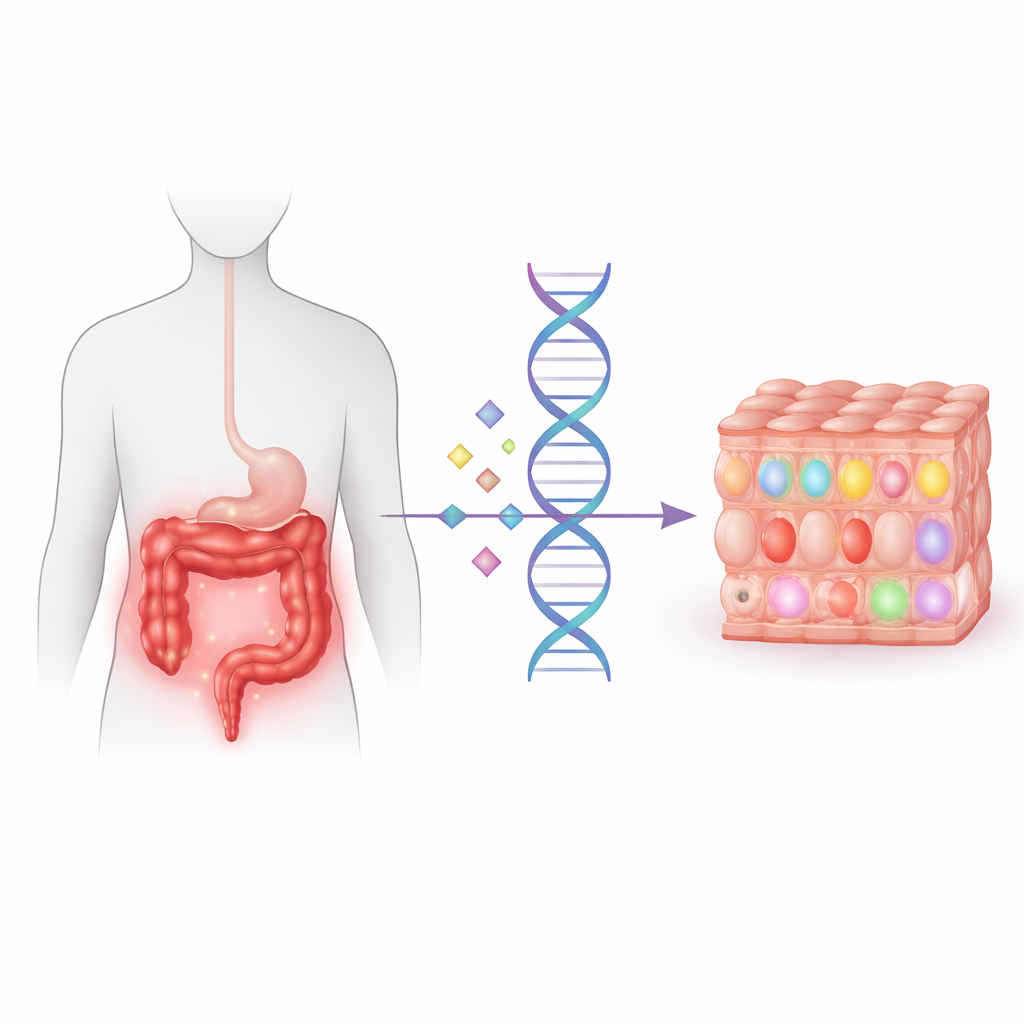
Reading the genetic control switches in the diseased colon
The researchers focused on “control switches” in the genome: places where DNA variants subtly dial nearby genes up or down. These are called expression quantitative trait loci, or eQTL, and they are easiest to spot when you measure gene activity in the right tissue. Instead of studying only healthy donors, the team collected non-inflamed colon samples from 252 patients with IBD. They measured which genes were active in each sample and compared this with each person’s DNA, scanning more than eight million variants across over thirty thousand genes to find variants that consistently changed gene activity in the colon.
Comparing IBD tissue to healthy colon
To understand what is special about diseased tissue, the team compared their findings to two large reference projects that mapped eQTL in colon from people without IBD. Most of the genetic control signals were shared: roughly 88% of the eQTL detected in IBD colon lined up with those seen in healthy colon, and their effects were strongly correlated. This suggests that the core regulatory program of the colon remains largely intact even in patients with IBD. Yet about 5–10% of the signals in the IBD cohort did not match the healthy references, despite those studies having more participants and therefore more statistical power. These “IBD-only” signals point to regulatory changes that become visible, or stronger, only in the setting of disease.
Linking risk DNA to specific colon genes
The crucial step was to connect these control switches to the 320 genomic regions previously linked to IBD risk in genome-wide association studies. By asking where disease-linked variants and colon eQTL share the same underlying DNA signal, the authors identified 194 potential target genes for 108 of these risk regions, raising the fraction of IBD loci with concrete gene candidates from colon tissue to about one-third. Many genes fell into categories that make biological sense for IBD: immune response, cell adhesion, cell growth, and signaling pathways that regulate how intestinal cells respond to microbes. Some genes, such as FUT2, ELMO1, and several immune regulators in the HLA region, had already been implicated in intestinal defense, but others emerged as new or stronger candidates when diseased tissue was considered.
New clues from ABO blood group and TNFRSF14
Two particularly striking examples show how studying IBD tissue reveals connections that healthy-tissue studies missed. At a Crohn’s disease risk region near the ABO blood group gene, a well-known variant that determines blood type also turned out to control ABO activity specifically in IBD colon, but not in healthy colon datasets. People carrying the version linked to blood group O—already thought to be somewhat protective—showed reduced ABO expression, supporting a model in which blood group sugars on the colon surface influence the microbiome and immune responses. At another region associated with ulcerative colitis, the IBD tissue pointed to TNFRSF14, a receptor that helps balance immune reactions in the gut lining. In healthy colon data, nearby but different signals instead pointed to other genes of unclear relevance. In animal studies, loss of this receptor worsens experimental colitis, so finding a genetic link to its expression in human colon strengthens the case that it is a key player in disease.
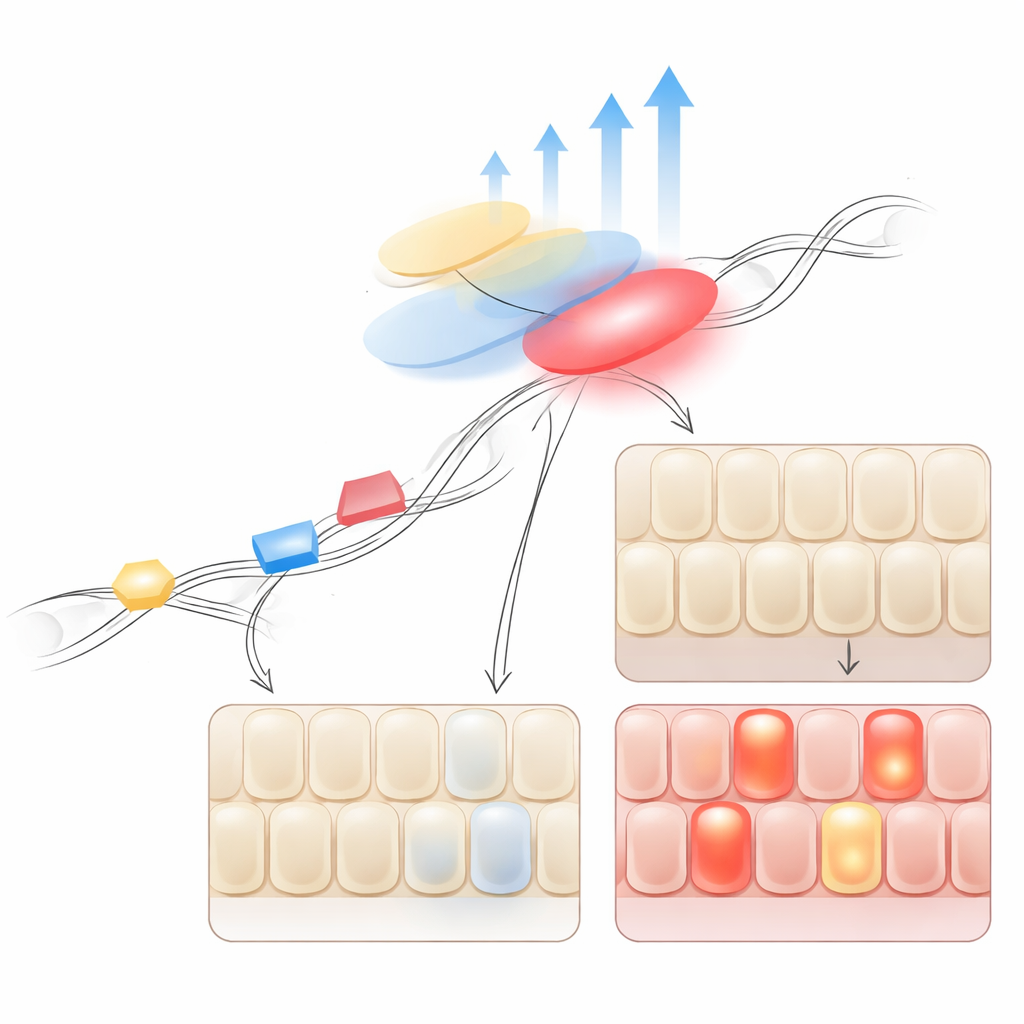
How disease reshapes genetic effects
Looking across all regions where IBD risk variants and eQTL overlapped, the authors found that the IBD-specific signals were not only different but often stronger. In diseased colon, many of these variants lay farther from the genes they controlled, in regions that likely act as long-range enhancers. When the team carefully adjusted for differences between cohorts, they saw that for a subset of genes—especially those involved in immune responses and barrier integrity—the same variant had a larger impact on gene activity in IBD tissue than in healthy tissue. This suggests that once disease has altered the cellular environment, certain regulatory elements become more active, amplifying the effect of existing genetic risk.
What this means for patients and future research
By combining DNA information with gene activity directly in the colons of IBD patients, this study provides the most extensive list yet of candidate genes that may mediate inherited risk for IBD through their behavior in the gut. It shows that many risk variants only fully reveal their impact in the context of disease, where regulatory circuits shift and some genetic effects are magnified. For non-specialists, the key message is that knowing “where” in the genome risk lies is not enough; we must also know “when” and “in which tissue state” those variants act. Disease-focused maps like this one will help researchers prioritize genes such as ABO and TNFRSF14 for functional studies and drug development, moving closer to treatments that are tuned to the specific molecular wiring of an inflamed intestine.
Citation: Nishiyama, N.C., Silverstein, S., Darlington, K. et al. eQTL in diseased colon tissue identifies potential target genes associated with IBD. Nat Commun 17, 2736 (2026). https://doi.org/10.1038/s41467-026-69364-6
Keywords: inflammatory bowel disease, colon genetics, gene regulation, IBD risk variants, eQTL