Clear Sky Science · en
Selective sweep probabilities in spatially expanding populations
Why this matters for growing populations and cancer
When a population spreads into new territory—whether it is a plant invading a coastline, bacteria forming a biofilm, or cancer cells pushing into healthy tissue—evolution happens on the move. This study asks a deceptively simple question: when a helpful genetic change appears in such an expanding population, how likely is it to take over everything? Using mathematics and computer simulations, the authors show that sweeping takeovers of this kind are surprisingly rare and, when they do happen, they almost always occur very early in the expansion. This finding helps explain why tumours and other expanding populations are so genetically diverse.
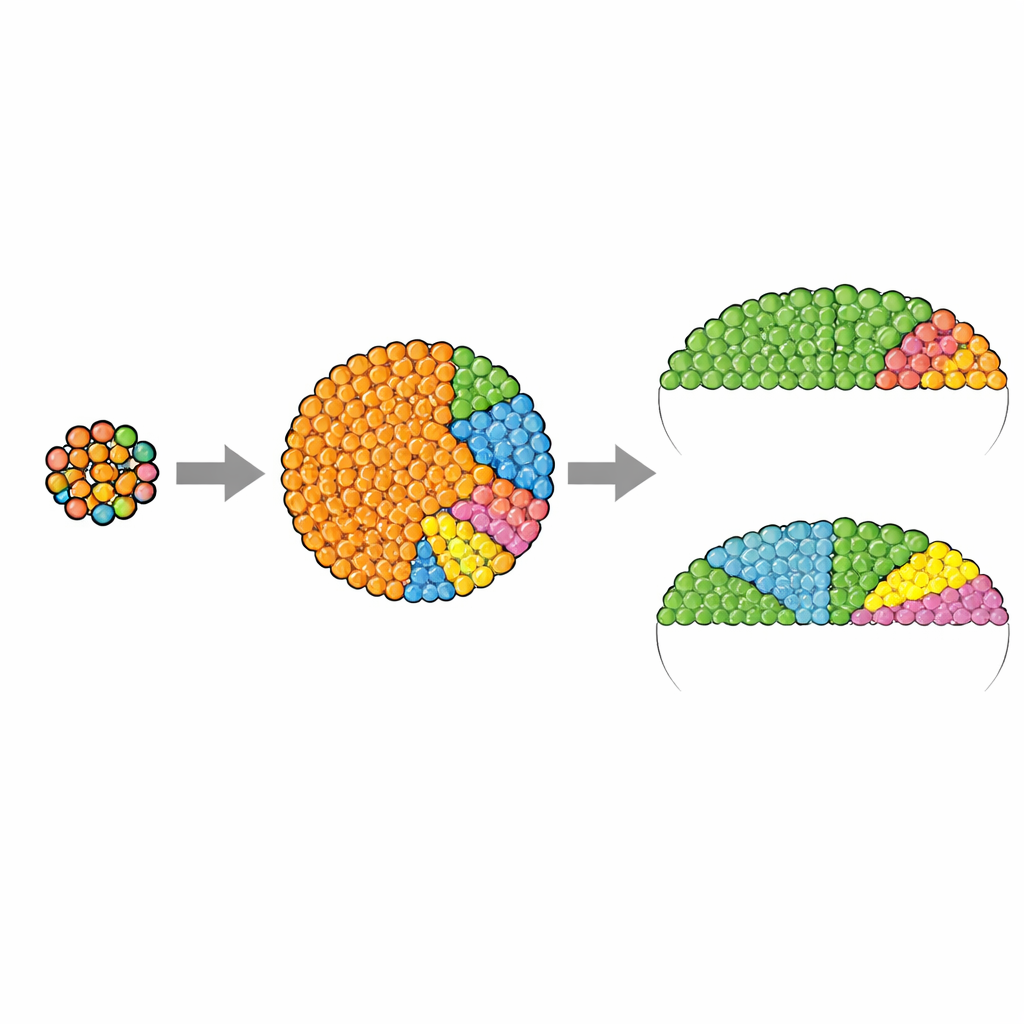
How helpful mutations compete at the moving edge
As a population spreads outward, most growth happens near the moving front. Occasionally, a mutant appears that grows or spreads faster than its neighbours. If this mutant can outpace the rest of the population along the front, it may produce a selective sweep, where nearly all individuals in the expanded region trace back to that one successful ancestor. However, the same conditions that favour one beneficial mutant also favour others. New, equally strong or stronger mutants can appear elsewhere on the front, leading to “clonal interference” in which multiple lineages compete and no single one takes over completely.
A simple model for complex spreading
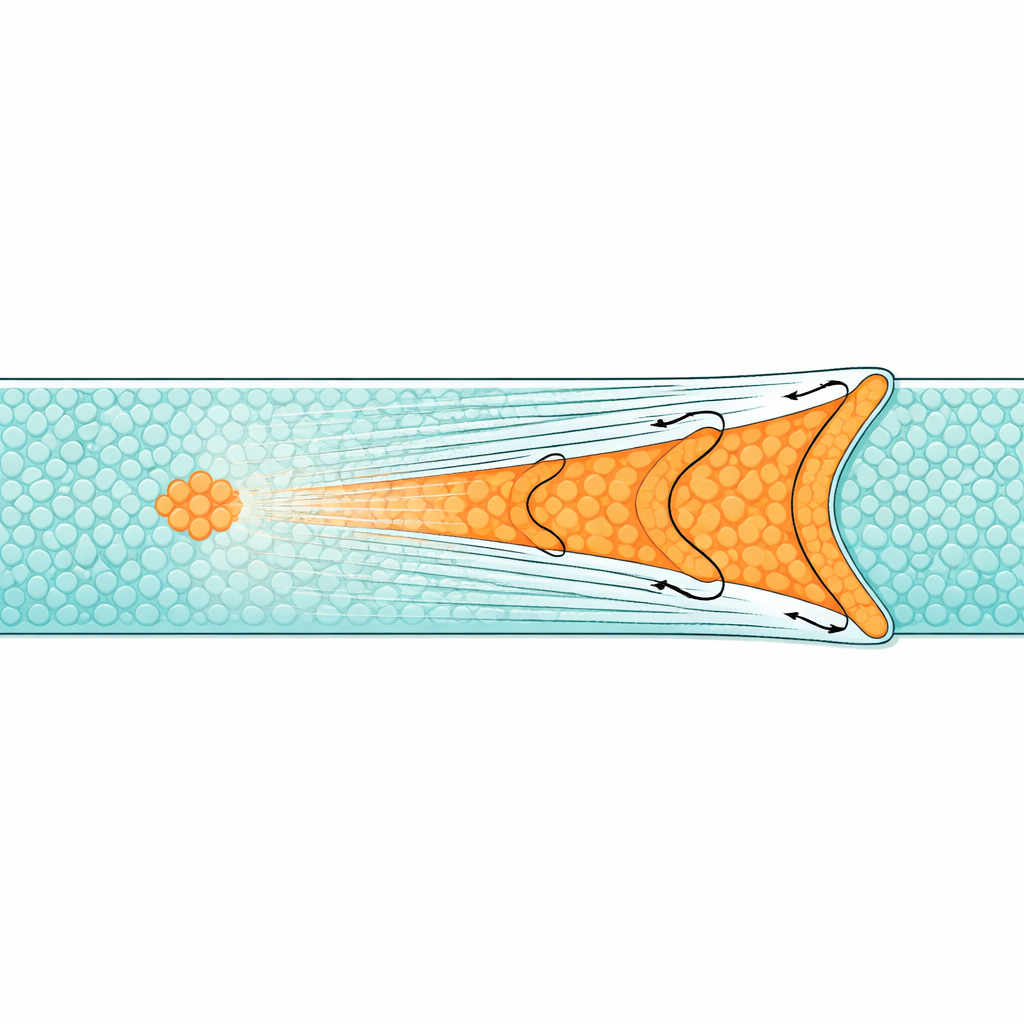
The authors build a macroscopic model that treats the population as a growing ball expanding at a constant radial speed. A wildtype strain spreads outward at one speed, while any beneficial mutant spreads within it at a faster speed. Using tools from probability theory, they compute when and where the first successful mutant is likely to appear and how long it would need to reach every point on the population’s boundary. The key result is an explicit formula showing that the chance of a complete sweep depends only on the ratio of the mutant’s expansion speed to that of the wildtype, raised to the power of the number of spatial dimensions. Crucially, this probability does not depend on how frequently mutations occur.
Why mutation rate does not change sweep chances
At first glance, it seems obvious that more mutations should make sweeps more common. The analysis reveals a balance: increasing the mutation rate makes the first beneficial mutant appear earlier, when the population is smaller and easier to conquer, but it also increases the chance that competitors appear quickly and cut off the sweep. Under the assumption of steady expansion speeds, these two effects cancel out exactly. The same low sweep probabilities reappear in detailed agent-based simulations, where individual cells live on a grid, divide, move, and die stochastically. Even when the authors allow mutations to have random strengths or to build on one another, the overall message holds: sweeps are uncommon unless mutants are much faster than the background population.
What this means for tumours and other real systems
Applying the model to human solid tumours, the authors estimate realistic rates of advantageous “driver” mutations and typical tumour growth speeds. They find that, except for extremely powerful drivers that arise very early—when a tumour is still microscopic—selective sweeps are unlikely once the tumour has grown beyond roughly a cubic millimetre. Later driver mutations can become common in certain regions but rarely take over the entire tumour. This prediction aligns with large-scale sequencing studies that find both a handful of early, tumour-wide driver mutations and many later, local ones.
Big-picture takeaway for evolution on the move
The study concludes that in expanding populations, complete genetic takeovers by new beneficial mutations are the exception, not the rule. The probability that a mutation sweeps is set mainly by how much faster it spreads spatially than its competitors, and it drops sharply in higher dimensions, such as in three-dimensional tissues. As a result, growing tumours, biofilms, and invading species should generally accumulate rich patchworks of competing lineages rather than repeatedly being dominated by single winners. This simple mathematical insight offers a unifying explanation for the widespread genetic diversity observed in cancers and other expanding biological populations.
Citation: Stein, A., Bostock, K., Kizhuttil, R. et al. Selective sweep probabilities in spatially expanding populations. Nat Commun 17, 2181 (2026). https://doi.org/10.1038/s41467-026-69363-7
Keywords: range expansion, selective sweep, clonal interference, tumour evolution, spatial population genetics