Clear Sky Science · en
Using firm-level supply chain networks to measure the speed of the energy transition
Why this matters for everyday life
How quickly businesses move away from fossil fuels will largely determine whether countries meet their climate targets—and how expensive energy becomes for all of us along the way. This study looks under the hood of an entire national economy, Hungary, to see which companies are actually switching to cleaner electricity, which are not, and what that means for the future pace of the energy transition.
Following the money through the economy
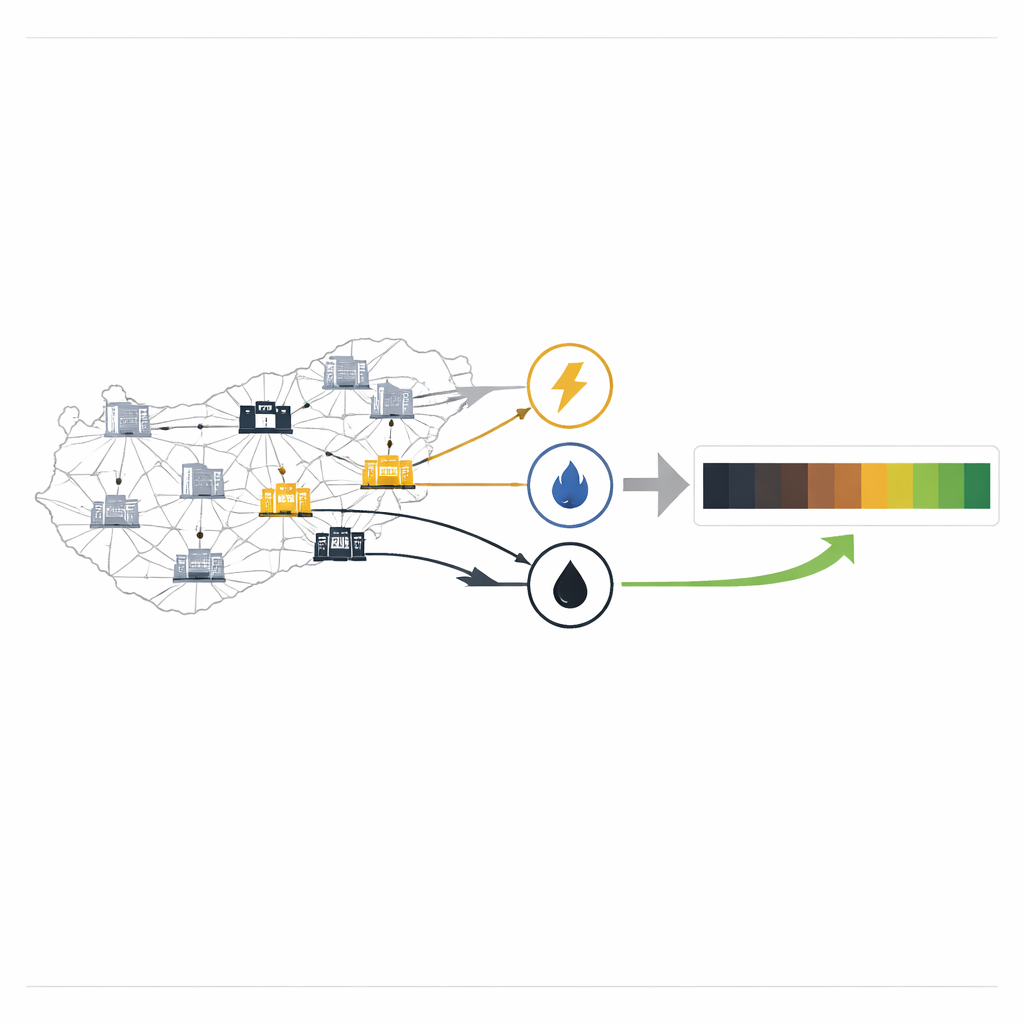
Instead of surveying companies or relying only on broad industry statistics, the researchers traced real invoices exchanged between about 25,000 Hungarian firms from 2020 to 2024. These records, used for value-added tax reporting, reveal who buys electricity, gas, and oil from whom. By combining these payments with official energy price data, the team translated money spent into actual energy use in kilowatt-hours for each firm. They then overlaid this with information on Hungary’s national electricity mix—how much of it comes from low-carbon sources such as nuclear, solar, wind, hydro, and bioenergy—to estimate what share of each firm’s total energy use is effectively low-carbon electricity.
Measuring who is moving and who is stuck
For every firm, the authors tracked how its low-carbon share changed year by year. They fitted two simple patterns to these changes. One assumes a slow and steady shift, like a straight line trending up or down. The other allows for more sudden acceleration, like a curve that starts flat and then bends sharply upward when a company makes a big investment in new equipment. Using these two measures, they labeled firms as “transitioning” if both indicators pointed toward increasing use of low-carbon electricity, and as “non-transitioning” if at least one pointed backward. Across the economy, they found striking diversity even among firms in the same line of business: while roughly half of firms increased their low-carbon share, an equally large group actually moved in the opposite direction.
What makes a firm a climate leader or laggard
The study then asked what sets transitioning firms apart. It turns out that the structure of energy costs matters more than their number of employees. Firms that spend a higher share of their revenue on fossil fuels are much less likely to shift toward cleaner electricity, suggesting they are locked into fossil-based machinery or processes that are costly to replace. In contrast, firms for which electricity already makes up a larger share of costs are more likely to keep increasing their low-carbon share, perhaps because switching to cleaner electricity fits more naturally with the technologies they use. Larger revenues do not automatically translate into greener choices: high-revenue firms were, on average, less likely to transition, consistent with the idea that they can afford to pay higher fossil prices rather than gamble on new equipment. At the same time, companies that consume a lot of energy overall are somewhat more likely to transition, reflecting stronger pressure to cut fuel risks and costs.
Peering into possible futures
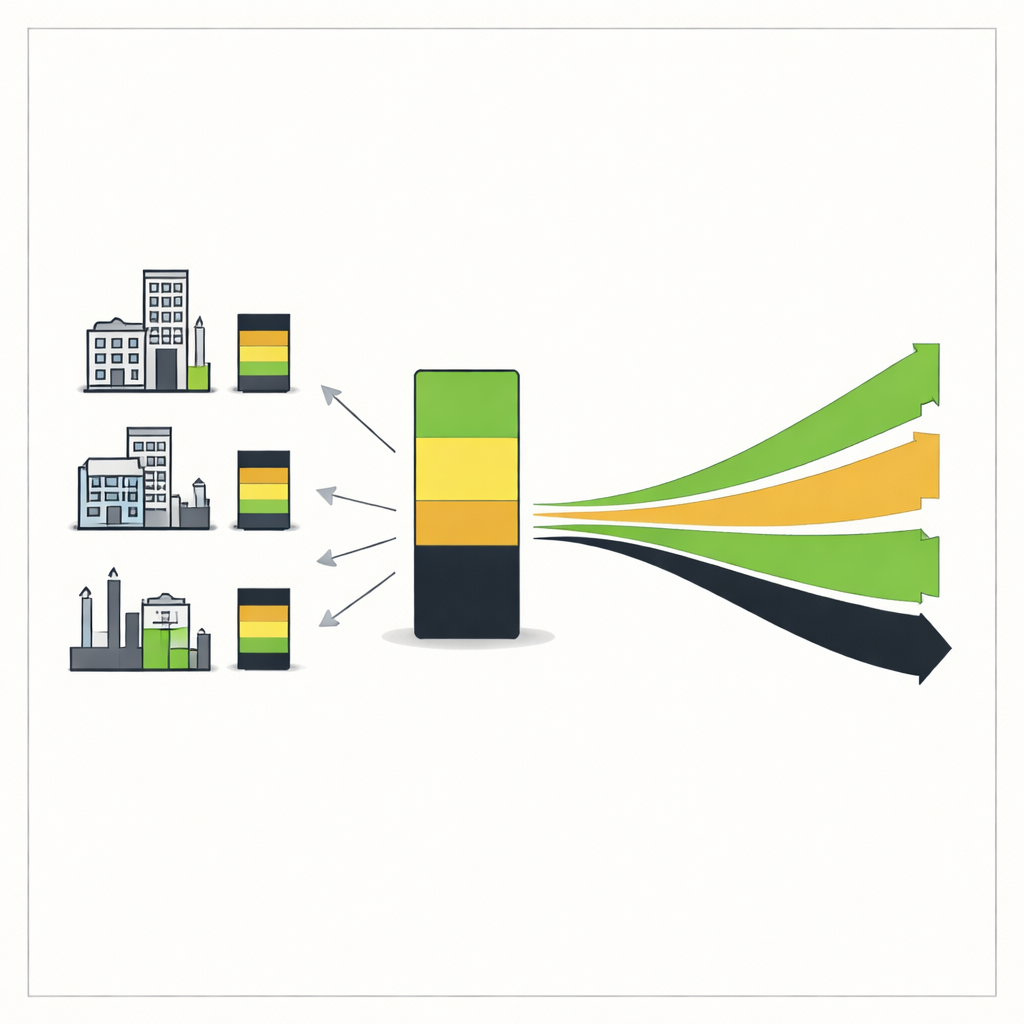
Using the firm-level trends, the researchers built simple scenarios out to 2050. They assumed Hungary’s electricity grid continues to decarbonize and that each firm keeps using about as much total energy as it does today. In business-as-usual scenarios—whether based on slow, linear changes or faster, curved ones—the combined share of low-carbon electricity in firms’ energy use rises only to about 20–26% by mid-century. That is far from what would be needed to align with international climate goals. The team then explored “what if” worlds where every lagging firm imitates a top-performing peer in its own niche of the economy. When all firms copy the best steady improvers, the overall low-carbon share could reach around 55% by 2050. If instead they adopt the most rapid transition patterns observed in their sector, the share could climb to roughly 70%, a level far more compatible with climate targets, especially when combined with efficiency gains and other low-carbon options.
What this means for climate policy and business
For a layperson, the message is clear: the technologies to decarbonize many parts of the economy already exist and are being used by some firms, but progress is uneven. Climate success now depends less on new inventions and more on spreading existing best practices, lowering the upfront costs of cleaner equipment, and making it harder to delay change by clinging to fossil fuels. By showing how to track the energy transition company by company using routine tax data, this study offers governments a new dashboard for spotting leaders, laggards, and sectors where targeted support or tougher rules could make the biggest difference in steering the whole economy toward cleaner energy.
Citation: Stangl, J., Borsos, A. & Thurner, S. Using firm-level supply chain networks to measure the speed of the energy transition. Nat Commun 17, 2529 (2026). https://doi.org/10.1038/s41467-026-69358-4
Keywords: energy transition, low-carbon electricity, industrial decarbonization, supply chain data, climate policy