Clear Sky Science · en
Mechanochemical engineering of chiroptical properties in indium-based chiral metal halides by grinding
Grinding Crystals for Smarter Light
Imagine tiny crystals that can glow not just in color, but with a twist—literally. These materials emit light whose waves spiral like a corkscrew, a feature that could power sharper 3D displays, more secure data storage, and advanced medical imaging. The catch has been that such “twisted light” materials are often hard to make and even harder to fine‑tune. This study reveals a surprisingly simple alternative: you can reprogram the way these crystals shine just by grinding them with everyday salts, unlocking new colors and stronger, more controllable circularly polarized light.

Why Twisted Light Matters
Light normally wiggles back and forth in a flat plane, but in circularly polarized light, the direction of that wiggle spirals as the beam travels. Materials that emit this kind of light on their own are valuable for future technologies like glasses‑free 3D screens, ultra‑dense information storage, anti‑counterfeiting tags, and ultra‑sensitive sensors. To be useful, a material must glow brightly and also strongly favor one twist direction over the other, a balance that has proven difficult to achieve. Traditional routes rely on delicate crystal growth or complex chemical recipes, which can be slow, finicky, and hard to adjust once the crystals are made.
Building Chiral Crystals from Simple Ingredients
The researchers started with indium‑based metal halide crystals built from a small chiral molecule—the mirror‑image kind often seen in biology. These first crystals glowed sky‑blue and emitted circularly polarized light with long‑lived phosphorescence, meaning they continued to glow after the lamp was turned off. By replacing a fraction of the indium with antimony, the team shifted the emission from blue into a warm orange, while keeping the handedness, or chirality, of the light. This orange‑emitting version served as a versatile “parent” crystal that could later be reshaped and recolored without having to rebuild the structure from scratch.
Grinding as a Tuning Knob
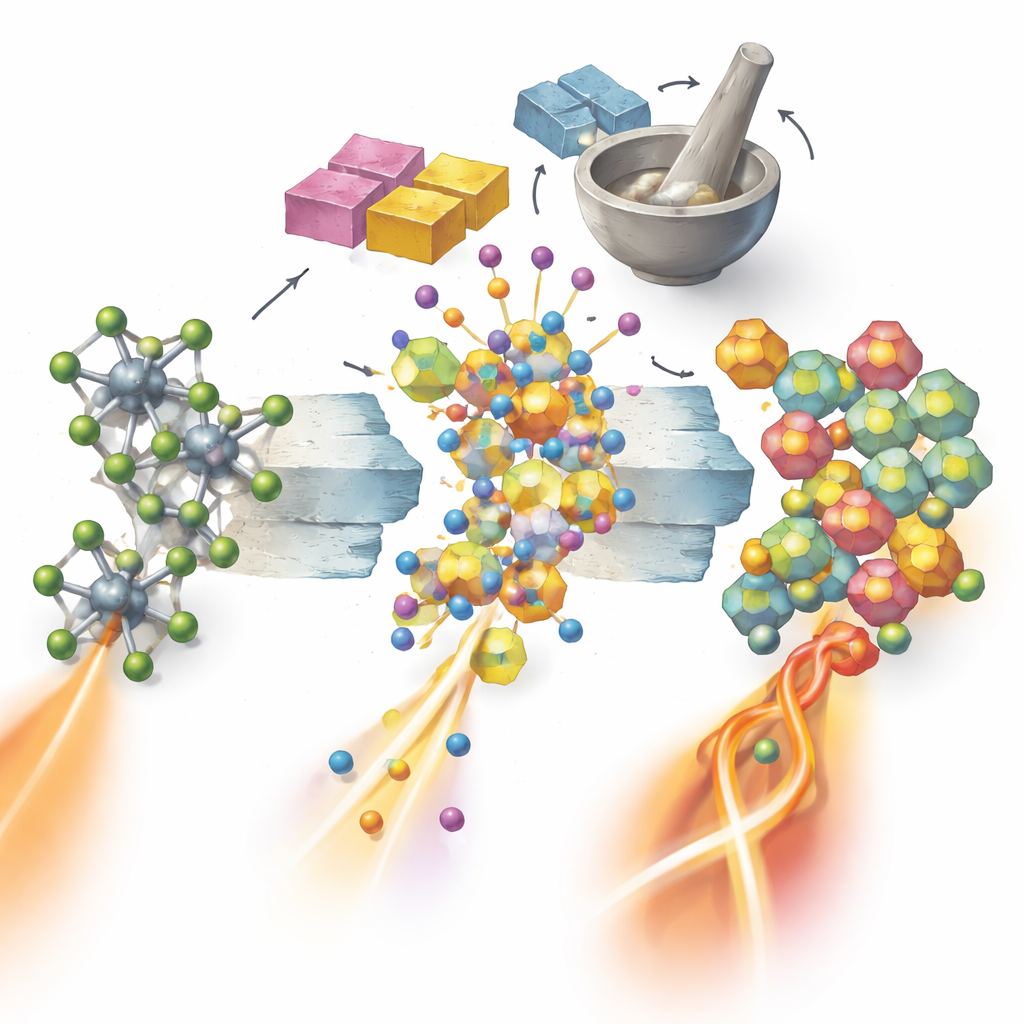
The key step was unexpectedly simple: grinding the parent crystals together with different bromide salts, such as potassium bromide or organic salts used in perovskite solar cells. This mechanical mixing caused the glow color to swing across the spectrum—from bright yellow all the way to deep near‑infrared—without adding rare‑earth elements or changing to heavier halides like iodide. Measurements showed that bromide ions actually slip into the crystal framework, partially replacing chloride ions and subtly distorting the metal‑halide building blocks. This ion swap, driven purely by physical grinding, changes how the crystal absorbs and releases light, including the range and strength of its circularly polarized emission.
Flipping and Boosting the Light’s Handedness
Beyond color control, grinding also transformed how strongly and in which direction the crystals twisted light. For some inorganic salts, the intensity of circularly polarized luminescence increased by about tenfold, reaching levels that are highly attractive for device use. With certain organic bromide salts, the effect was even more remarkable: in one case, the handedness of the emitted light actually reversed, as if a right‑handed spiral became left‑handed after grinding. Structural studies revealed that new hydrogen‑bond networks and bromide substitution rearranged the metal‑halide octahedra into a mirror‑opposite chiral pattern, explaining this flip. The same distortions also boosted second‑harmonic generation, a nonlinear optical effect where the material converts incoming light into new light at double the frequency, by nearly thirty times compared with a quartz reference.
From Bench to Light‑Emitting Devices
To show that this is more than a curiosity, the team coated commercial ultraviolet LED chips with their ground powders. These simple devices emitted circularly polarized light across visible to near‑infrared wavelengths, with the direction and strength of the twist closely matching the behavior seen in the lab. Because everything is controlled by which salt is chosen and how the powders are ground, the approach acts like a mechanical dial for color and chirality. In plain terms, the authors demonstrate that a mortar and pestle, plus well‑chosen salts, can turn one family of crystals into a finely tunable source of twisted light—paving the way for more accessible, scalable components for advanced displays, optical communication, and secure photonic technologies.
Citation: Wu, J., Li, H., Wang, J. et al. Mechanochemical engineering of chiroptical properties in indium-based chiral metal halides by grinding. Nat Commun 17, 2619 (2026). https://doi.org/10.1038/s41467-026-69353-9
Keywords: circularly polarized luminescence, chiral metal halides, mechanochemical grinding, near-infrared emission, nonlinear optics