Clear Sky Science · en
A ketogenic diet enhances aerobic exercise adaptation and promotes muscle mitochondrial remodeling in hyperglycemic male mice
Why Blood Sugar and Exercise Don’t Always Add Up
People with high blood sugar are often told that aerobic exercise will boost their fitness and protect their heart. Yet many find that, even when they exercise regularly, their endurance and “engine capacity” don’t improve as much as expected. This study in mice explores a provocative idea: could a very low-carbohydrate, high-fat ketogenic diet help the body respond better to aerobic training when blood sugar is chronically high?
High Blood Sugar, Blunted Fitness Gains
In diabetes and prediabetes, the body swims in excess glucose. Earlier work showed that, in this state, the normal training response to aerobic exercise is muted: peak oxygen uptake (called VO2peak), a strong indicator of health and longevity, barely budges even after regular workouts. The researchers used male mice with moderate hyperglycemia, created by a drug that damages insulin-producing cells without causing severe illness. These animals mimic people who have high blood sugar but can still be active. The key question was whether changing diet—without adding more medications—could restore their ability to gain aerobic fitness from training.
A Tale of Two Diets
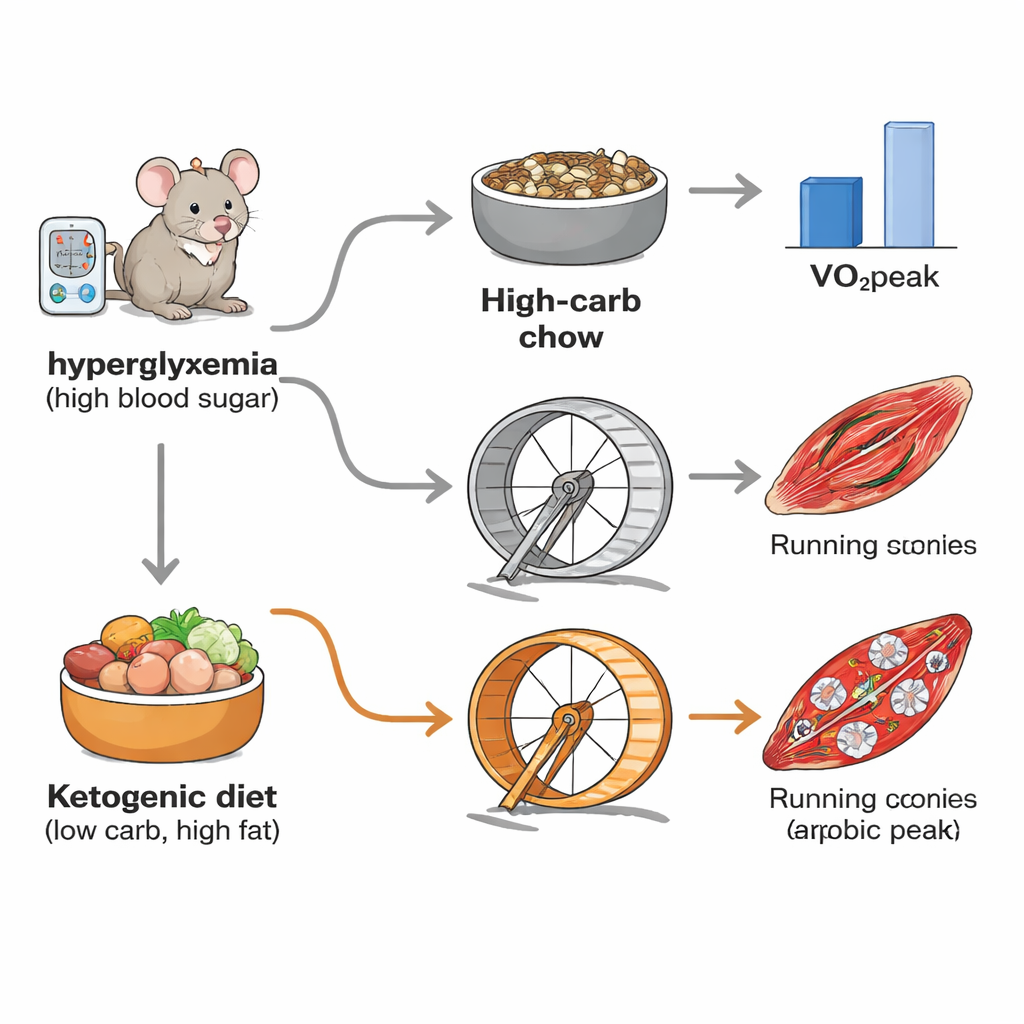
After inducing high blood sugar, the team split the mice into two diet groups. One group stayed on standard high-carbohydrate chow, which kept their glucose elevated. The other group switched to a ketogenic diet: about 90 percent of calories from fat, almost no carbohydrate, and the rest from protein. Within a week, the ketogenic diet pulled blood glucose down into the normal range and raised levels of ketone bodies, alternative fuels made from fat. Importantly, this glucose lowering happened even though insulin levels remained low and the mice still showed poor tolerance to a sudden sugar load, underscoring that the diet itself, not extra insulin, drove the effect.
Training the Hyperglycemic Body
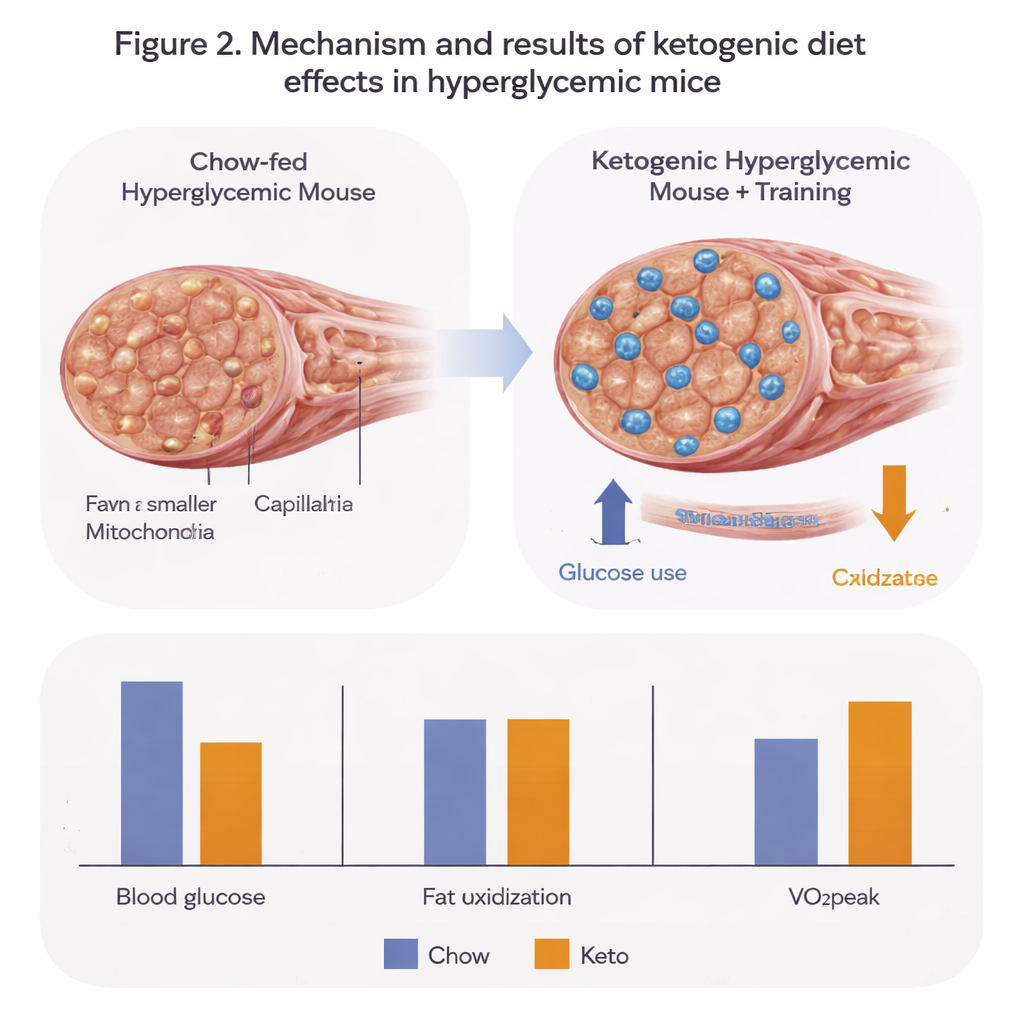
Next, mice from each diet group either remained sedentary or trained by running voluntarily on wheels for eight weeks. All training groups ran similar distances, so any differences in outcome reflected physiology, not effort. Exercise, as expected, improved several health markers in every group: body composition shifted toward more lean tissue, and blood sugar control improved somewhat across the board. But when the researchers measured VO2peak on a treadmill, a striking pattern emerged. Hyperglycemic mice on standard chow showed only small gains in VO2peak with training. In contrast, hyperglycemic mice on the ketogenic diet regained robust improvements in VO2peak, matching or exceeding normal-control mice. Curiously, their actual time to exhaustion did not rise as much, hinting that fitness and performance can be uncoupled when fuel supplies differ.
How Muscles Remodel on Ketogenic Fuel
To understand why a ketogenic diet changed the training response, the team dissected muscle tissue and examined both chemistry and structure. In keto-fed mice, muscles burned far more fat and much less glucose, at rest and during exercise. Levels of proteins that ferry fatty acids into muscle cells and mitochondria rose sharply, while proteins that handle glucose uptake and breakdown declined. Under the electron microscope, muscles from ketogenic mice showed more and larger mitochondria—the organelles that turn oxygen and fuel into energy—as well as signs of increased mitophagy and fusion, processes that recycle and reshape these powerhouses. Crucially, when combined with exercise, the ketogenic diet restored two hallmarks of highly aerobic muscle that were blunted by hyperglycemia: a higher proportion of slow, oxidative fibers and a denser web of tiny blood vessels (capillaries). Both features correlated strongly with VO2peak, suggesting they are key links between diet, training, and fitness.
Who Might Benefit—and How
The researchers also tested the ketogenic diet in mice with normal blood sugar. In these animals, the diet still shifted muscles toward fat use and slightly raised VO2peak in sedentary mice, but it did not enhance the added fitness gains from training. This contrast suggests that the greatest benefit of ketogenic eating arises when it corrects a problem—chronic high blood sugar—that otherwise blocks the body’s ability to adapt to exercise. At the same time, keto-fed mice had lower muscle and liver glycogen and did not perform as well in endurance tests unless carbohydrates were briefly reintroduced, indicating that a pure ketogenic approach may limit race-day performance even as it boosts underlying aerobic capacity.
What This Means for People with High Blood Sugar
For lay readers, the takeaway is that in this mouse model, a strict ketogenic diet turned high blood sugar from a roadblock into a solvable problem for aerobic training. By normalizing glucose, raising ketones, and reshaping muscle to burn fat efficiently and accept more blood flow, the diet allowed exercise to do what it does best: build a stronger, more enduring cardiorespiratory system. The work does not prove that everyone with diabetes or prediabetes should adopt a ketogenic diet—human studies, long-term safety, and individual preferences all matter. But it does highlight an important principle: when blood sugar is chronically high, tailoring diet to lower glucose may be essential for getting the full fitness and health benefits from aerobic exercise.
Citation: Pattamaprapanont, P., Nava, R.C., Grover, R. et al. A ketogenic diet enhances aerobic exercise adaptation and promotes muscle mitochondrial remodeling in hyperglycemic male mice. Nat Commun 17, 1656 (2026). https://doi.org/10.1038/s41467-026-69349-5
Keywords: ketogenic diet, aerobic exercise, hyperglycemia, skeletal muscle, VO2peak