Clear Sky Science · en
Assessing HPAI-H5 transmission risk across wild bird migratory flyways in the United States
Why bird flu routes matter to everyone
Wild birds crisscross North America along ancient migratory highways in the sky. This study asks a pressing question: as these birds move, how do they carry and reshape outbreaks of dangerous bird flu viruses across the United States, and what does that mean for risks to wildlife, farms, and even people? By following infection records, virus genetics, bird movement routes, and weather patterns from 2022 to 2025, the authors reveal where and when the virus flourishes, which birds quietly shuttle it around, and which ones act as high‑risk amplifiers.
Following the paths of traveling flocks
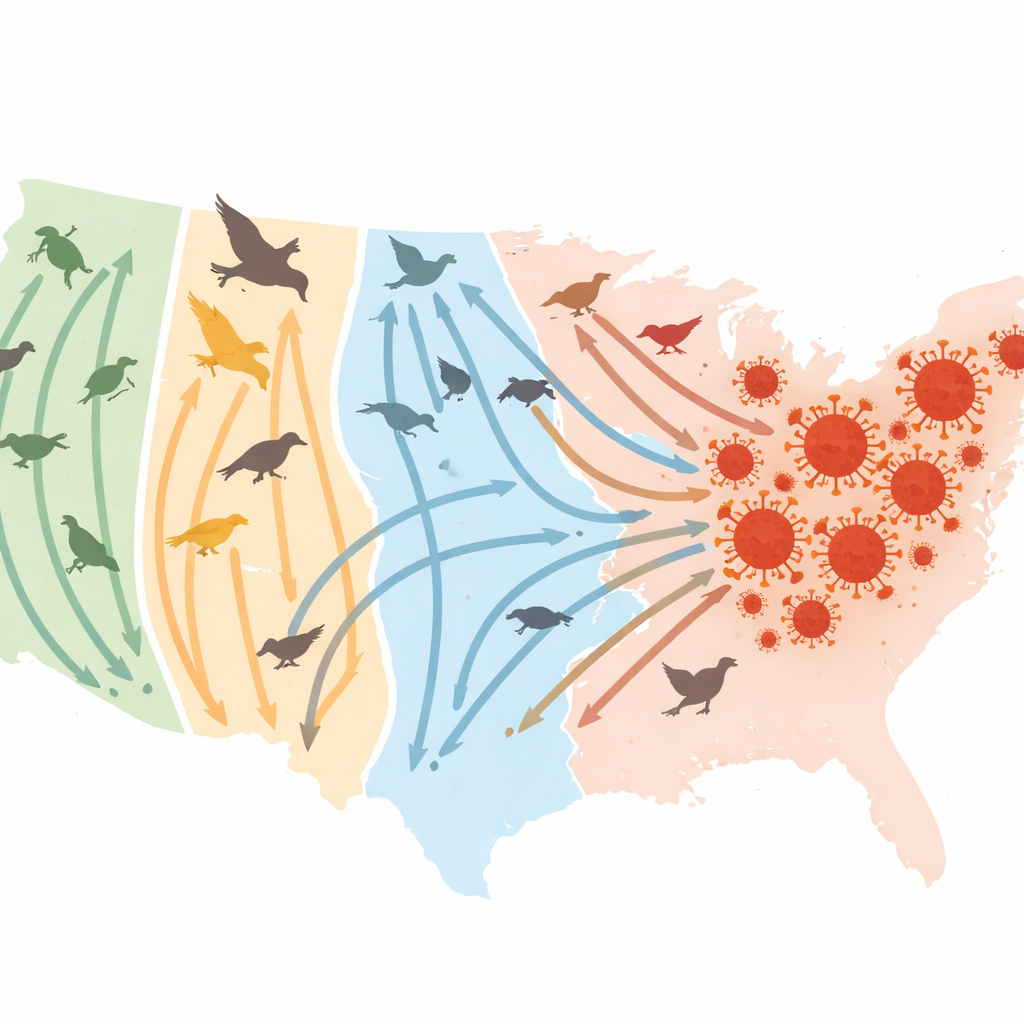
The researchers focused on a form of highly pathogenic avian influenza known as HPAI‑H5, which has caused large die‑offs in wild birds and poultry worldwide. They gathered nearly 3900 virus genomes from wild birds and more than 12,000 field detections across the United States between 2022 and early 2025. By overlaying these data on the four major bird flyways—the Pacific, Central, Mississippi, and Atlantic—they reconstructed how different genetic versions of the virus first followed single flyways and then spread across multiple routes. Early variants tended to stay within one corridor, but later ones, especially a genotype called D1.1, formed dense transmission networks that linked all four flyways and reached nearly every state.
Different birds, different roles
Not all birds contributed to the epidemic in the same way. Ducks, geese, and other waterfowl (grouped as Anseriformes) accounted for most recorded infections and showed strong seasonal waves, peaking in autumn and winter. Yet their estimated transmission strength—the average number of new cases caused by each infected bird—was relatively low. In contrast, owls (Strigiformes) and hawks and eagles (Accipitriformes) were infected less often but had much higher transmission potential once the virus entered their populations. These top predators, sitting at the upper levels of food webs, may help move the virus from wetlands into terrestrial ecosystems and closer to mammals, including livestock and humans.
Seasons and shifting hotspots
Time‑series analysis showed that HPAI‑H5 outbreaks in wild birds recur every year, with a six‑month season centered on autumn and winter. Infection numbers in those cooler months were several times higher than in summer. Mapping cases over space and time revealed that hotspots are not fixed; they migrate with the birds. In spring, high‑risk areas clustered in north‑central states such as North Dakota, South Dakota, and Minnesota, overlapping major breeding grounds for waterfowl. During summer, activity shifted toward northwestern states, while in autumn and winter, hotspots slid southward along key flyways. Importantly, along the Mississippi and Atlantic routes, year‑round resident birds—not just migrants—acted as strong local “engines” that kept transmission going, particularly in parts of the Midwest and the southeastern states of Georgia and Florida.
Weather, drought, and hidden influences
To probe how climate may shape these patterns, the team used a machine‑learning approach called Random Forests to relate monthly infection counts to weather indicators. Measures of drought emerged as the most influential factors, followed by temperature and rainfall. The relationships were not simple straight lines: infection risk was highest at intermediate drought levels and tended to rise when conditions were either much wetter or much drier than that sweet spot. Cooler average temperatures and fewer hot‑day “cooling degree” totals were associated with more infections, echoing the autumn–winter peaks. These nonlinear responses suggest that moderate water stress and unusual moisture patterns can alter where birds gather and how long viruses persist in the environment, subtly steering outbreak dynamics.
What this means for protecting birds, farms, and people
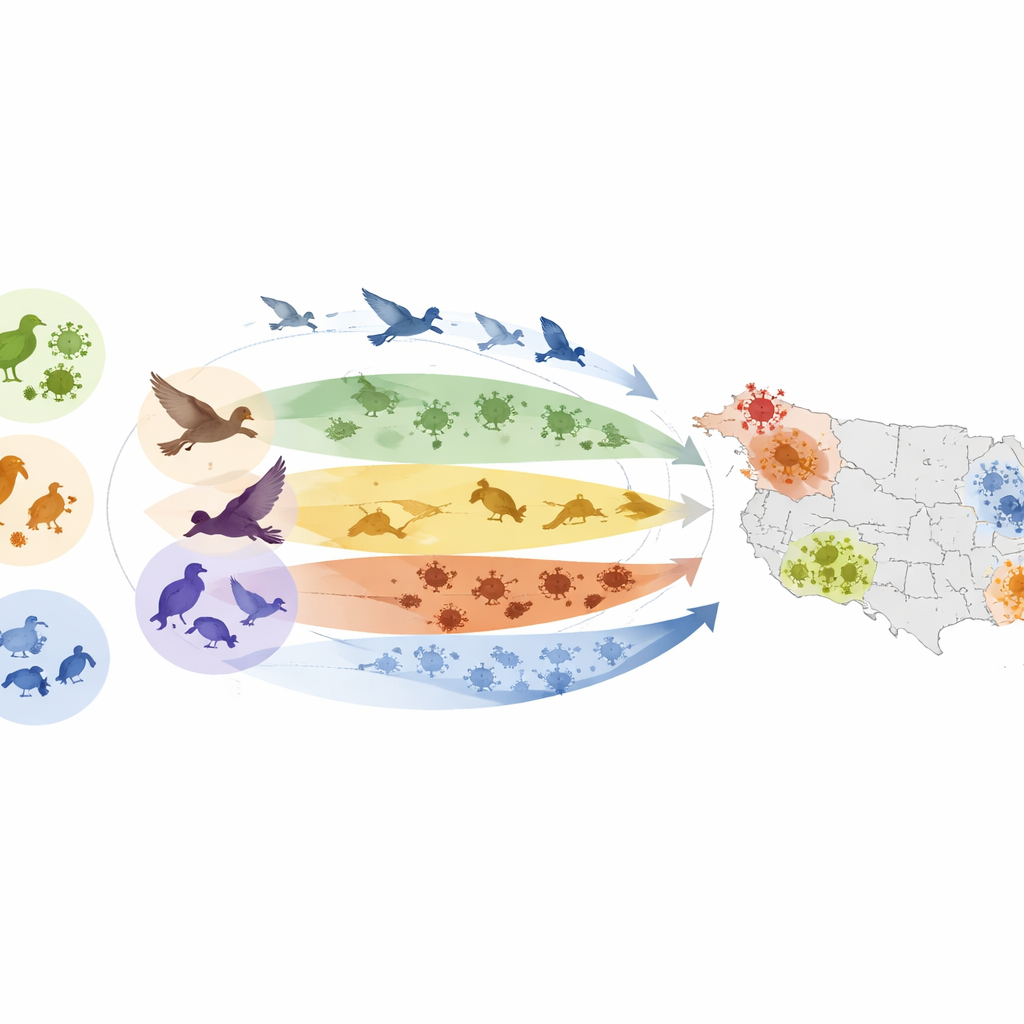
Taken together, the study paints HPAI‑H5 in the United States as a moving target shaped by bird behavior, local resident populations, and shifting climate conditions. Long‑distance migrants, especially waterfowl, act as wide‑ranging carriers that seed the virus across the continent, while high‑risk raptors and resident birds can sustain and amplify it in specific regions. The rise of a single dominant genotype that now spans all four flyways underscores how quickly the virus can adapt and reorganize its spread. By pinpointing seasonal windows, geographic hotspots, and climate thresholds linked to elevated risk, this work offers a framework for more focused surveillance and early warning—guiding where and when to watch wild birds, safeguard poultry flocks, and reduce the chances that a virus circulating in the skies over North America sparks the next spillover into livestock or humans.
Citation: Fang, K., Li, J., Zhao, H. et al. Assessing HPAI-H5 transmission risk across wild bird migratory flyways in the United States. Nat Commun 17, 2524 (2026). https://doi.org/10.1038/s41467-026-69344-w
Keywords: avian influenza, wild birds, migratory flyways, zoonotic risk, climate and disease