Clear Sky Science · en
Dispersive detection of a charge qubit with a broadband high-impedance quantum-Hall plasmon resonator
Listening to Tiny Charges with Ripples of Electricity
Modern quantum technologies rely on exquisitely fragile states of single electrons, but reading out those states without destroying them is a major challenge. This study shows how ripples of electric charge that flow along the edge of a special two-dimensional material can be used as a sensitive, broadband probe of a nearby artificial atom called a charge qubit. By harnessing these edge ripples, known as plasmons, the researchers open a route to compact quantum devices that borrow tricks from both electronics and photonics.
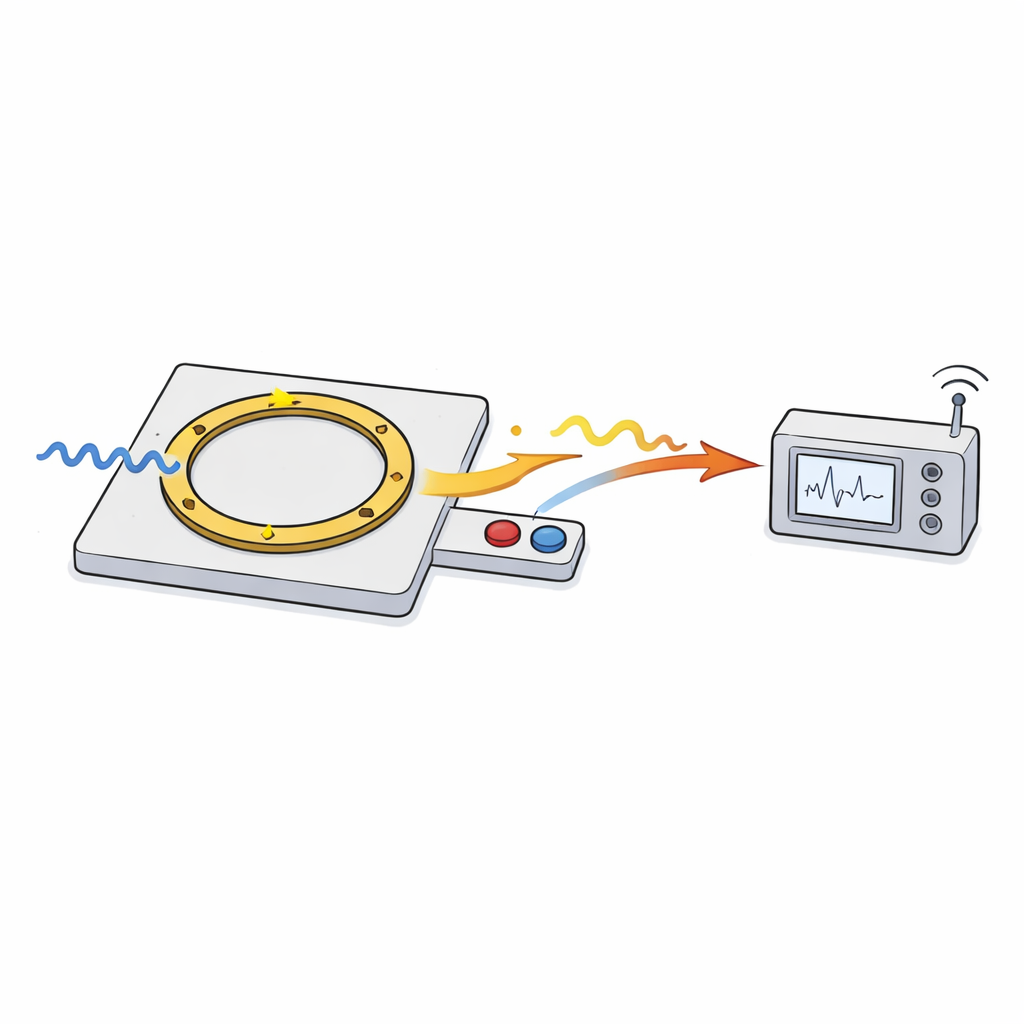
Ripples Along a Quantum Highway
When a very clean, flat layer of electrons is cooled and placed in a strong magnetic field, it enters the quantum Hall state. In this state, electric current flows only along the sample’s edge, forming one-way “highways” for electrons. Instead of thinking about individual electrons, it is more accurate to picture collective ripples of charge—plasmons—moving along these edges. A key feature of these edge plasmons is that their electrical resistance, or impedance, is naturally very large and fixed by fundamental constants. This high impedance means that even tiny charge motions create relatively large voltage swings, making the edge an attractive place to sense delicate quantum systems.
Building a Ring-Shaped Quantum Ear
To turn this idea into a working device, the team patterned a ring-shaped region in a gallium-arsenide semiconductor that hosts a two-dimensional electron gas. Under the right magnetic field, the ring becomes a closed track for edge plasmons, forming a kind of on-chip resonator for microwave-frequency charge waves. Two metal electrodes placed near the ring act as input and output ports: microwaves sent into one electrode launch plasmons around the ring, which are then picked up at the other electrode. By measuring how the amplitude and, crucially, the phase of the transmitted signal depend on frequency and magnetic field, the authors confirmed well-defined resonant modes and extracted the resonator’s properties: a very high impedance of about 13 kilo-ohms but a modest quality factor, corresponding to relatively broad resonances.
Coupling a Double Quantum Dot Qubit
Next, the researchers positioned a double quantum dot—a tiny structure that can trap an extra electron in one of two neighboring sites—close to the plasmon ring. This double dot serves as a charge qubit: the electron’s position (left or right dot) represents the two states, and quantum tunneling allows it to occupy a superposition of both. Gate voltages on nanometer-scale electrodes tune the energy difference between the two sites and the tunneling strength. Although no direct electrical contact is made between the qubit and the plasmon channel, they influence each other through the electric field: when a plasmon passes by, it slightly shifts the energies of the qubit states, and conversely, the qubit’s configuration modifies the resonator’s effective frequency.
Reading the Qubit by Phase Shifts
Instead of measuring current through the double dot, which would strongly disturb it, the team reads out the qubit indirectly by monitoring the phase of microwaves transmitted through the plasmon resonator. When the qubit’s natural transition frequency is far from the resonator frequency, theory predicts a small, “dispersive” shift of the resonator’s frequency that depends on the qubit parameters but not on actual qubit flips. Experimentally, this appears as a change in phase of the transmitted signal as gate voltages sweep the qubit through different conditions. The authors observe characteristic patterns, including simple dips and more complex double-dip shapes, that match detailed calculations based on the standard Jaynes–Cummings model of light–matter interaction. From these data they extract how the qubit’s energy splitting and decoherence vary with gate settings, all without strongly exciting the qubit.
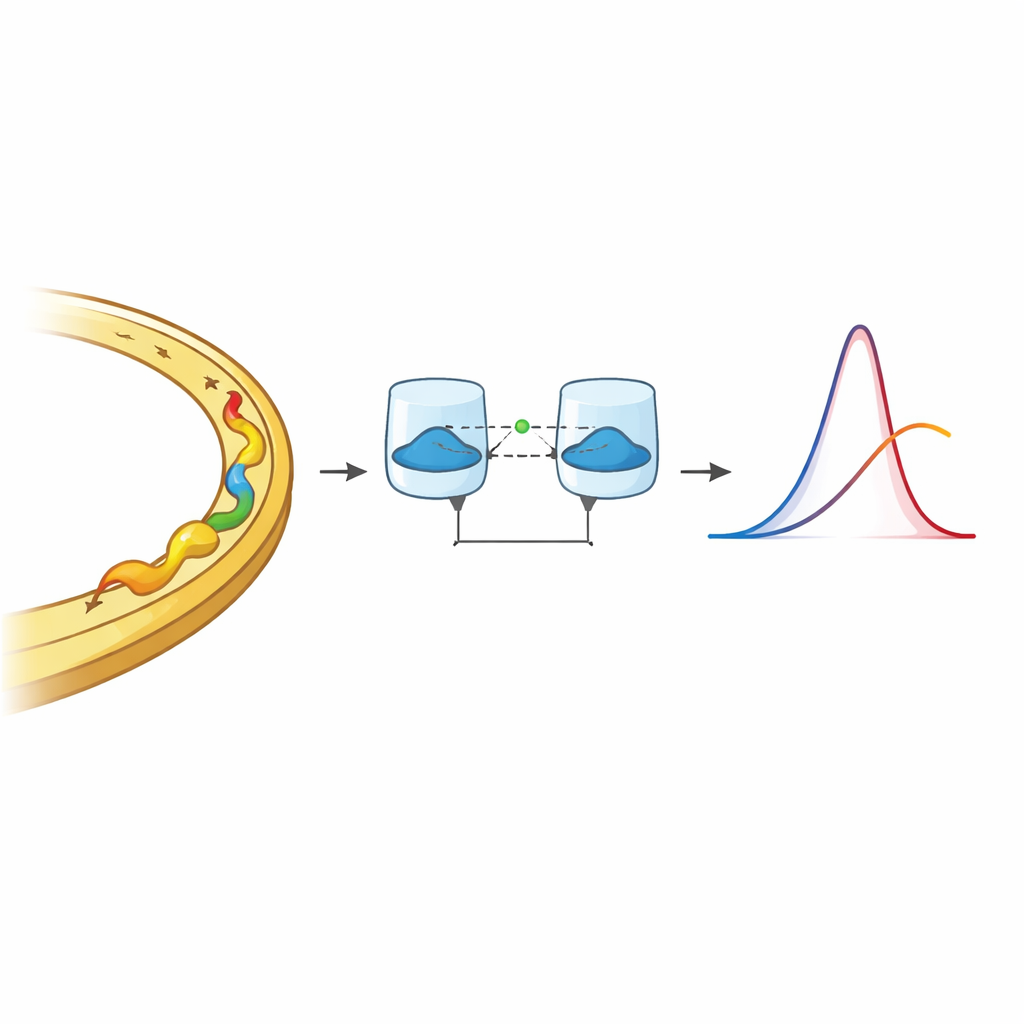
Why a Broad, High-Impedance Resonator Matters
Conventional quantum readout cavities are designed to have very sharp resonances, which boosts sensitivity but restricts the usable frequency range and slows down measurements. Here, the edge-plasmon resonator deliberately has a low quality factor, so it responds over a broad frequency band, yet its very high impedance keeps the phase shifts large enough to detect. The team also shows that, under their measurement conditions, only a small number of plasmons are present in the resonator, so the qubit remains mostly in its ground state. This balance of broadband response, strong effective coupling and gentle probing suggests that two-dimensional topological edge channels—such as those in quantum Hall systems—could become a versatile platform for future quantum-electrodynamics experiments, potentially reaching regimes where plasmons and qubits exchange energy extremely rapidly and enabling new ways to control quantum information on a chip.
Citation: Lin, C., Teshima, K., Akiho, T. et al. Dispersive detection of a charge qubit with a broadband high-impedance quantum-Hall plasmon resonator. Nat Commun 17, 2600 (2026). https://doi.org/10.1038/s41467-026-69342-y
Keywords: quantum Hall edge plasmons, charge qubit readout, circuit quantum electrodynamics, double quantum dot, high-impedance resonator