Clear Sky Science · en
Persistent representation of a prior schema in the orbitofrontal cortex facilitates learning of a conflicting schema
Why mental shortcuts can both help and hurt
Everyday life relies on mental shortcuts: once you learn the rules of driving or using a new app, you can reuse that know‑how in new situations. But those same shortcuts, called schemas, can mislead you when the rules suddenly change, like driving in a country where traffic flows on the opposite side of the road. This study asks how the brain manages old and new rule sets that clash with each other, and whether hanging on to an old schema helps or hinders learning a new one.
Training rats to switch between clashing rules
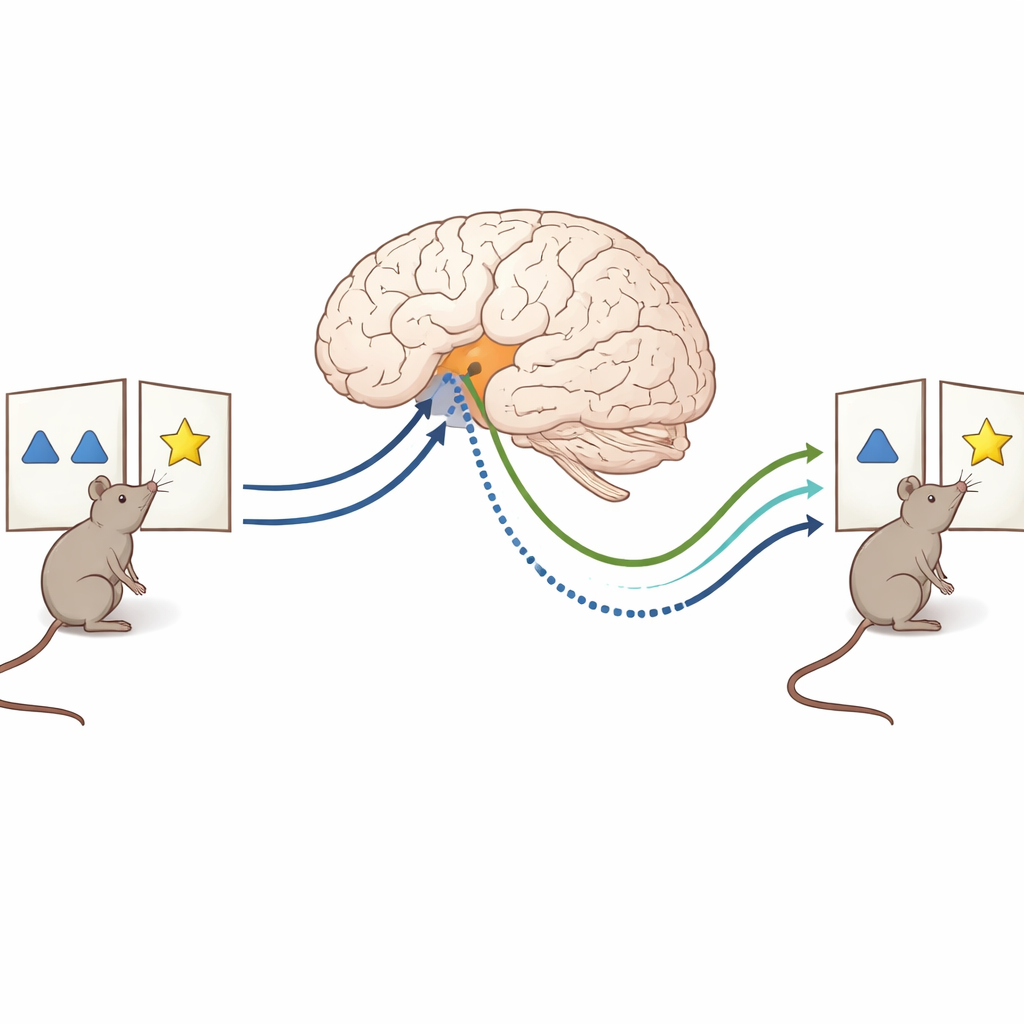
The researchers trained rats on a series of smell‑based choice tasks that looked identical on the surface but followed different hidden rules. In the first phase, rats learned a “compare with the last trial” rule: they earned sugar water only if the current odor was different from the one they had just smelled. After mastering this, they were introduced to a second phase in which exactly the same odor cues were used, but now reward depended only on each odor’s identity, not on comparison with the previous trial. This new “identity” rule directly conflicted with the old comparison rule. A separate control group of rats learned only the identity rule from the start, so their brains never had to juggle the earlier comparison rule.
How a decision area in the brain tracks hidden rules
While rats learned and switched between rules, the team recorded activity from individual neurons and large groups of cells in a decision‑making area called the orbitofrontal cortex, located just above the eyes. As rats first acquired the comparison rule, more and more orbitofrontal neurons began to fire differently on rewarded versus unrewarded trials, and population activity neatly separated trials that followed the rule. When the identity rule was introduced, this brain area rapidly reorganized so that its activity now grouped odors by whether they were rewarded under the new rule. Crucially, however, traces of the old comparison rule did not disappear: many neurons, and the overall pattern of activity, continued to carry information about whether a trial would have been rewarded under the old rule, even after behavior fully followed the new one. Control rats that never learned the comparison rule showed little or no such “ghost” signal.
Old and new schemas stored side by side, not overwritten
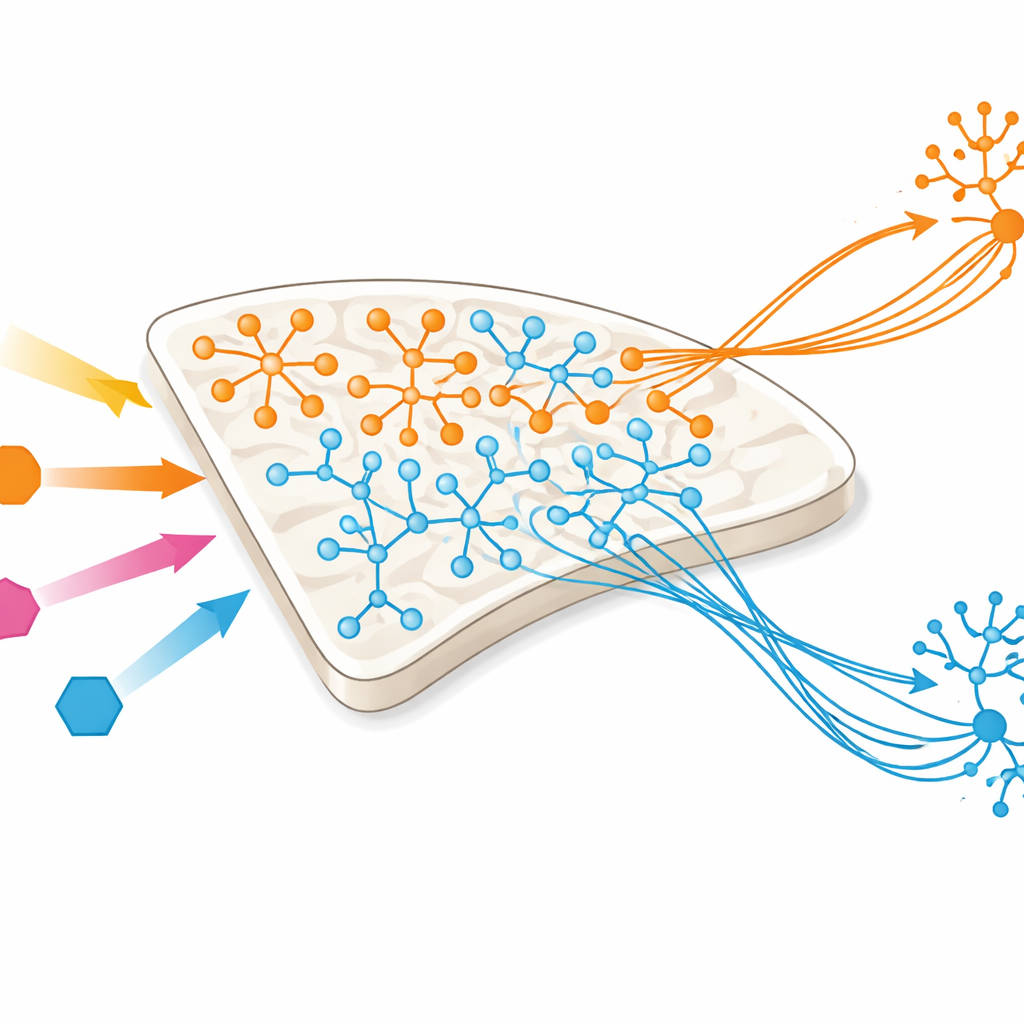
Closer analysis revealed that orbitofrontal neurons tended to specialize: most signaled reward versus no reward for either the old or the new rule, but not both. At the population level, activity for the two rules could be read out along largely separate “axes,” meaning the brain area effectively hosted two overlapping but partially independent maps of the task. Classifiers trained on the neural data could reliably decode both which rule was currently in force and what the outcome would have been under the alternative rule. In other words, instead of erasing the previous schema, orbitofrontal cortex maintained a clean, parallel representation of it while building a new one.
When an accurate memory of the old rule helps learning the new
The key surprise was behavioral: stronger neural representation of the old, now irrelevant rule did not make rats more likely to cling to it. As learning progressed, rats actually became better at ignoring the old rule’s predictions, even on trials where it would have signaled “go,” and this improvement was greatest in animals whose orbitofrontal activity most clearly encoded the old rule. Those same animals learned the new identity rule faster, despite not having been better learners of the first rule. When the researchers temporarily silenced orbitofrontal neurons during consolidation of the first schema in a separate experiment, rats later struggled both to generalize the old rule to new odors and to pick up the new, conflicting rule. This suggests that having the orbitofrontal cortex actively represent the initial schema prepares the brain for later flexibility.
What this means for flexible thinking and smart machines
To a layperson, the main message is that the brain’s decision circuits do not simply overwrite old knowledge when rules change. Instead, the orbitofrontal cortex keeps a detailed trace of prior schemas running in the background, while constructing a new rule set in a partly separate channel. This parallel storage appears to support, rather than block, flexible behavior: by preserving an accurate model of “how things used to work,” the brain can better detect when that model fails and adjust to new demands. The authors suggest that this strategy—maintaining multiple rule maps at once and selectively suppressing or using them—could inspire artificial intelligence systems that avoid catastrophic forgetting and learn new tasks without erasing what they already know.
Citation: Maor, I., Atwell, J., Ascher, I. et al. Persistent representation of a prior schema in the orbitofrontal cortex facilitates learning of a conflicting schema. Nat Commun 17, 2610 (2026). https://doi.org/10.1038/s41467-026-69330-2
Keywords: schemas, orbitofrontal cortex, cognitive flexibility, reinforcement learning, neural representations