Clear Sky Science · en
Strong magnon–photon coupling enhanced by photonic lattice flat-bands
Turning Gentle Light into a Strong Partner
Light and matter usually interact only weakly: a beam can pass through a material with barely a nudge from the atoms inside. This limits how efficiently we can store, route, or process information using light. The research in this article shows how to engineer a special type of "traffic pattern" for light that dramatically strengthens its grip on tiny magnetic waves, potentially paving the way for compact devices that shuffle information between photons and spins with high efficiency and stability.
Flat Highways Where Light Slows Down
In many materials, light behaves like cars on a hilly highway: its energy and speed change smoothly with direction and wavelength. In a "flat band," by contrast, this landscape becomes perfectly level. Light waves in such a band share the same energy and hardly move, which crowds many possible states into a narrow range and allows them to form spatially concentrated patterns. These unusual features have already drawn attention in electronics and photonics for creating slow light, unusual conduction, and compact lasers. The authors ask a deeper question: can such flat bands also sustain strong, reversible exchange of energy with matter, instead of merely boosting one-way emission?
Magnets Talking to Lattices of Tiny Rings
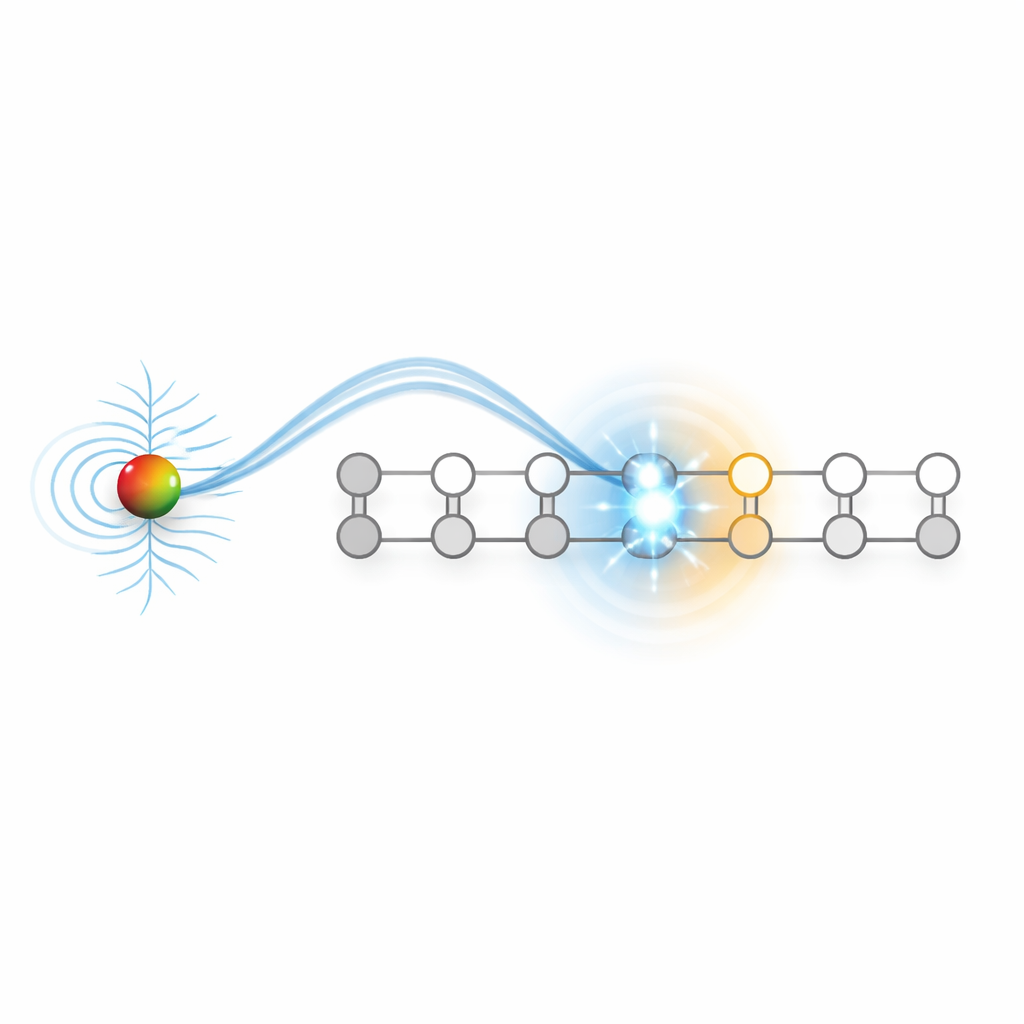
To explore this, the team builds one-dimensional chains of metallic split-ring resonators—tiny microwave "loops" that behave like artificial atoms for light. In one design, the loops form a simple chain with a conventional, gently curved band of allowed light states. In the other, they are arranged in a more intricate pattern known as a Lieb lattice, which naturally hosts a flat band sandwiched between two normal, sloping bands. A small crystal of yttrium iron garnet (YIG), acting as a collective magnet with a well-defined spin wave or magnon, is positioned above a chosen ring. By tuning an external magnetic field, the magnon’s frequency can be swept through the lattice’s photonic bands while the team monitors how the local microwave response changes.
Many Voices Merging into One Bright Mode
When the magnon’s frequency meets a regular, "dispersive" band in a simple chain, it couples to one extended light mode at a time, producing modest level splittings that actually shrink as the chain grows. In the Lieb lattice, the story is different. The flat band provides many light modes that share the same energy. Even though each of these modes is spread out along the lattice, they can all "talk" to the magnon at once. Mathematically, the interaction reshuffles these many options into one bright combination that couples strongly to the magnon and a set of dark combinations that do not. The bright mode becomes strongly concentrated at the lattice site beneath the YIG sphere, while the dark ones fade at that point. This collective effect mimics a famous phenomenon called Dicke superradiance, but with the roles of light and matter swapped.
Coupling That Refuses to Fade with Size
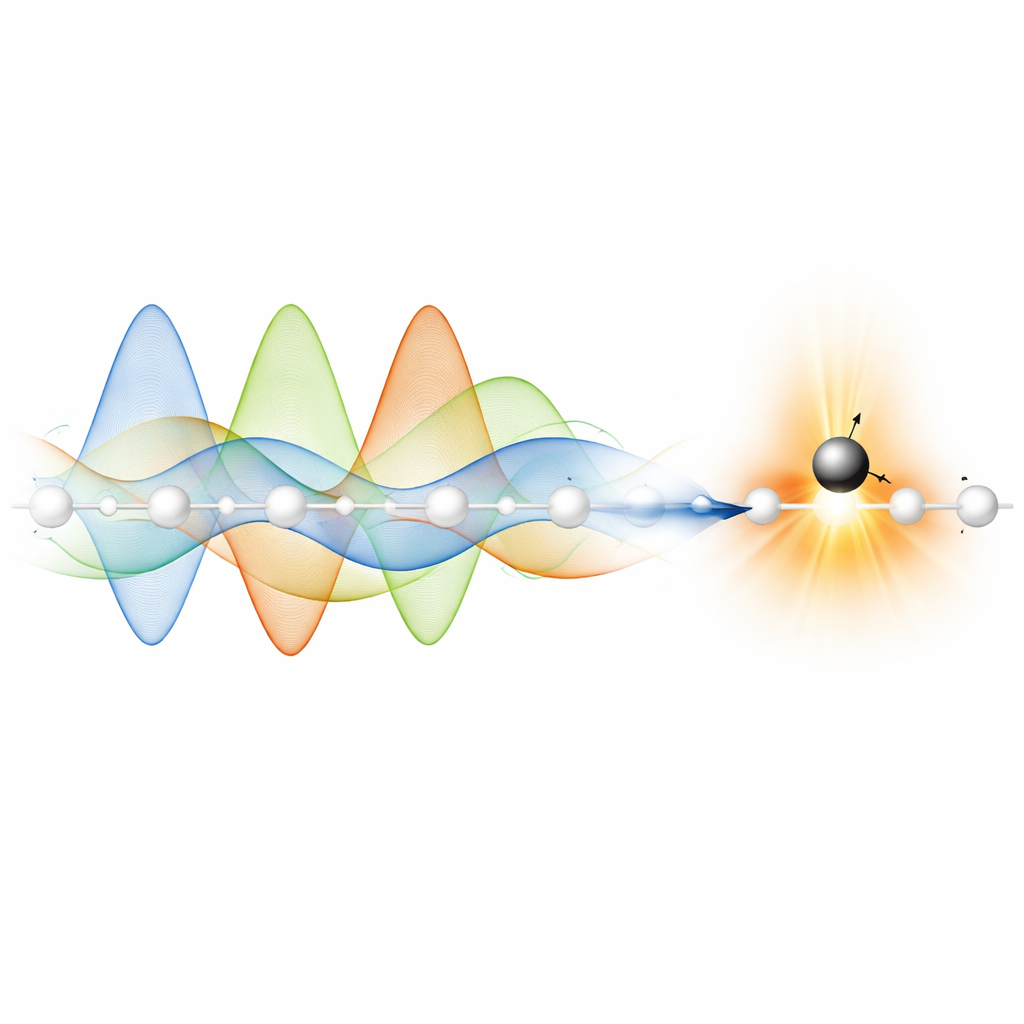
A key surprise is how this bright connection behaves as the lattice grows longer. In ordinary chains, spreading the light mode over more sites weakens the field at the magnon’s position, so the splitting between mixed light–magnon states steadily shrinks. In the flat-band Lieb lattice, however, the dilution of each individual mode is exactly compensated by the growing number of modes that participate. The net result is a coupling strength that stays essentially fixed as the lattice length increases—a robustness the authors call "coupling pinning." They confirm this behavior experimentally in lattices with up to twelve cells and also show that stacking two Lieb lattices around the same YIG sphere lets two bright modes merge into a "super-bright" one, further boosting the interaction strength while leaving a new dark mode behind.
Building Blocks for Future Light–Spin Circuits
Seen from a non-specialist’s perspective, this work demonstrates a practical recipe for making light and magnetism talk to each other strongly and reliably in extended on-chip structures. By carefully arranging tiny metal rings to create flat bands, the researchers harness many otherwise fragile light states and convert them into a single, robust channel that couples to a magnetic element without fading as devices get larger. This strategy could underpin future photonic circuits that store information in spins, route signals nonreciprocally, or exploit protected bright and dark pathways to control where and how energy flows—all by sculpting the landscape in which light moves.
Citation: Hong, Q., Qian, J., Chen, F. et al. Strong magnon–photon coupling enhanced by photonic lattice flat-bands. Nat Commun 17, 2438 (2026). https://doi.org/10.1038/s41467-026-69326-y
Keywords: photonic flat bands, magnon–photon coupling, Lieb lattice, cavity magnonics, light–matter interaction