Clear Sky Science · en
Phosphine-mediated hydrogen bond and phosphorescence energy transfer for tunable chiroptical afterglow in stacked polymers
Glowing Plastics That Remember Light
Imagine a plastic film that keeps glowing long after you switch off a lamp, and whose glow can be tuned in color and even twisted into a kind of optical “handedness.” This study shows how chemists designed such smart glowing plastics by carefully arranging tiny molecular attractions, opening paths to advanced security inks, hidden QR codes, and new types of light-based devices.
Building a Better Long-Lasting Glow
Many modern materials can glow in the dark, but getting them to shine brightly, for a long time, and in different colors is challenging—especially when the materials must be flexible, transparent plastics instead of brittle crystals or inorganic powders. The key difficulty is that the excited states that store light energy are easily lost as heat when molecules wiggle and vibrate. Previous organic “afterglow” materials relied on relatively weak bonds formed between common chemical groups, which tended to fall short at higher temperatures or offered only limited color options. The researchers set out to create a sturdier internal framework inside a plastic film that could trap these excited states more effectively and serve as a platform for tunable colors.
Stronger Invisible Bridges Inside Plastic
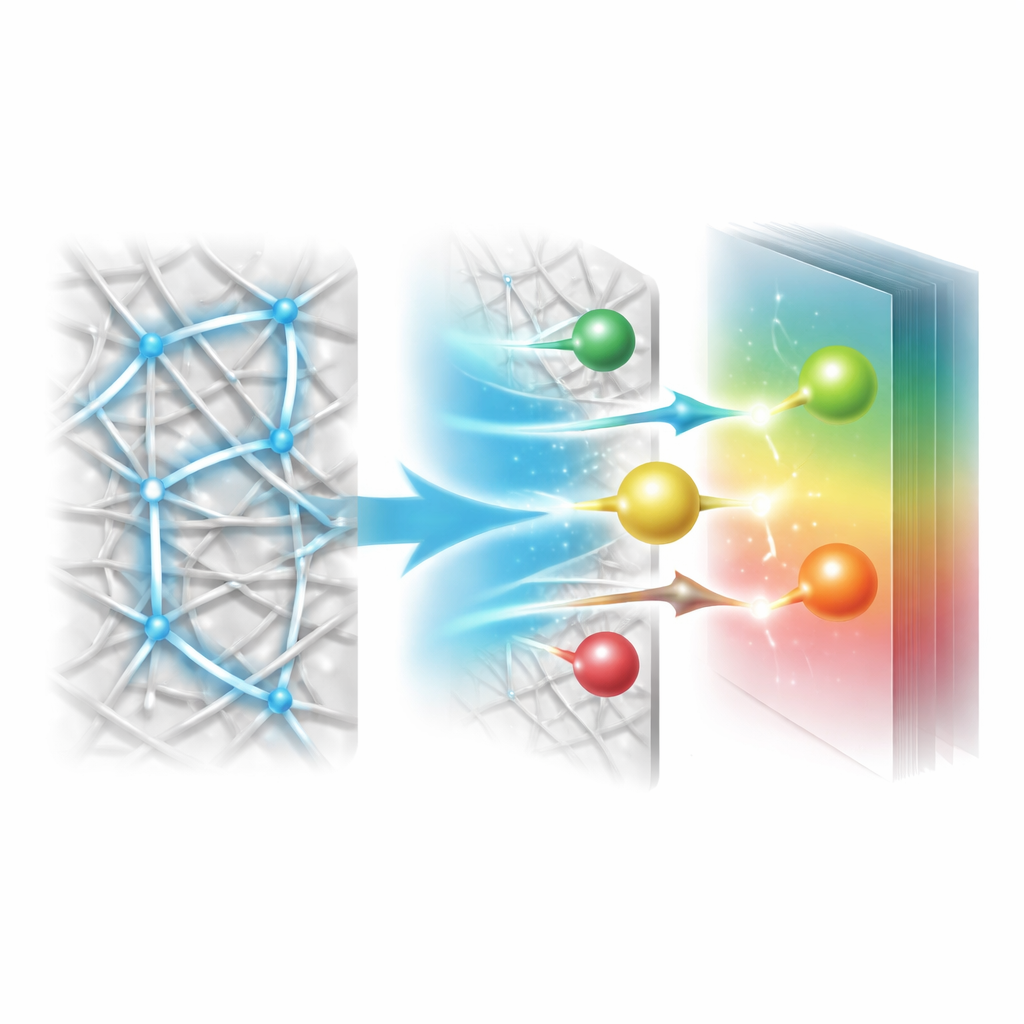
The team focused on hydrogen bonds, the same subtle attractions that help hold water and DNA together. They designed a small organic molecule, called 2PACz, that carries a phosphonic acid group. When mixed into polyvinyl alcohol (PVA), a common water-soluble plastic, this group forms a dense three-dimensional network of hydrogen bonds with the polymer chains. Because of phosphorus’s chemistry, these bonds tend to be stronger and more linear than those formed by more familiar acid groups. Experiments and computer simulations showed that this network tightly anchors the glowing 2PACz units, reducing their motion and improving the stability of their light-storing states. The result is a blue-emitting plastic film with a remarkably long afterglow—around three seconds—and a relatively high efficiency for an organic material.
From Blue Glow to a Full Color Palette
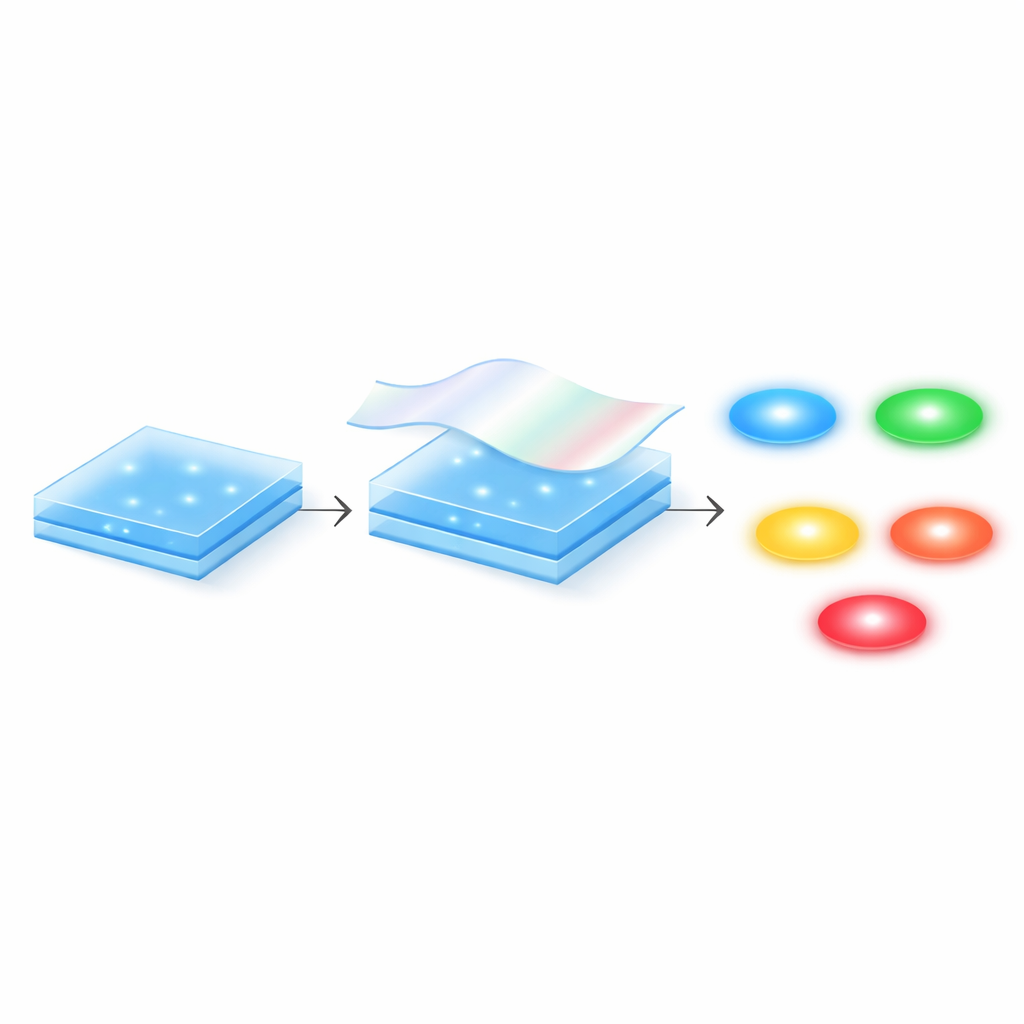
Once the blue afterglow layer was in place, the researchers used it as an internal light source to feed other dyes. They doped tiny amounts of water-soluble fluorescent molecules that naturally emit green, yellow, or red light into the same PVA network. Because the blue afterglow spectrum overlaps with the absorption of these dyes, energy can hop from the 2PACz units to the color dyes without emitting a photon first—a process known as energy transfer. This turns the original blue afterglow into bright green, yellow, or red afterglows, depending on which dye is present, all while keeping the films flexible, transparent, and easy to process from water-based solutions.
Twisting Light and Hiding Messages
To add another layer of control, the team coated the glowing films with a thin layer of polylactic acid (PLA), a biodegradable plastic that can be made in left- or right-handed helical forms. This coating acts like a built-in circular polarizing filter, imparting a twist to the emitted light so that it becomes circularly polarized—a property often linked with molecular “handedness.” By stacking the chiral PLA on top of different colored afterglow layers, the researchers created multicolor films whose glow carries not only color and brightness, but also a chiral optical signature. They demonstrated practical uses by painting afterglow coatings on coins, printing hidden QR codes that appear only after the light is switched off, and writing multicolor messages with water-based inks that encode information both in color and in the polarization state of the afterglow.
Why This Matters for Everyday Technology
In simple terms, this work shows how carefully designed molecular “Velcro” inside a plastic can lock in light energy and hand it off to other components on demand. The stronger hydrogen-bond framework created by phosphonic acid groups gives long-lived, temperature-tolerant blue afterglow. Adding color dyes extends that glow across the visible spectrum, and a chiral top layer imprints a twist onto the light itself. Because all of this is achieved in thin, transparent, water-processable films, the approach is promising for next-generation security labels, time-stamped messages, and flexible optical devices where information can be hidden in when the light appears, what color it is, and how it is polarized.
Citation: Gao, Z., Huang, S., Lian, X. et al. Phosphine-mediated hydrogen bond and phosphorescence energy transfer for tunable chiroptical afterglow in stacked polymers. Nat Commun 17, 2613 (2026). https://doi.org/10.1038/s41467-026-69324-0
Keywords: afterglow polymers, hydrogen bonding, circularly polarized light, security inks, energy transfer