Clear Sky Science · en
Hierarchical picot-fiber hydrogel coating with ultralow friction and high wear resistance
A Gentler Surface for Artificial Joints
Anyone who has seen a knee or hip replacement up close knows that metal and plastic parts must slide smoothly against each other, millions of times, inside the body. Over years, this rubbing can grind away material, release tiny particles, and inflame nearby tissue, sometimes forcing patients to undergo painful revision surgery. This paper introduces a new kind of soft, water-rich coating that aims to make artificial joints—and other implants—last longer by combining very low friction with remarkable resistance to wear, much like our own natural cartilage.
Why Wear Is a Hidden Threat in Implants
Load‑bearing implants such as artificial hips, knees, and spinal devices endure countless cycles of movement. With each step or bend, hard surfaces scrape past each other, generating microscopic debris and damage that can trigger inflammation and bone loss around the implant. Common plastics used today are tough but relatively dry and simple in structure, so they struggle to match the slippery yet durable nature of real cartilage. Previous attempts to add hydrogel coatings—soft, water‑rich layers—often ran into a critical trade‑off: making a coating wet enough to slide easily usually made it too weak to survive long‑term wear.
Borrowing Nature’s Layered Design
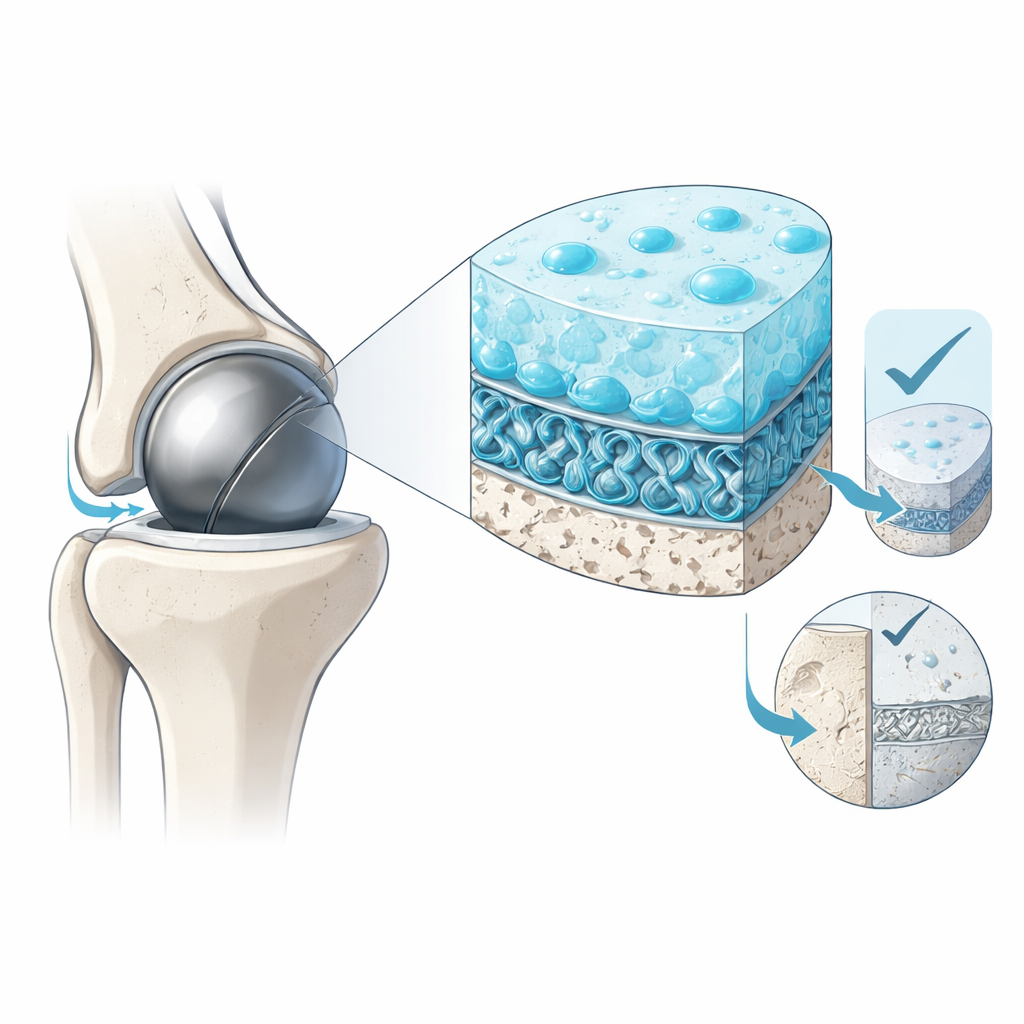
The researchers tackled this conflict by copying the layered architecture of natural cartilage. In joints, a thin, gel‑like surface provides lubrication, while a deeper region reinforced with collagen fibers carries the load. Their picot‑fiber hydrogel coating (PFHC) mirrors this idea. At the top is a loose, porous layer that soaks up water and forms a thin fluid film, allowing surfaces to glide past each other with minimal resistance. Beneath it lies a thicker core layer made of a dense polymer network strengthened by special microscopic fibers. At the bottom, this core interlocks tightly with a porous plastic base so the coating does not peel off during repeated motion.
Hidden Loops That Absorb the Strain
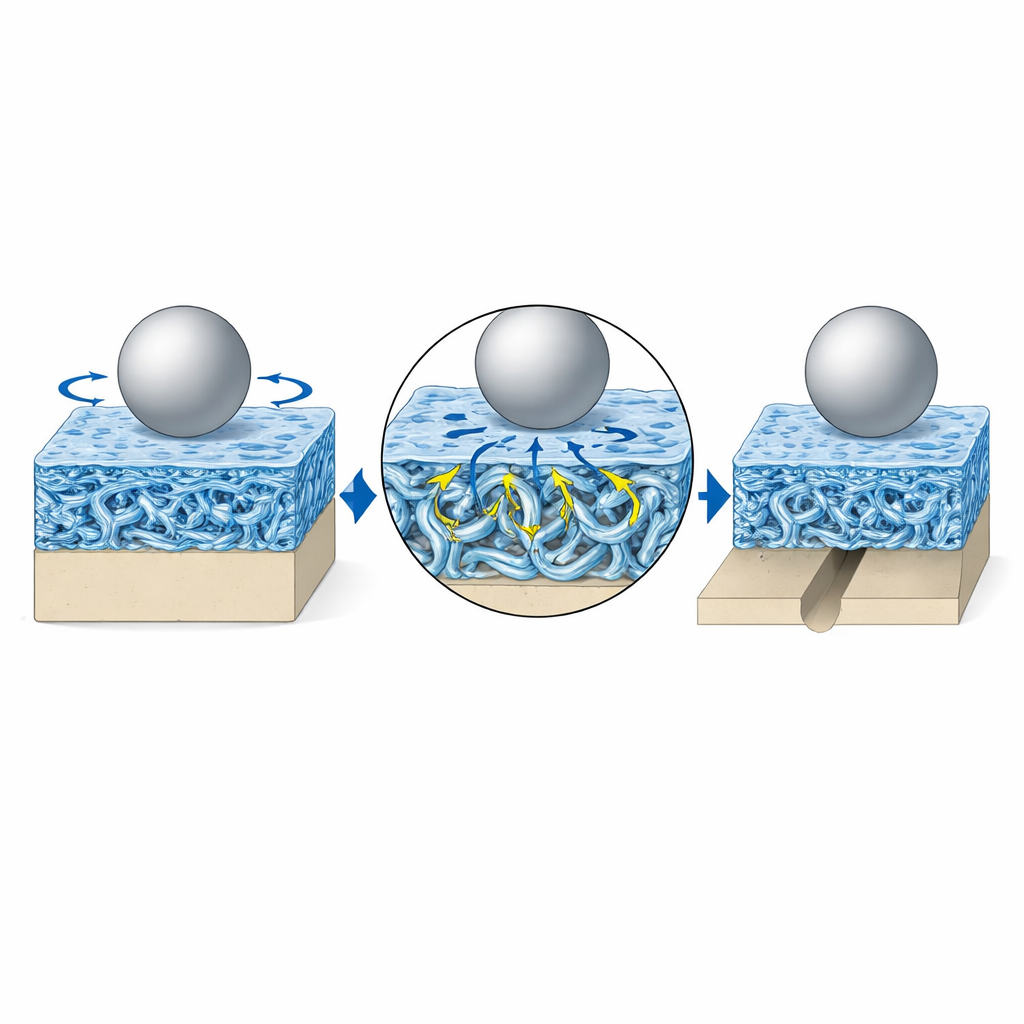
The heart of the technology is the so‑called picot fiber network. These fibers are built from short peptide strands that line up into tiny rods, then are stitched into a longer polymer chain that forms loop‑like “picots” along the way. When the coating is squeezed or stretched, these loops and peptide bundles can unfold and lengthen, soaking up energy that would otherwise tear the material. When the load is removed, they refold and the material bounces back. Tests showed that hydrogels containing these picot fibers could stretch to many times their original length, resist crack growth over thousands of cycles, and recover almost completely after heavy compression. At the same time, the surface remained highly hydrated, preserving its slippery character.
Staying Slippery Under Realistic Joint Motion
To mimic joint use, the team slid a metal ball over the coated surface in a warm, salt solution similar to body fluid, for 100,000 back‑and‑forth cycles under loads comparable to walking upstairs. The new coating kept its friction extremely low—around 0.009, rivaling or even beating natural cartilage—and showed almost no measurable wear. In contrast, bare plastic produced deeper grooves and higher friction, and a simpler hydrogel coating started out slippery but quickly degraded, wearing even more than the uncoated plastic. The picot‑fiber design also spread the contact pressure over a larger area, greatly lowering peak stress at the surface and helping to protect both the coating and the underlying implant material.
Safe for Cells and Stable Inside the Body
A durable coating is only useful if it is also safe. In cell‑culture tests, human stem cells grew and remained healthy on the new material, suggesting good compatibility. In rats, implants covered with the coating were placed under the skin and monitored for up to seven weeks. Blood tests, organ samples, and tissue sections around the implants all pointed to mild or negligible inflammatory response. The coating kept its structure, solid content, and lubricating performance during and after this time, indicating that it can remain stable in the body for extended periods.
What This Could Mean for Future Implants
At its core, this work shows that it is possible to break the long‑standing compromise between “slippery but fragile” and “tough but abrasive” surfaces. By separating lubrication to a soft, water‑rich top layer and load‑bearing to a hidden fibrous core with built‑in energy absorbers, the picot‑fiber hydrogel coating offers both ultralow friction and high wear resistance. For patients, that could one day translate into joint replacements and other implants that move more like natural tissue and last far longer before needing replacement.
Citation: Sun, W., Sun, X., Zhang, J. et al. Hierarchical picot-fiber hydrogel coating with ultralow friction and high wear resistance. Nat Commun 17, 2430 (2026). https://doi.org/10.1038/s41467-026-69322-2
Keywords: hydrogel coatings, artificial joints, wear resistance, biomimetic materials, cartilage lubrication