Clear Sky Science · en
Diffusion models enable high-fidelity prediction of fuel cell impedance spectrum from short time-domain profiles
Listening to Fuel Cells in Real Time
Proton-exchange membrane fuel cells are a promising way to power cars and backup power systems without tailpipe emissions, but they can wear out faster than we’d like. Engineers would love to “listen” to what is happening inside these devices, catching early signs of trouble such as drying, flooding, or oxygen starvation. A powerful listening tool already exists—the electrochemical impedance spectrum—but it is slow and expensive to measure in the field. This paper shows how a new type of artificial intelligence, called a diffusion model, can reconstruct that rich internal fingerprint from the simple sensor data that fuel cells already produce.
Why Measuring the Fuel Cell’s Signature Is Hard
Impedance spectra act like a full-body checkup for a fuel cell. By probing how the cell responds to tiny electrical nudges over many frequencies, researchers can tease apart losses linked to proton motion through the membrane, the speed of surface reactions, and the flow of gases and water. Today, collecting this information requires specialized lab hardware, long test times, and carefully controlled conditions, making it impractical for vehicles or commercial stacks running in the real world. Faster methods that inject more complex signals still demand high-end electronics and careful tuning. As a result, industry often relies on cruder measurements, such as simple voltage–current curves, and loses the detailed insight that impedance could provide.
Teaching an AI to Rebuild the Hidden Spectrum
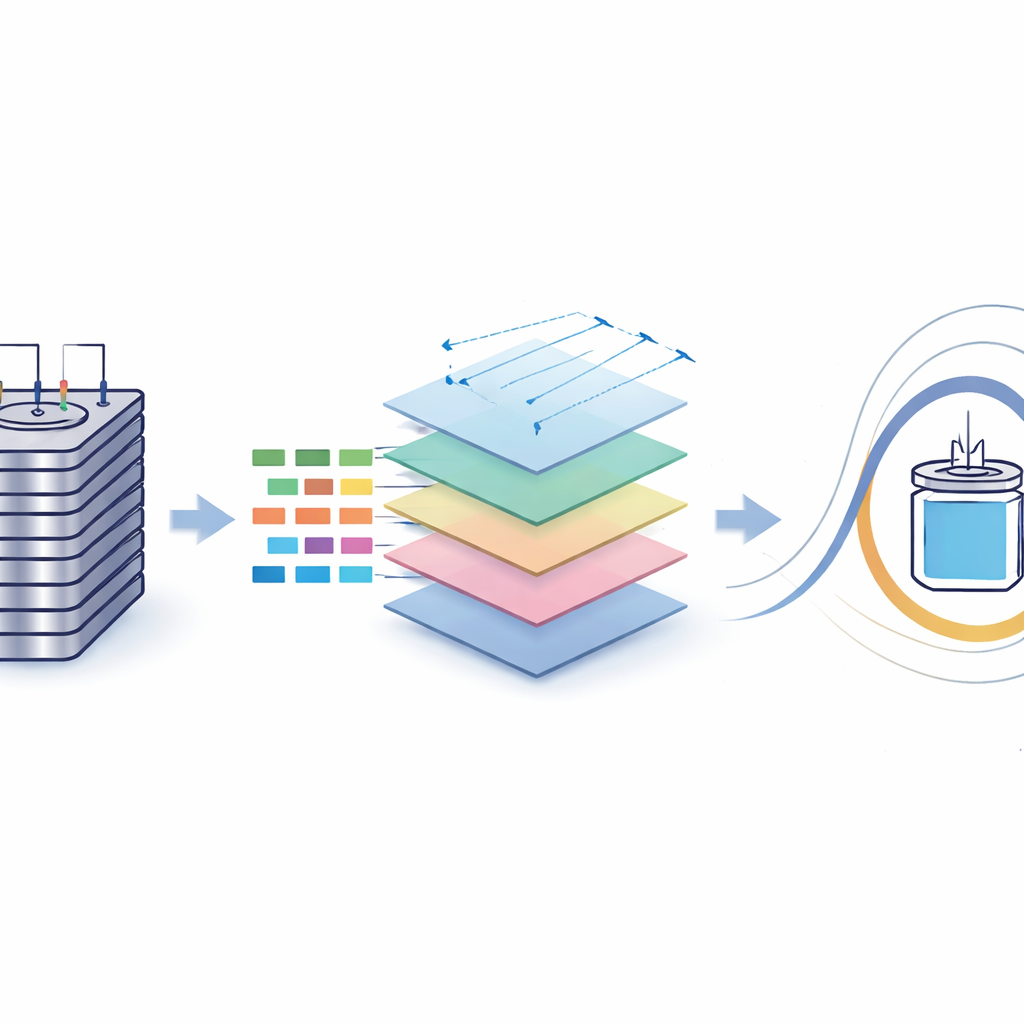
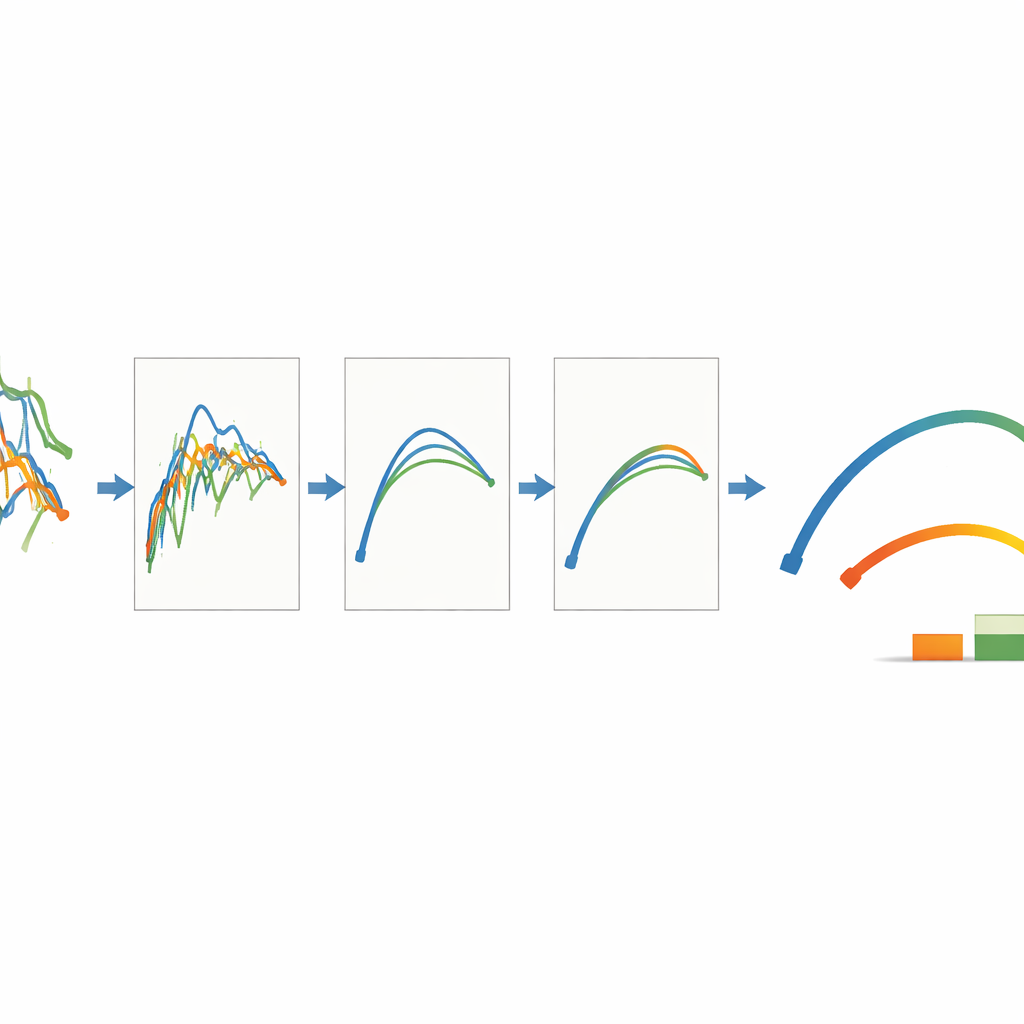
The authors propose a different route: instead of measuring the full spectrum directly, they predict it from brief time streams of easily collected signals, such as current, voltage, temperatures, pressures, and gas flow ratios. They use a diffusion model, a generative AI technique better known for creating images, and adapt it to one-dimensional electrical data. During training, the model learns to undo artificial noise that has been added step by step to real impedance spectra. A Transformer-based neural network—originally designed for language tasks—serves as the backbone, using an attention mechanism to capture long-range relationships within the time-series inputs and between inputs and spectra. Once trained, the system starts from noise and iteratively “denoises” its way to a predicted spectrum that is consistent with the incoming sensor history.
Building Big Datasets from Real Fuel Cells
To make this work, the team assembled what they report as the largest open collection of fuel cell impedance data so far. They tested two single-cell membrane–electrode assemblies with different flow-field designs, as well as two stacks rated at 30 kW and 9 kW. Across these devices, they varied operating conditions such as current density, inlet pressures, temperatures, and gas stoichiometries, and introduced controlled faults including membrane dehydration, flooding, and air starvation. For each condition they recorded short time-domain profiles from standard sensors and then measured full spectra over a wide frequency range. In total, they gathered more than 5,700 paired examples, which they used both to train and to rigorously test their model.
How Well the AI “Hears” the Cell
When evaluated on unseen data, the diffusion-based approach predicted complete spectra with errors around or below one percent for many conditions, using only the previous 100 seconds of sensor history sampled once per second. It outperformed several alternatives, including long short-term memory networks and pure Transformer models, cutting median percentage errors by up to about 37%. The method remained reasonably accurate when artificial noise was added to the input signals, and it degraded gracefully when some sensors were removed—important for cost-sensitive applications. The authors also compared different ways of integrating physical insight, such as predicting circuit-model parameters first versus predicting the spectrum directly, and found that direct spectrum prediction was more reliable.
Turning Predictions into Actionable Health Insights
Accurate spectra are only useful if they reveal something about the fuel cell’s health. The team showed that spectra generated by their model can be fed into established analysis tools to extract quantities such as ohmic resistance, reaction-related losses, and mass-transport limitations—numbers that track membrane hydration, catalyst performance, and oxygen delivery. These inferred losses matched values obtained from measured spectra closely enough to distinguish normal operating regimes from developing faults. The authors further discuss how combining such impedance-based indicators with detailed physics simulations or advanced imaging could, in the future, provide direct estimates of internal variables like water content or oxygen concentration, enabling smarter control strategies.
What This Means for Clean Energy Devices
In plain terms, this work shows that an AI model can reconstruct a fuel cell’s intricate electrical “voice” from the simple signals its onboard sensors already supply. That makes it much more practical to monitor internal stress, diagnose faults early, and manage operation to slow down wear, all without adding bulky or costly measurement equipment. If adopted widely and extended to other electrochemical systems such as batteries, this kind of data-driven impedance prediction could become a key ingredient in making clean energy devices more reliable, longer lasting, and easier to manage in everyday use.
Citation: Yuan, H., Tan, D., Zhong, Z. et al. Diffusion models enable high-fidelity prediction of fuel cell impedance spectrum from short time-domain profiles. Nat Commun 17, 2552 (2026). https://doi.org/10.1038/s41467-026-69321-3
Keywords: fuel cell health monitoring, electrochemical impedance, diffusion models, proton exchange membrane fuel cell, data-driven diagnostics