Clear Sky Science · en
Detecting genuine multipartite entanglement in multi-qubit devices with restricted measurements
Why quantum connections matter
Modern quantum devices can now juggle dozens of tiny quantum bits (qubits) at once, opening the door to powerful new computers, sensors, and communication networks. But to trust these machines, scientists must check not just that qubits work individually, but that they are deeply interlinked in a special way called genuine multipartite entanglement. This paper presents a practical method to verify such deep quantum connections in large devices, even when experiments are limited to only simple, local measurements on a few qubits at a time. 
Many particles, one shared quantum state
Entanglement is the famous quantum link that lets particles behave as a single system, no matter how far apart they are. When more than two particles are involved, things become richer and more complicated. Some many-qubit states can be built from separate pairs or small groups of entangled particles; others display stronger, truly global correlations. The latter are said to have genuine multipartite entanglement: they cannot be explained as a mixture of “just pairs plus noise.” Such states are crucial ingredients for quantum communication networks, error-correcting codes that protect fragile quantum data, and measurement-based quantum computers that run algorithms by performing a sequence of simple measurements.
The challenge of checking big quantum systems
In principle, one can fully reconstruct a quantum state by making many different measurements, a process called tomography. But as the number of qubits grows, the number of required measurements explodes, making this approach impossible for large devices. Existing shortcuts to detect multipartite entanglement often demand joint measurements on many qubits at once. That is a serious obstacle for platforms where qubits can interact only with immediate neighbors in a chain or lattice, or where measurement noise increases quickly as more qubits are measured together, as happens with microwave photons in superconducting circuits. The authors therefore ask: can we reliably certify strong, many-body entanglement using only simple measurements on small, local groups of qubits?
A new way to probe quantum webs with few measurements
The work focuses on an important family of states called graph states, where each qubit is a point and entangling operations follow the links of a graph. These include cluster states used for measurement-based quantum computing and ring or tree structures used in advanced communication and error-correction schemes. For such states, the authors design an entanglement test built from so-called stabilizers, mathematical quantities that stay fixed for an ideal target state. Their key insight is to select only a small subset of these stabilizers—those tied to individual vertices and their connecting edges—and to combine their measured values in a carefully weighted sum. Remarkably, they show analytically that, for any way of splitting the qubits into separate groups, this sum is bounded if the state lacks genuine multipartite entanglement. Whenever the experimentally measured sum breaks this bound, the state must contain strong multipartite entanglement, and the degree of violation gives information about how many groups it cannot be separated into. 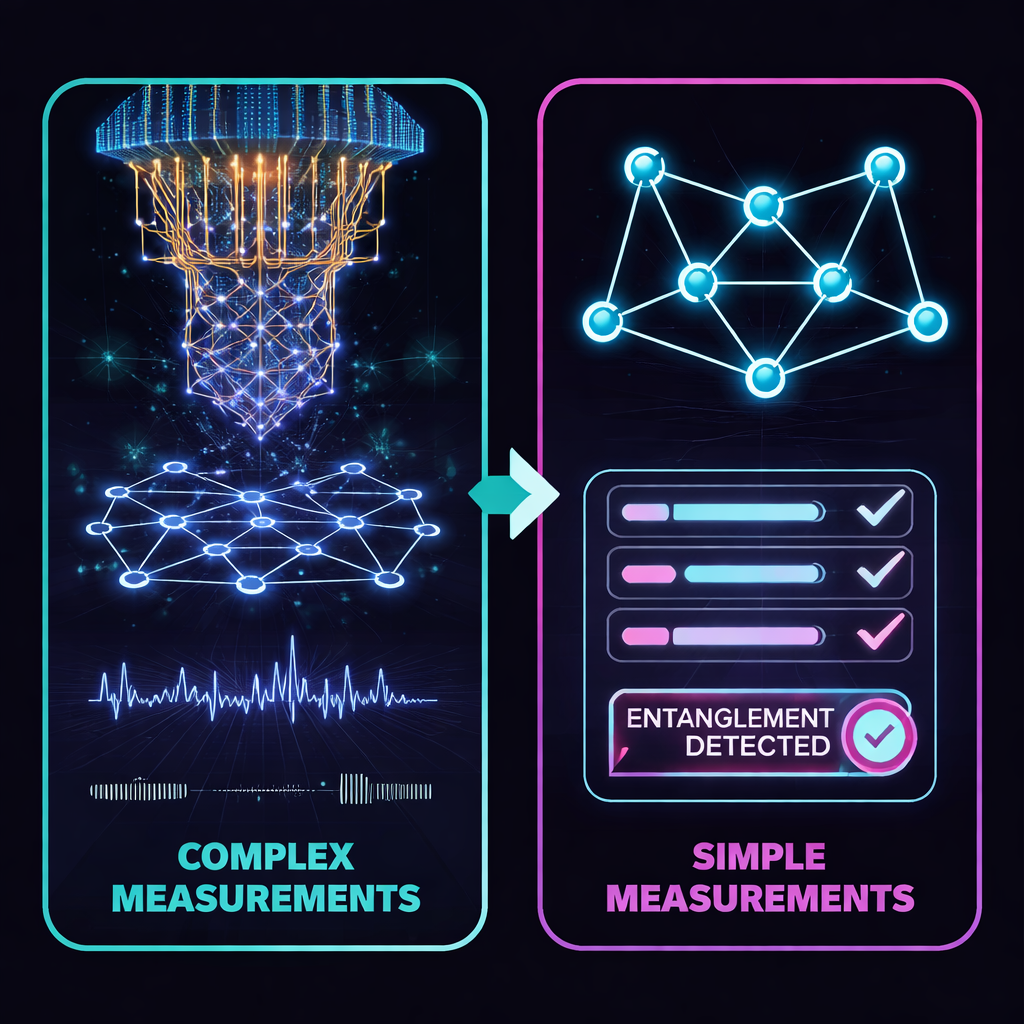
Making the most of limited experimental access
Crucially, the stabilizers in this test involve only a constant number of neighboring qubits, rather than growing with the size of the device. That makes the method well suited for platforms where only low-weight, local measurements are feasible. The authors further show that by using mathematical optimization tools known as semidefinite programming, they can still infer useful lower bounds on unmeasured stabilizers from the ones that are measured, tightening the test without extra experimental effort. They apply their criteria to realistic simulations of microwave-photonic graph states generated in superconducting circuits and find that they can detect genuine multipartite entanglement in situations where previous low-complexity methods fail. The certified level of multipartite entanglement tracks how close the state is to the ideal target, turning the test into a practical performance benchmark.
What this means for future quantum machines
To a non-specialist, the message is that the authors have developed a scalable “stress test” for the quantum links inside emerging multi-qubit devices. Instead of requiring detailed, global measurements that quickly become unmanageable, their method reads out just a modest set of local patterns and still decides whether the device is producing the strong, many-body quantum correlations that advanced applications rely on. This offers experimental teams a realistic way to certify and compare complex quantum resources, helping to guide the development of larger, more reliable quantum processors, sensors, and networks.
Citation: Li, N.K.H., Dai, X., Muñoz-Arias, M.H. et al. Detecting genuine multipartite entanglement in multi-qubit devices with restricted measurements. Nat Commun 17, 1707 (2026). https://doi.org/10.1038/s41467-026-69320-4
Keywords: multipartite entanglement, graph states, quantum benchmarking, superconducting circuits, entanglement detection