Clear Sky Science · en
Synthesis of 2D amorphous carbons via energy-autonomous carbonization of polyaniline upon decomposition of HClO₄
A popcorn-like way to make advanced carbon
From batteries and fuel cells to devices that turn carbon dioxide into useful chemicals, many clean-energy technologies rely on special forms of carbon. Making these carbons usually means hours of baking at red‑hot temperatures in large furnaces, which consumes a lot of energy and money. This study introduces a very different approach: a solid material that carries its own chemical fuel inside and, when gently triggered, “pops” like popcorn into ultra-thin carbon sheets in a fraction of a second.
Why turning plastic into carbon is so hard
Modern carbon materials are often made by slowly heating polymers—plastics built from carbon‑rich molecules—up to 800–1200 °C in carefully controlled ovens. This traditional route, called pyrolysis, takes time, equipment, and continuous external heating. It also tends to lock in the shape of the starting material, limiting how finely the final carbon structure can be tuned. Alternative shortcuts, such as flash heating, plasma, or shock waves, either still need extra thermal treatment or require complex machinery. As demand grows for cheaper, scalable, and greener ways to produce high‑performance carbons, researchers are looking for methods that can supply their own energy and run under simpler conditions. 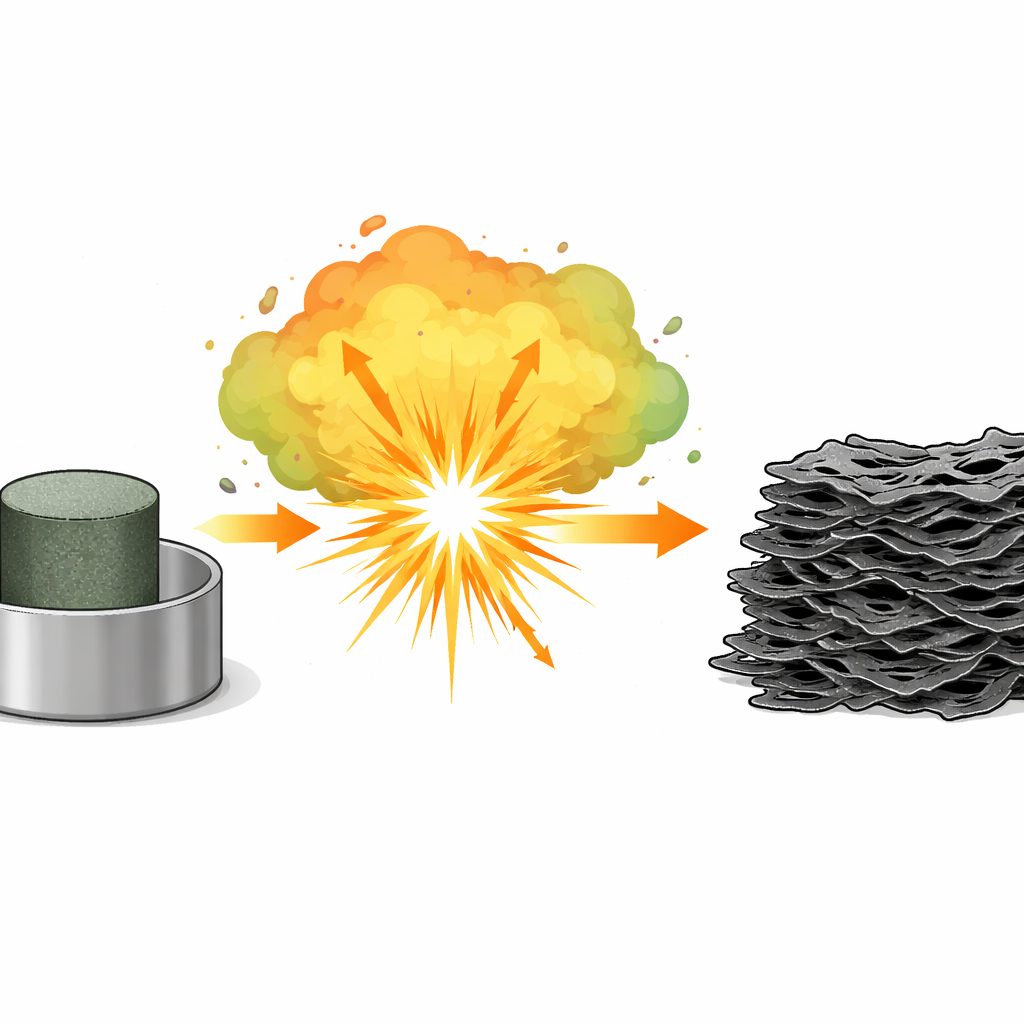
Building a self-igniting carbon precursor
The authors design a composite based on polyaniline, a well-known conducting polymer, mixed with perchloric acid. In this solid, the acid plays two roles: some of it is bound to the polymer chain, while another portion remains loosely trapped as “free” oxidizer. When the material is gently warmed to little more than the temperature of boiling water, exposed to microwaves, or even mechanically disturbed, the free oxidizer suddenly decomposes. That breakdown releases intense heat and large amounts of gas inside the soft polymer. In less than half a second, the material flashes, loses about 90% of its mass, and expands dramatically in volume. Careful imaging shows that the once-dense fibers turn into an interconnected web of extremely thin, crumpled sheets of carbon.
What the new carbon looks like on the inside
Microscopy and scattering experiments reveal that the “popped” product is made of two‑dimensional amorphous carbon nanosheets: ultrathin layers that are wavy and highly porous rather than flat and crystalline like graphite. The sheets stack loosely, producing a very high surface area—over 900 square meters per gram, comparable to or better than many advanced carbons. Atomic‑scale measurements indicate that the carbon network is mostly built from three‑bonded (sp2) atoms, as in graphene, but with many defects, vacancies, and ring patterns of different sizes. Nitrogen from the original polymer and oxygen-containing groups are naturally incorporated into the structure, creating a chemically rich surface that can serve as active sites for reactions.
Turning the popping sheets into smart catalysts
Because the process starts from a tailor‑made polymer, the team can easily add small amounts of metal ions such as iron, cobalt, nickel, or copper before the popping step. During the explosive carbonization, these ions become isolated single atoms anchored to nitrogen sites within the carbon sheets—a highly prized configuration for catalysts. The resulting materials show strong performance in two important electrochemical reactions. In oxygen reduction, relevant to fuel cells and hydrogen peroxide production, different metals steer the reaction either toward water or toward concentrated hydrogen peroxide with high efficiency. In carbon dioxide reduction, the various metal-doped carbons favor different useful products, including carbon monoxide, formate, and even ethanol, with some formulations achieving nearly perfect selectivity for carbon monoxide over competing hydrogen formation. 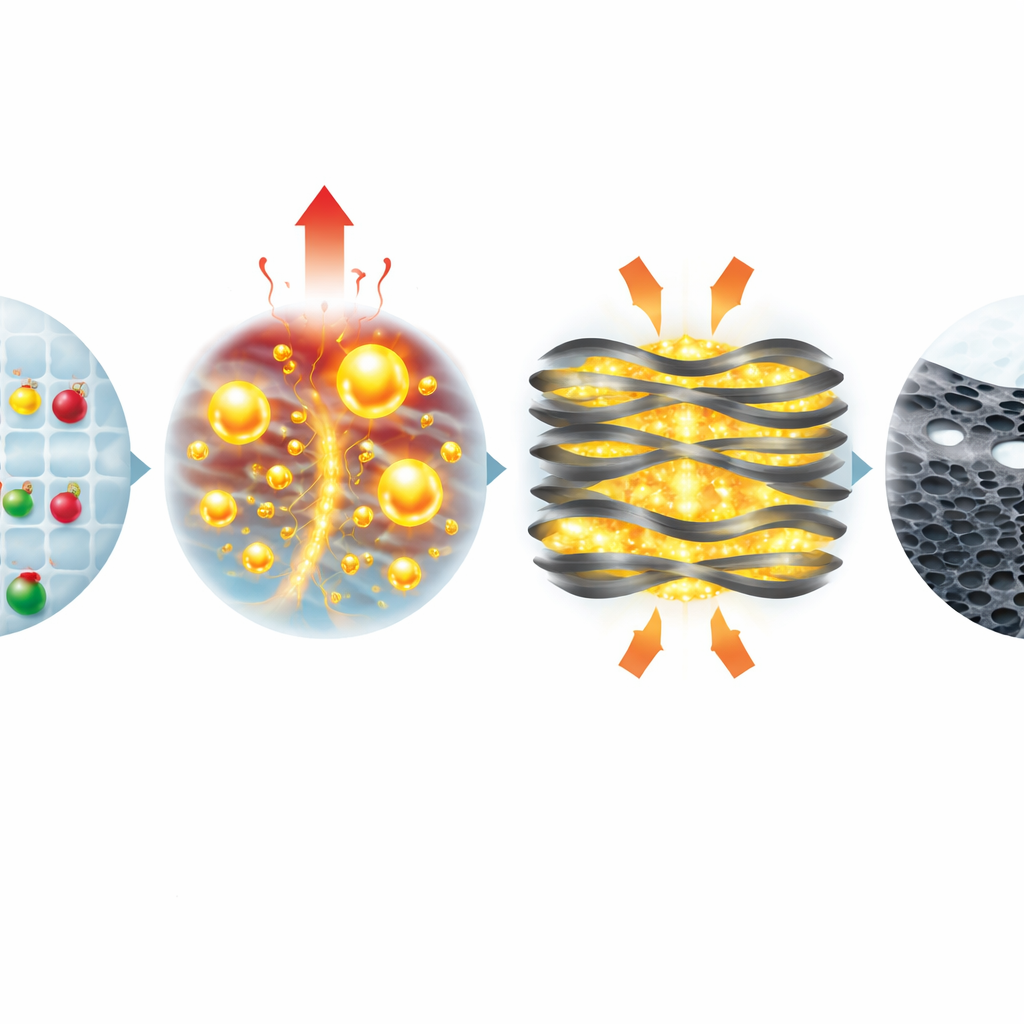
How the popping works and why it matters
By systematically varying the amount and state of perchloric acid in the starting material, the authors show that only the “free” oxidizer is truly responsible for the popping event. Too little of it produces only small carbon flakes; above a threshold, the rapidly released heat and gas are strong enough to fully exfoliate the polymer into extended nanosheets. Simulations at the atomic level support this picture: under extreme, short‑lived heating, the molecular rings in polyaniline first break apart and then quickly reconnect into defect‑rich carbon layers. Overall, the work demonstrates a scalable, self‑powered way to convert a common polymer into advanced two‑dimensional carbons in an instant, without long furnace runs. For non‑experts, the key takeaway is that the researchers have found a “popcorn chemistry” route to designer carbon materials and catalysts, potentially lowering both the energy cost and complexity of producing components for future clean‑energy devices.
Citation: Shen, LL., Zhang, GR., Zhang, W. et al. Synthesis of 2D amorphous carbons via energy-autonomous carbonization of polyaniline upon decomposition of HClO₄. Nat Commun 17, 2485 (2026). https://doi.org/10.1038/s41467-026-69314-2
Keywords: energy-efficient carbon synthesis, 2D amorphous carbon, self-propagating reaction, single-atom catalysts, electrocatalysis