Clear Sky Science · en
Magnon squeezing in the quantum regime
Listening to the quietest magnets
Scientists are constantly pushing against the limits of what can be measured, from faint ripples in space-time to whispers of dark matter. To do this, they need ways to tame the random quantum jitters that normally blur any tiny signal. This paper shows how to calm those jitters in a new kind of system made of trillions of tiny magnetic moments acting together. By shaping their fluctuations into a special “squeezed” form, the researchers open a path to ultra-sensitive detectors and new tests of where quantum physics ends and everyday experience begins.
Many spins acting as one
In certain crystals, the magnetic moments of countless atoms can move together in lockstep, behaving like a single vibrating object. These collective ripples of magnetization are called magnons. The team worked with a sphere of a material known as yttrium iron garnet, only a millimeter across but containing roughly ten billion billion spins. In this sphere, the simplest vibration—where all spins precess in unison—acts like a very clean, long-lived quantum oscillator. Because of this, such spheres are attractive candidates for building quantum devices that bridge the gap between microscopic circuits and macroscopic, almost tangible objects.
Teaching a magnet to feel quantum squeezing
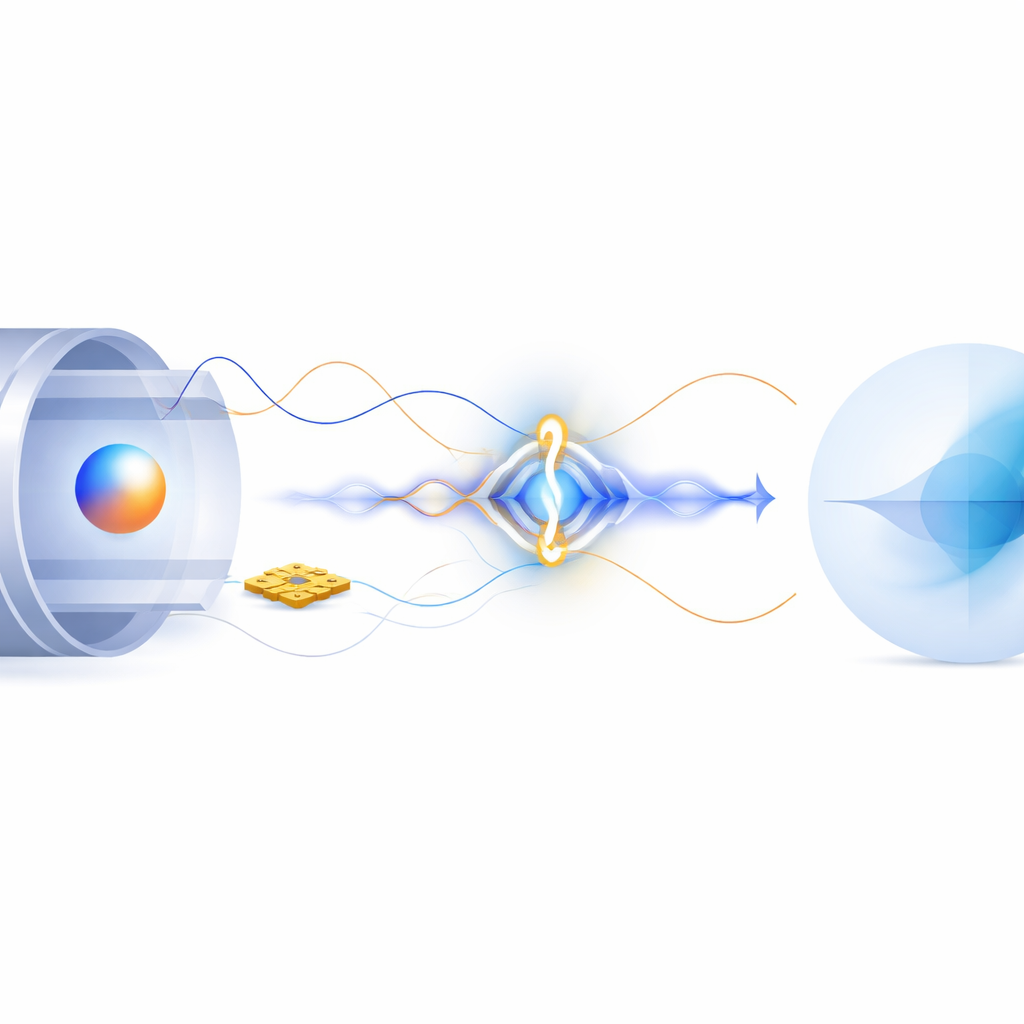
Quantum squeezing means reducing the uncertainty in one property of a system while allowing extra uncertainty in a complementary one, much like making a circle of possible positions and momenta into a skinny ellipse. For light, this has already improved gravitational-wave observatories. But performing the same trick on magnons in a large solid has been difficult, because the natural interactions that could reshape their quantum noise are extremely weak. The authors solve this by placing the magnetic sphere and a tiny superconducting circuit, called a transmon qubit, inside a shared microwave cavity cooled to about ten thousandths of a degree above absolute zero. The cavity allows the qubit and the magnon mode to influence each other strongly without constantly swapping real energy, creating an effective nonlinear interaction that can sculpt the magnon’s quantum state.
Shaping and viewing the quantum noise
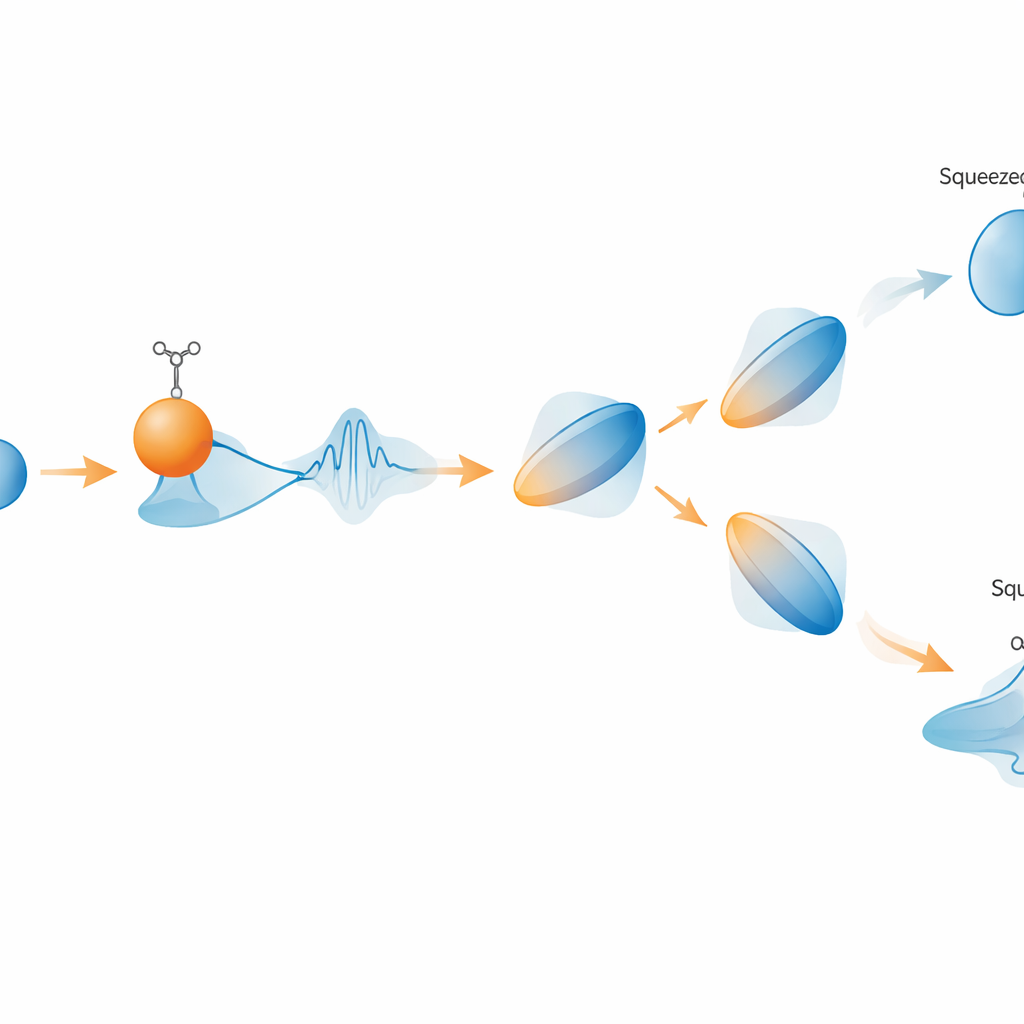
By carefully tuning the frequency of the qubit using a controlled microwave drive, the researchers engineer a self-interaction in the magnon mode known as a Kerr nonlinearity. At the same time, they gently drive the magnons so that they do not stay in their natural ground state. Under this combined action, the quantum state of the magnons gradually shears in an abstract “phase space,” evolving from a round blob into a distorted, squeezed shape. To see this invisible transformation, the team develops a magnon-assisted Raman process: a two-step interaction that swaps information between the magnons and the qubit in a controllable way. Using the qubit as a probe, they reconstruct a full portrait of the magnon state, known as its Wigner function, at different evolution times.
Proving it is truly quantum
The reconstructed portraits reveal the hallmark signatures of squeezing: one quadrature of the magnon motion shows reduced fluctuations compared with the quantum “vacuum,” while the orthogonal quadrature is more noisy. Quantitatively, the noise reduction reaches about 1 decibel below the vacuum level. Crucially, throughout the experiment the average number of magnons stays below one, meaning the effect is not a large, classical vibration but a genuine reshaping of tiny quantum fluctuations. The team also tracks how this fragile state decays. When the engineered interaction is turned off, the squeezed pattern relaxes back to a round, unsqueezed form on a timescale of about 145 billionths of a second. When the interaction is left on, it partially counteracts this decay, keeping visible squeezing for more than twice as long.
A new tool for ultra-precise sensing
This work demonstrates that even a solid object containing an enormous number of spins can be steered into a delicately squeezed quantum state and kept there long enough to be useful. By boosting the strength of the coupling and further refining the magnetic material, stronger squeezing and longer lifetimes should be within reach. Such improvements could translate directly into sharper quantum sensors for gravitational waves, dark-matter axions, and other elusive phenomena, while also offering a new arena for exploring how quantum behavior survives—or fails—at macroscopic scales.
Citation: Weng, YC., Xu, D., Chen, Z. et al. Magnon squeezing in the quantum regime. Nat Commun 17, 2679 (2026). https://doi.org/10.1038/s41467-026-69312-4
Keywords: quantum squeezing, magnonics, yttrium iron garnet, hybrid quantum systems, quantum metrology