Clear Sky Science · en
Continuously trapped matter-wave interferometry in magic Floquet-Bloch band structures
Why tiny waves of matter can act as precision force meters
Measuring tiny forces—such as subtle twists in gravity or hints of new physics—usually demands enormous, carefully isolated experiments. This study shows a very different route: using waves made from ultracold atoms, held in place by laser light, as compact yet extremely sensitive “force meters.” By cleverly shaping how these matter waves move, the researchers build a device that keeps its atoms continuously trapped, resists common sources of noise, and can be reprogrammed like a flexible scientific tool.
Turning a cloud of atoms into a force sensor
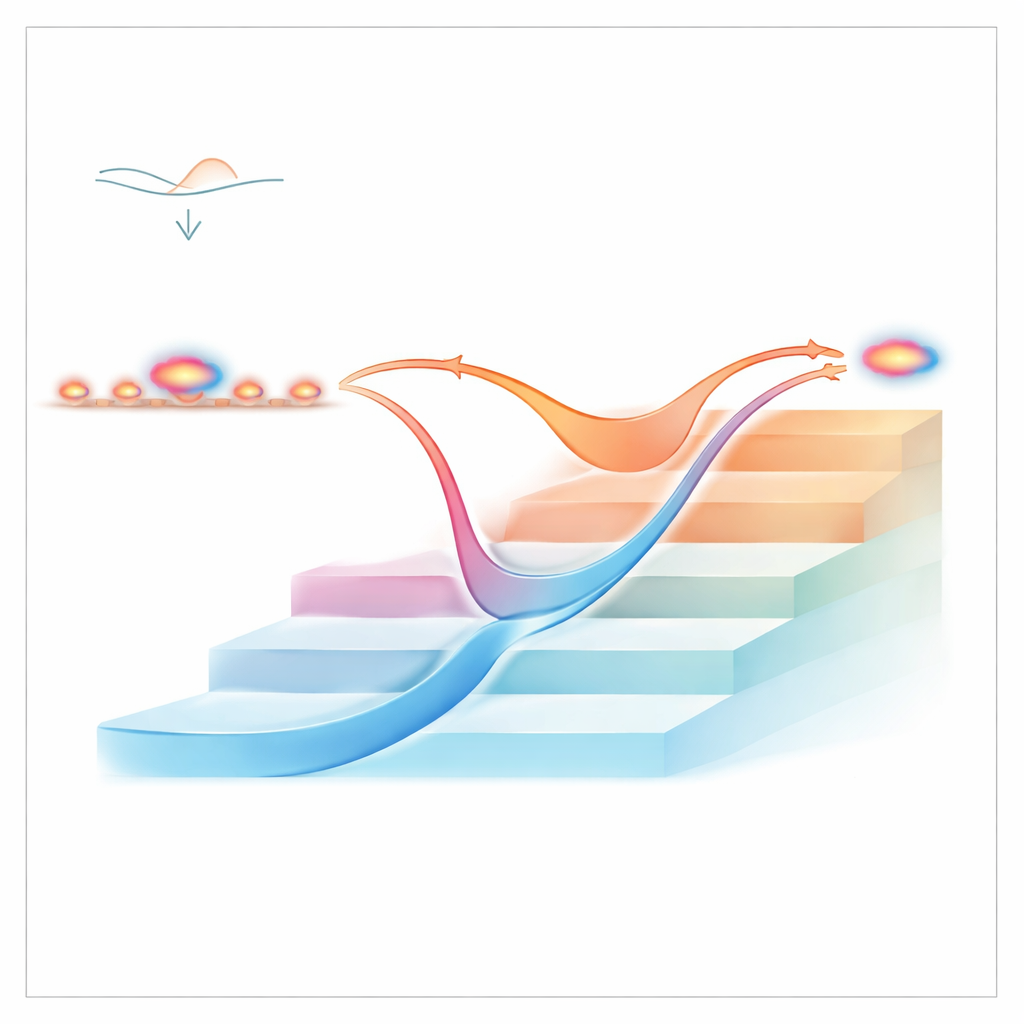
The work begins with a cloud of lithium atoms cooled until they behave as a single, unified matter wave. Instead of letting this wave fall freely under gravity, the team traps it in a horizontal “egg carton” of light known as an optical lattice. When a gentle push is applied along the lattice—using a magnetic field gradient—the matter wave doesn’t simply slide. It performs rhythmic back-and-forth motions called Bloch oscillations, tracing out a looping path whose size in space and time determines how sensitively it can sense a force.
Using light’s rhythm to split and guide matter waves
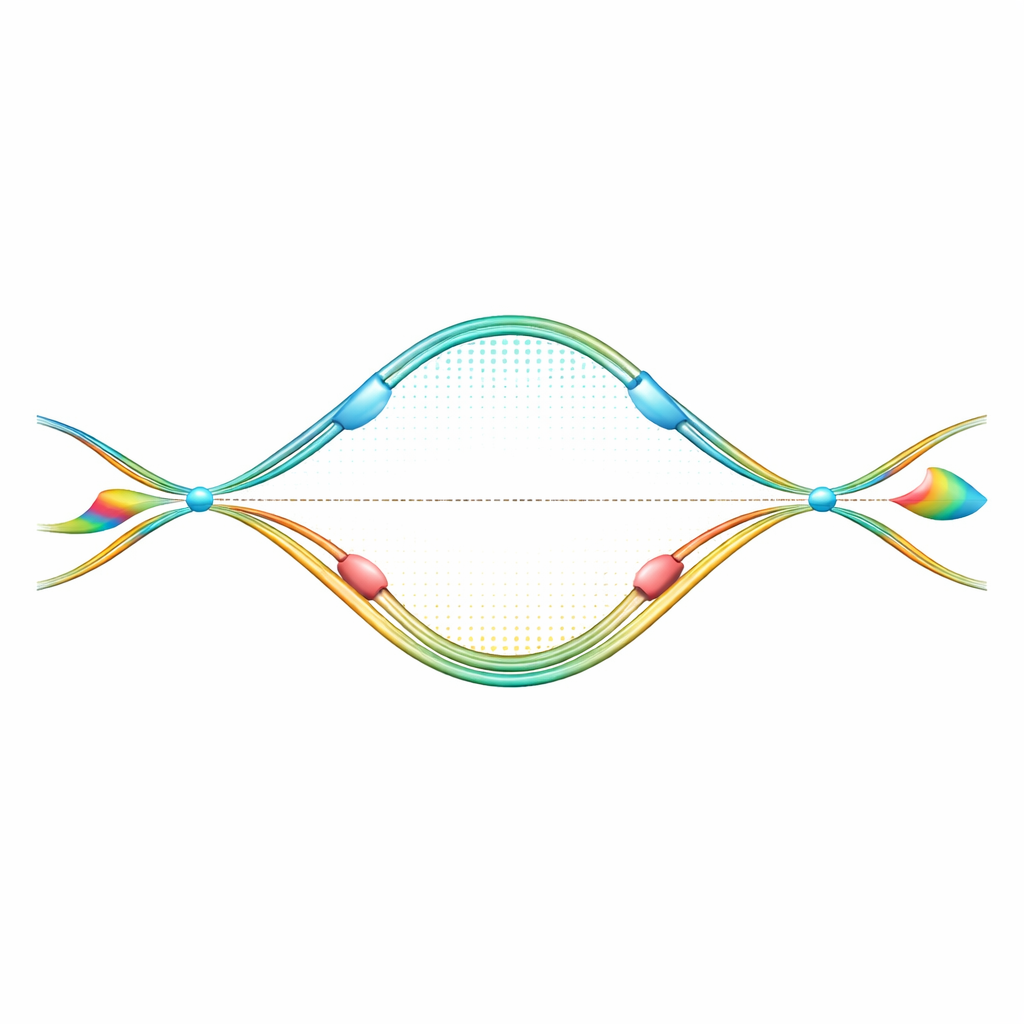
To turn these loops into a working interferometer, the authors periodically shake the depth of the optical lattice at precise radio frequencies. This timed shaking reshapes the energy landscape seen by the atoms into so‑called Floquet-Bloch bands. At special points, two bands come very close together, creating natural beam splitters: as the matter wave passes, it smoothly divides into two copies that travel along different bands, then later recombines. Because the splitting is controlled by the band structure itself, rather than by separate laser pulses, the device is remarkably insensitive to errors in timing, laser phase, or the atoms’ initial motion.
Designing “magic” paths that ignore trap noise
A major challenge for trapped sensors is that noise in the laser intensity normally scrambles the phase that carries information about the force. Here, the researchers exploit the flexibility of Floquet engineering to design “magic” band structures whose interferometer phase barely changes when the lattice depth fluctuates. By choosing specific pairs of excited bands and carefully tuning the modulation, they find loops where increasing the trap strength speeds up one arm of the interferometer exactly as much as it slows down the other. Experiments show that near this magic setting, changing the lattice depth has almost no effect on the output signal, in stark contrast to nearby non-magic configurations.
Dialing up sensitivity and reprogramming the device
With magic operation in hand, the team explores how to boost and shape the sensor’s response. They enlarge the interferometer loops in momentum space, which translates into greater enclosed spacetime area and sharper fringes that respond more strongly to small force changes, all while preserving noise tolerance. They also introduce more advanced control tricks: pulsing the modulation so that unwanted band couplings are switched off except during beam-splitting, adding extra modulation frequencies to involve higher bands and build larger loops, and shifting the phase of one modulation pulse to slide the interference pattern at will. These knobs let the experimenters tune sensitivity, suppress spurious pathways, and test stability without needing to change the applied force itself.
What this means for future ultra-precise measurements
Altogether, the work demonstrates that matter-wave interferometers can be kept continuously trapped, highly programmable, and surprisingly immune to one of their main noise sources. By engineering magic Floquet-Bloch band structures, the authors show a clear path toward compact sensors that rival much larger free-fall experiments in their ability to detect exceedingly weak forces. With further refinement—such as improved magnetic control, higher-order magic designs, or alternative atoms—these trapped interferometers could become powerful tools for probing tiny deviations in gravity, searching for new particles or forces, and performing precision measurements in settings where large apparatuses or microgravity are not practical.
Citation: Chai, X., Nolasco-Martinez, E., Liang, X. et al. Continuously trapped matter-wave interferometry in magic Floquet-Bloch band structures. Nat Commun 17, 2530 (2026). https://doi.org/10.1038/s41467-026-69299-y
Keywords: atom interferometry, optical lattice, Floquet engineering, precision force sensing, quantum sensors