Clear Sky Science · en
Room-temperature plasticity in Ag2Te induced by Ag ions hopping
Metal That Bends Like Plastic
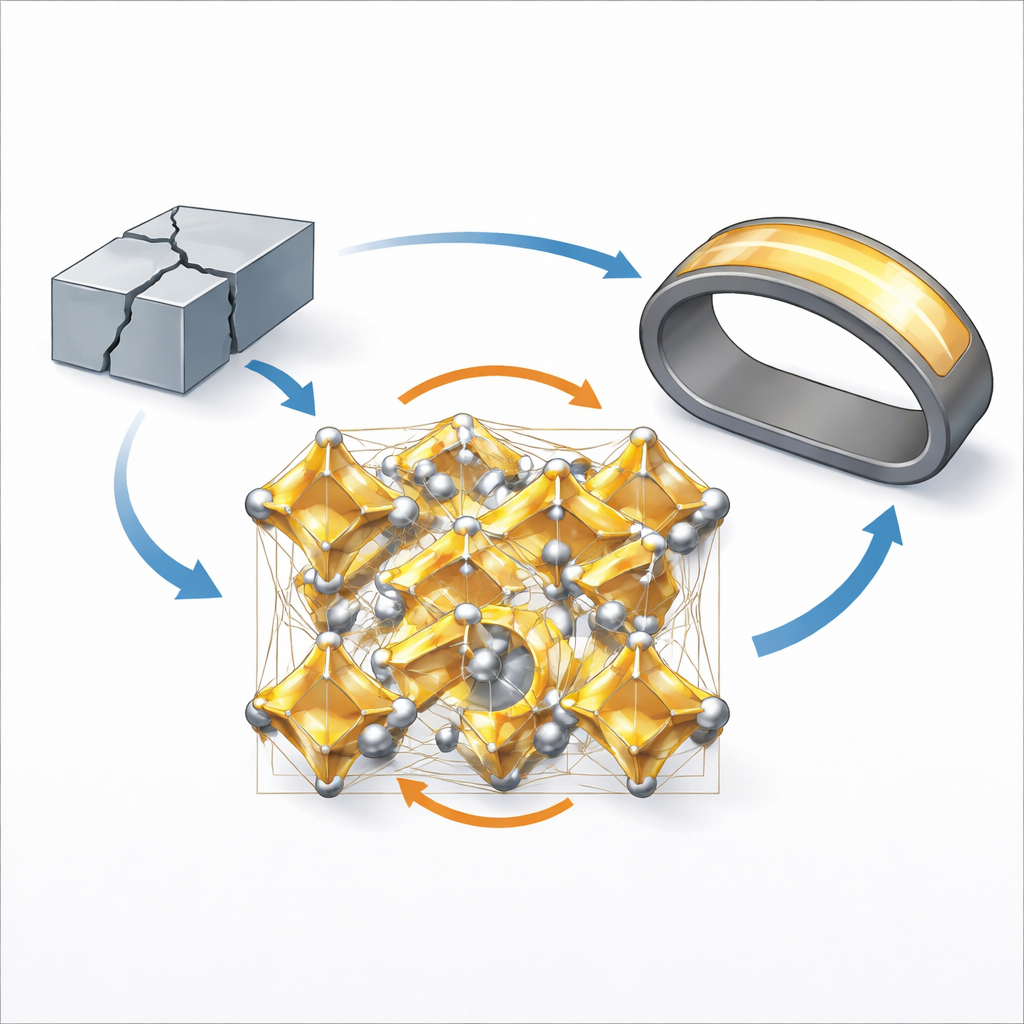
Imagine an electronic bracelet that can twist, stretch and flex with your wrist while quietly turning your body heat into electricity. To build such gadgets, engineers need semiconductors that behave more like soft metals or plastics than like the brittle crystals in today’s chips. This study reveals how a silver–tellurium compound, Ag2Te, manages this unlikely trick at room temperature, uncovering an atomic dance that lets a hard crystal bend without breaking while still conducting electricity efficiently.
Why Flexibility Matters
Wearable thermoelectric generators and flexible sensors promise power and computing woven into clothing, skin patches, and soft robots. Conventional inorganic semiconductors are stiff and prone to cracking, so flexible devices usually rely on thin films stuck onto soft plastics, which adds complexity and limits durability. A new class of “plastic” inorganic semiconductors is changing that picture: these materials can sustain large, permanent shape changes like metals, yet keep the electronic properties needed for useful devices. Among them, Ag2Te is especially intriguing because it is both unusually stretchable at room temperature and a respectable thermoelectric material, capable of turning temperature differences into electricity with performance that rivals other state-of-the-art flexible compounds.
Seeing Crystals Stretch in Real Time
To understand how Ag2Te bends without falling apart, the researchers stretched both bulk samples and nanoscale beams while watching their internal structure with advanced electron microscopes. Macroscopic tests showed that bulk Ag2Te can elongate by more than 10 percent at room temperature, a huge amount for a crystalline semiconductor, and it does so without forming the narrow “neck” typical of metals about to snap. Under the microscope, thin beams of Ag2Te stretched to nearly 13 percent strain while remaining crystalline. Chemical analysis confirmed that the ratio of silver to tellurium atoms stayed unchanged, ruling out large-scale melting or chemical segregation as an explanation.
Crystals That Gently Reorient
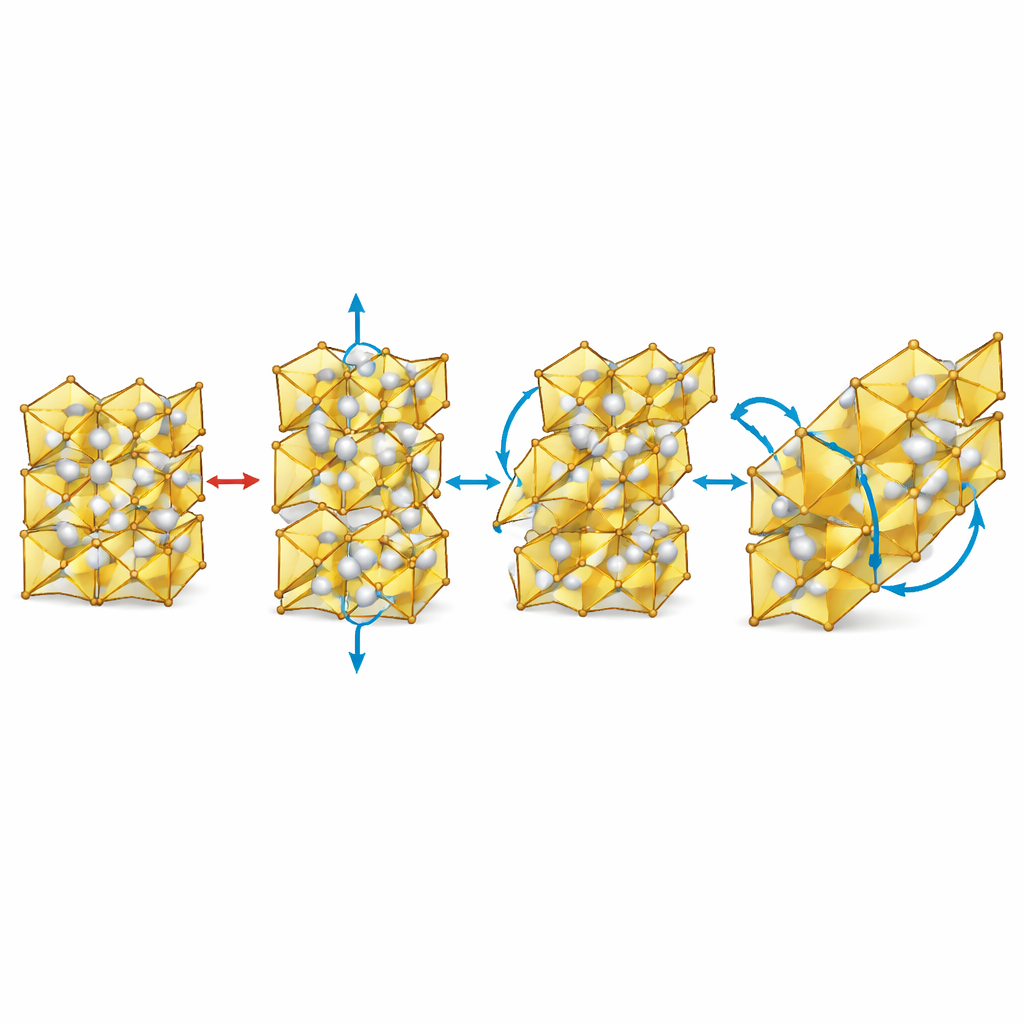
Instead of slipping along defect lines like metals do, Ag2Te accommodates stretching by breaking up into many tiny regions, or domains, whose crystal lattices rotate relative to one another by about 92 degrees. These rotation domains appear wherever the material experiences high stress, especially near eventual fracture points, and are also seen in larger bulk samples. Because the domains form and grow throughout the material rather than concentrating deformation in one narrow zone, the crystal avoids the localized thinning that leads to necking and sudden failure. The process resembles a crowd turning in coordinated steps rather than people pushing past each other along a single fault line.
The Hidden Role of Moving Silver Ions
At the heart of this behavior is a subtle rearrangement of atoms. Under tension, the framework built primarily from tellurium atoms stretches along the pulling direction and compresses sideways. This distortion squeezes silver ions out of their usual pockets and encourages them to hop into nearby empty sites that are naturally present in certain atomic planes. Computer simulations based on quantum mechanics show that the energy barrier for these hops is modest and becomes even lower when the lattice is strained, meaning the applied stress actively promotes ion motion. As silver ions migrate, an entire vacancy-rich plane of the crystal can pivot by about 92 degrees, creating a new domain that relieves built-up strain while preserving long-range order and overall composition.
Flexible and Efficient at the Same Time
Crucially, this rotation-and-hopping mechanism does not destroy the crystal’s ability to carry charge and heat in a controlled way. Measurements of Ag2Te’s thermoelectric performance show a figure of merit around 0.67 at about 400 K, comparable to other leading room-temperature ductile semiconductors. Because the material deforms by coordinated rotation of intact domains rather than by forming cracks, amorphous patches, or large concentrations of traditional defects, its electrical properties remain largely intact even after substantial bending. This makes Ag2Te a promising candidate for flexible thermoelectric generators and other bendable electronics where both toughness and functionality must coexist.
A New Design Rule for Soft Electronics
By revealing that stress-driven hopping of mobile silver ions can trigger large, coherent rotations of the crystal lattice, this work proposes a new way to design bendable semiconductors. Instead of relying on conventional metallic slip or partial loss of order, engineers can aim for materials where certain ions are free enough to move under stress and help the rigid framework gently reconfigure itself. Ag2Te thus serves as a model system, showing that carefully tuned ion mobility can turn intrinsically brittle crystals into mechanically forgiving components without sacrificing the electronic performance needed for next-generation flexible devices.
Citation: Guo, A., Liu, K., Wang, Z. et al. Room-temperature plasticity in Ag2Te induced by Ag ions hopping. Nat Commun 17, 2416 (2026). https://doi.org/10.1038/s41467-026-69298-z
Keywords: flexible electronics, thermoelectric materials, plastic semiconductors, silver chalcogenides, ion migration