Clear Sky Science · en
Decoding phantom limb movements from intraneural recordings
New Ways to Move with a Missing Leg
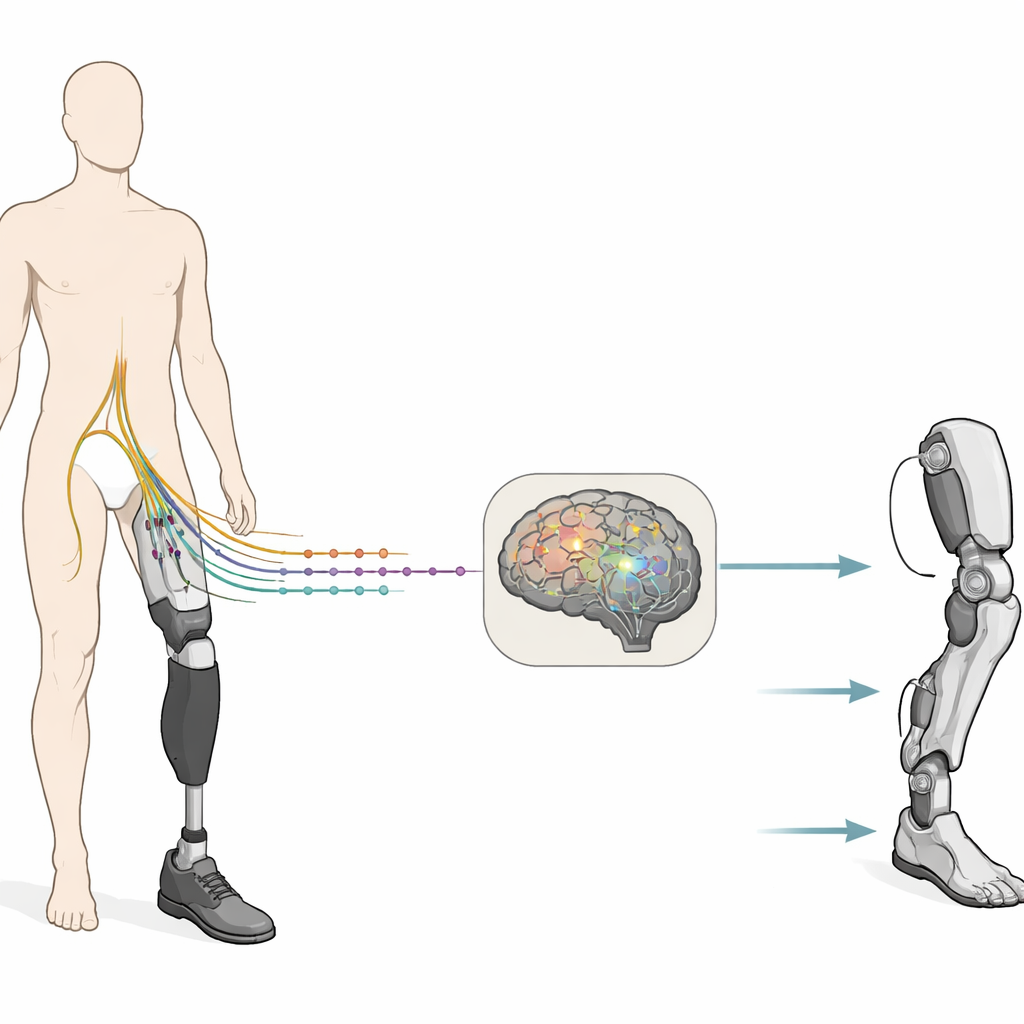
For people who have lost a leg above the knee, walking with a prosthesis can feel more like steering a stiff machine than moving a part of their own body. This study explores a different path: listening directly to the remaining leg nerves when amputees try to move their “phantom” leg, and using those signals to control a future bionic limb. By tapping into the same wiring the brain once used to move the knee, ankle, and toes, the researchers show that natural, intuitive control of an artificial leg may be within reach.
Listening to Nerves Inside the Thigh
The team worked with two volunteers who had lost a leg above the knee but could still vividly feel and “move” their phantom limb. Surgeons implanted four hair-thin electrode strips inside a branch of the sciatic nerve in the back of the thigh. Each strip carried multiple tiny recording sites, giving 56 channels in total. When the participants were seated and asked to flex and extend their phantom knee, ankle, or toes on command, the electrodes picked up bursts of electrical activity from nerve fibers that once controlled muscles now missing after amputation.
Ghost Movements Leave Real Electrical Traces
Even though the lower part of the leg was gone, attempts to move it produced clear and structured signals in the nerve. Most recording sites responded to at least one type of motion, and many distinguished between flexion and extension. Some electrodes were more tuned to knee movements, others to ankle or toes, mirroring how different muscle groups are wired to the nerve. The strength and timing of the nerve firing patterns differed from joint to joint, suggesting that the body’s original “map” of leg control survives in the remaining nerve stump. The researchers also found that these motor patterns lined up well with known anatomy: nerve channels that lit up for a given motion tended to match the muscles that would normally produce that movement.
Teaching a Brain-Inspired Decoder
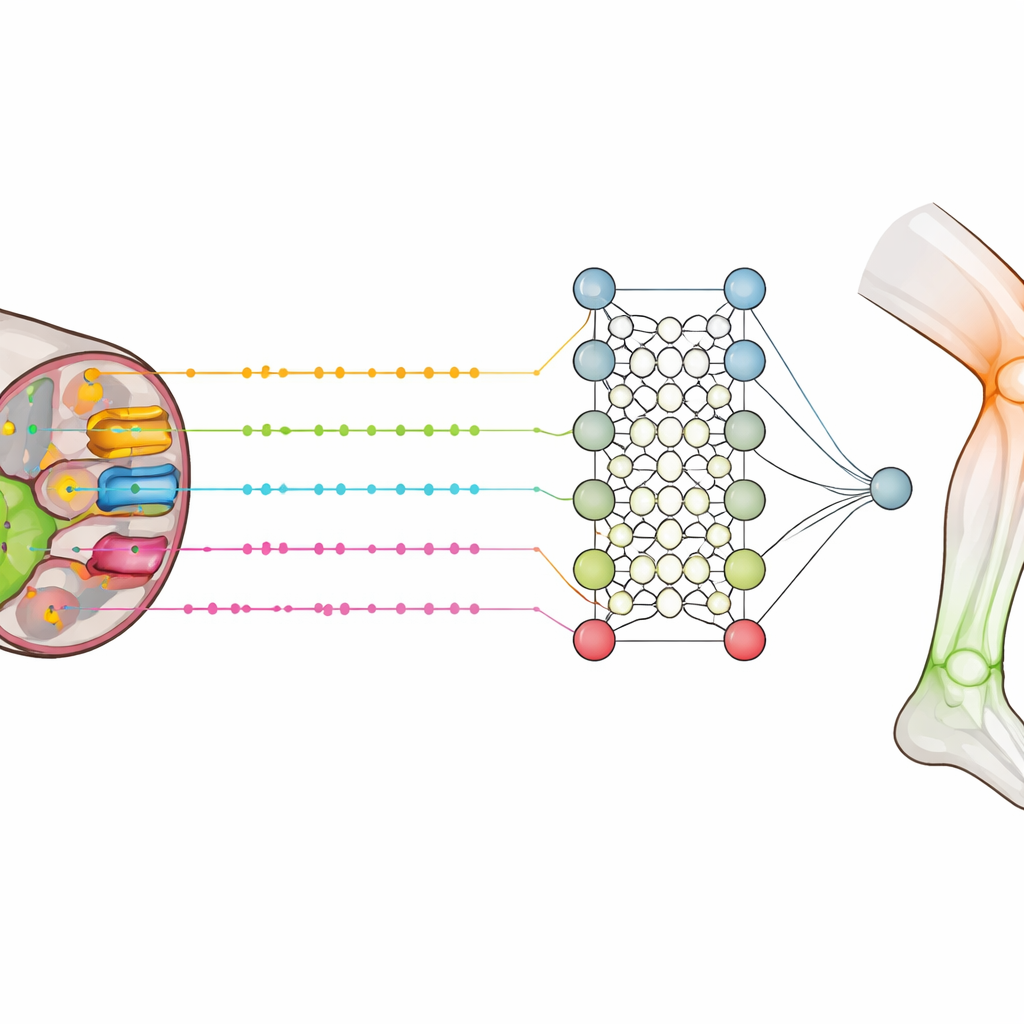
Capturing nerve activity is only half the story; a future prosthesis must quickly convert those complex signals into commands. The scientists turned to a spiking neural network, a type of artificial network that communicates using brief electrical pulses, much like real neurons do. They first transformed the raw nerve recordings into dense trains of spikes that emphasized how the signal’s power changed over time. These spike trains were then fed into a compact decoder that learned to sort them into movement “classes” such as ankle flexion or knee extension. Compared with standard machine-learning tools, the spiking decoder was both more accurate and more efficient, reliably recognizing multiple intended movements from short snippets of nerve activity.
Combining Nerve and Muscle Signals
Because the electrodes sat between thigh muscles, they also picked up small muscle signals in a lower frequency range. By filtering the recordings, the team could separate muscle-like activity from the faster nerve spikes. When they trained their decoder on muscle signals alone, performance improved compared with using only high-frequency nerve data. Best of all, combining both sources — nerve and residual muscle — boosted accuracy even further, especially for knee and ankle actions. This suggests that a single implanted technology could tap into both nerve traffic and leftover muscle activity to give a richer, more stable control signal for a robotic leg.
Feeling the Ground While Moving the Leg
The same intraneural electrodes that listened to outgoing movement commands could also be used in the opposite direction: to send small electrical pulses back into the nerve and evoke sensations. In earlier work with these volunteers, stimulation through these implants produced touch-like feelings on the sole of the foot and toes. In the present study, the researchers mapped where motor-related recordings and touch-related sensations overlapped. They found that nerve fibers for movement and sensation were largely separated at the thigh level, which could help designers assign some contacts mainly to motor decoding and others mainly to sensory feedback, reducing interference between the two.
What This Means for Future Bionic Legs
To a lay reader, the core message is that the “wires” for moving a missing leg are still active and readable, even years after amputation. By placing fine electrodes inside the remaining nerve and using brain-inspired algorithms to interpret the signals, it is possible to tell, moment by moment, whether an amputee is trying to bend the knee, point the ankle, or curl the toes of a phantom limb. When paired with electrical stimulation that restores a sense of touch from the missing foot, this approach could enable prosthetic legs that feel and move much more like a natural limb. Although the work is still at an early, laboratory stage and was tested offline in only two people, it lays important groundwork for future prostheses that connect directly to the nervous system, offering more intuitive control, better balance, and a stronger sense of embodiment.
Citation: Rossi, C., Bumbasirevic, M., Čvančara, P. et al. Decoding phantom limb movements from intraneural recordings. Nat Commun 17, 2511 (2026). https://doi.org/10.1038/s41467-026-69297-0
Keywords: phantom limb, neuroprosthetics, peripheral nerve interface, spiking neural networks, lower-limb amputation