Clear Sky Science · en
In-memory multilevel control of generic SO(m) holonomy in photonics
Light That Remembers
Modern technologies from data centers to quantum computers increasingly rely on manipulating light rather than electrons. But most optical chips are either very precise and fragile, or robust but hard to reprogram. This work shows how to build optical circuits that are both tough against imperfections and rewritable like a memory chip, using a special material that can "remember" its state even when the power is off.
Why Stable Light Paths Matter
Whenever light travels through a complex circuit, tiny fabrication errors or temperature drifts can ruin the delicate interference patterns that carry information. One way around this is to use so‑called geometric paths of evolution: the outcome depends mainly on the overall route the light takes in an abstract space of possibilities, not on exact timing or local details. These paths, known from quantum physics, can implement reliable rotations of information encoded in different light channels. Until now, however, such geometric operations on photonic chips were essentially frozen in place once the chip was made, making them ill‑suited for programmable or trainable optical processors.
A Chip That Can Rewire Its Own Rules
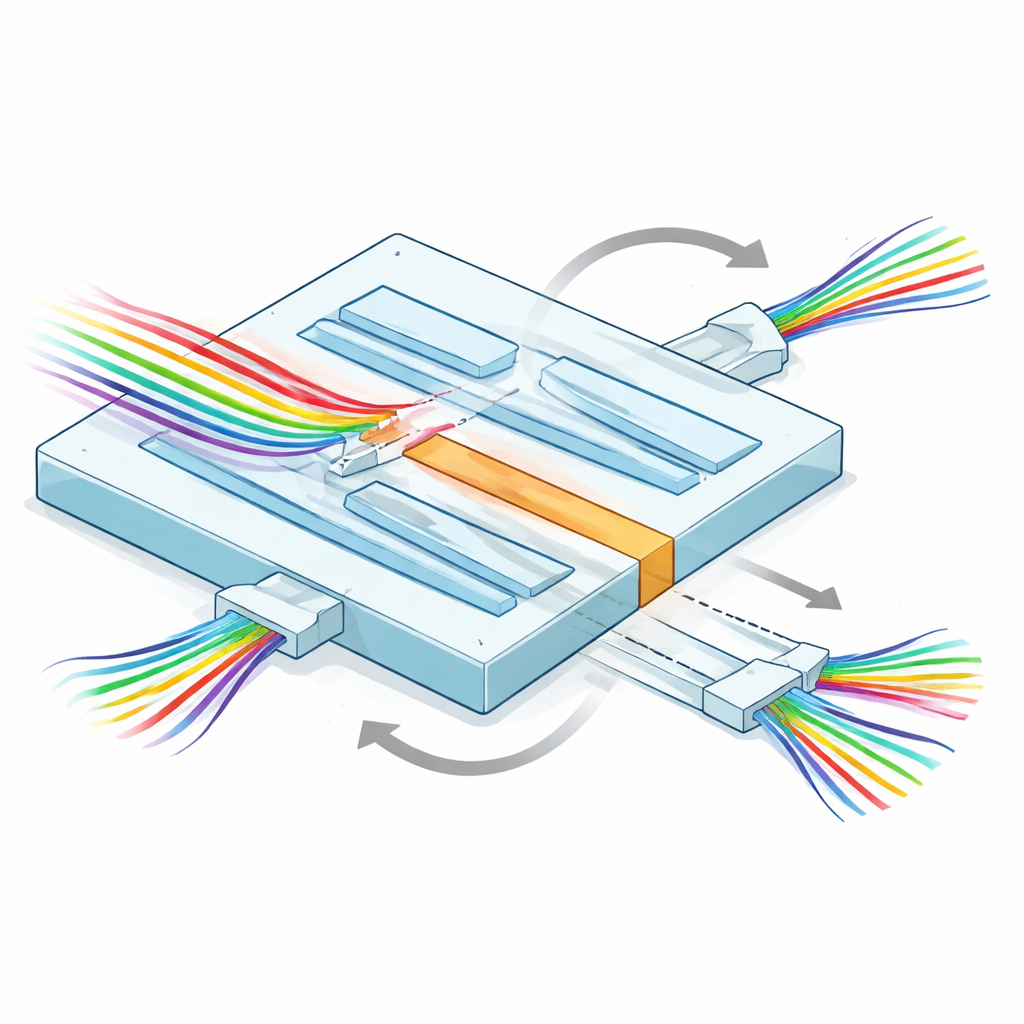
The authors tackle this rigidity by adding a thin layer of a phase‑change material called Sb₂Se₃ on top of a multilayer silicon photonic chip. This material is a kind of optical chameleon: when it is crystalline versus amorphous (more glass‑like), its refractive index changes dramatically. By using focused laser pulses, the team can flip selected Sb₂Se₃ waveguides between these two states, and the new state remains even after the laser is switched off. Because the Sb₂Se₃ guides are embedded directly in the light‑carrying network, changing their phase does not just tweak a single parameter; it actually changes how many light patterns share exactly the same conditions, reshaping the abstract space in which the geometric evolution occurs.
Switching Between Two and Three Ways of Sharing Light
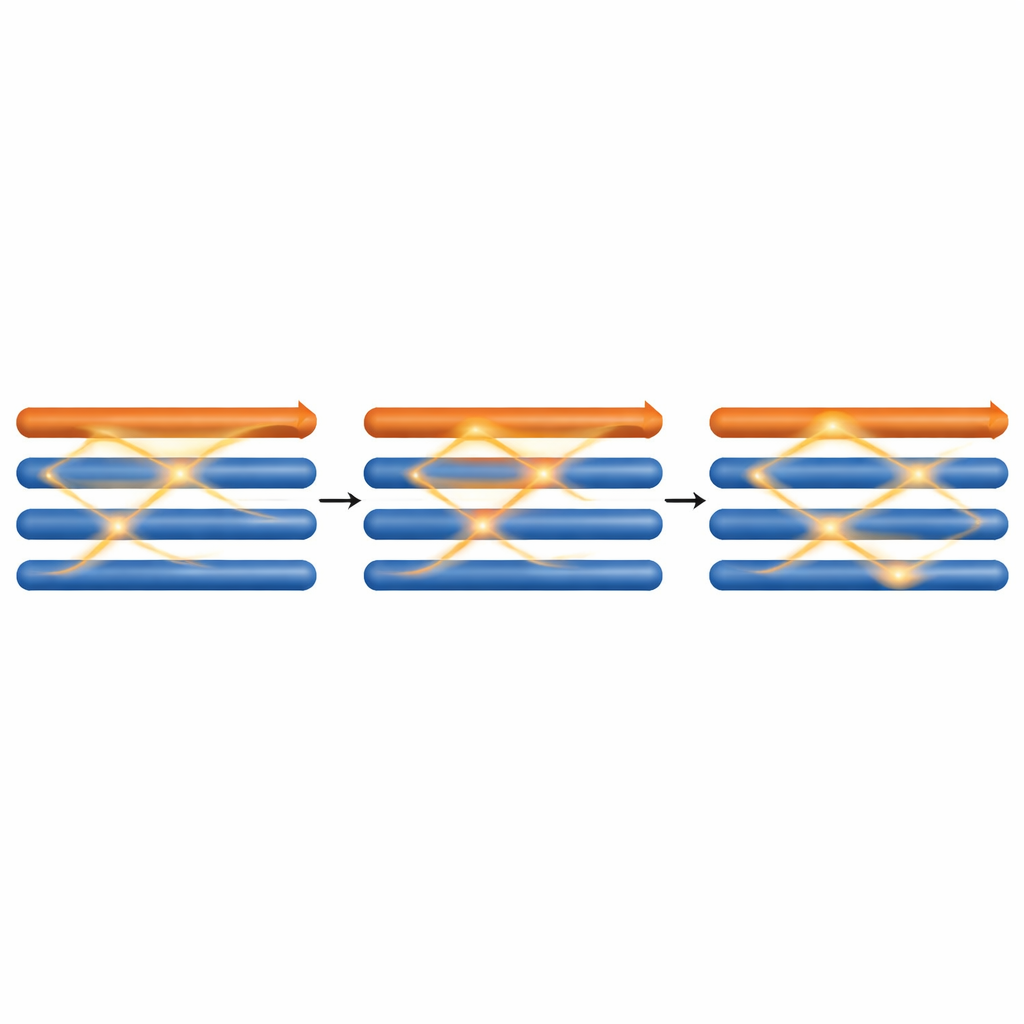
To make this concrete, the researchers engineer a structure of five closely spaced waveguides arranged in three vertical layers. Four are made of silicon and one, on the top layer, is made of Sb₂Se₃. Light is injected into two of the silicon guides. When the Sb₂Se₃ guide is crystalline, its optical properties differ strongly from silicon, so the system effectively supports two main shared light patterns. In this case, the light undergoes a controlled two‑channel geometric rotation while largely ignoring the Sb₂Se₃ path. When the same guide is switched to the amorphous state, its index nearly matches silicon, and a third shared pattern appears. The chip still behaves like a two‑channel rotator at the input and output, but the internal route of the light now winds through a three‑way space, leading to a different geometric phase and therefore a different rotation using the very same physical layout.
Building Multi‑Level Optical Control
Because each such block can behave in at least two distinct geometric ways depending on the stored material state, the authors can chain them together like bits in a digital word. Two cascaded units already yield three distinct rotation levels; three units enable eight different three‑channel transformations, assembled using a mathematical recipe known as Givens rotations. Experiments confirm that these multi‑level operations closely match theoretical expectations, with high fidelity even after repeated cycles of writing and erasing. The same building blocks can be arranged in more elaborate meshes that cause light in several channels to "braid" around one another, enabling programmable optical switching schemes relevant for both classical data routing and topological styles of quantum control.
From Concept to Future Devices
In simple terms, this work introduces an optical chip that can store not just data, but the very rules by which light is processed, and can rewrite those rules using bursts of light. By marrying geometric evolution—which naturally resists many sources of noise—with non‑volatile phase‑change materials, the authors demonstrate a path toward fault‑tolerant, power‑efficient photonic hardware. Such devices could underpin reconfigurable optical neural networks, flexible switching fabrics in data centers, and eventually robust quantum processors that rely on the geometry of light paths rather than fragile, finely tuned phases.
Citation: Chen, Y., Zhang, J., Xiang, J. et al. In-memory multilevel control of generic SO(m) holonomy in photonics. Nat Commun 17, 2480 (2026). https://doi.org/10.1038/s41467-026-69287-2
Keywords: integrated photonics, phase-change materials, geometric phase, optical computing, holonomic quantum control