Clear Sky Science · en
National analysis of cancer mortality and proximity to nuclear power plants in the United States
Why this study matters to everyday life
Nuclear power is often promoted as a clean, climate‑friendly way to keep the lights on, but many people quietly wonder: does living near a nuclear plant affect my chances of getting cancer? This national study from the United States takes a fresh, data‑driven look at that question, using nearly two decades of mortality records to see whether people who live closer to nuclear power plants are more likely to die from cancer than those farther away.
Taking a nation‑wide view
Instead of zooming in on a single plant or town, the researchers examined all U.S. counties located within 200 kilometers (about 125 miles) of at least one operating nuclear power plant between 2000 and 2018. They combined detailed maps of plant locations with county‑level death records from the Centers for Disease Control and Prevention. For each county, they calculated a measure of “proximity” that increases when a county is closer to a plant and when it is surrounded by several plants, not just one. This allowed them to capture long‑term, cumulative living near nuclear facilities rather than a simple “near versus far” cutoff. 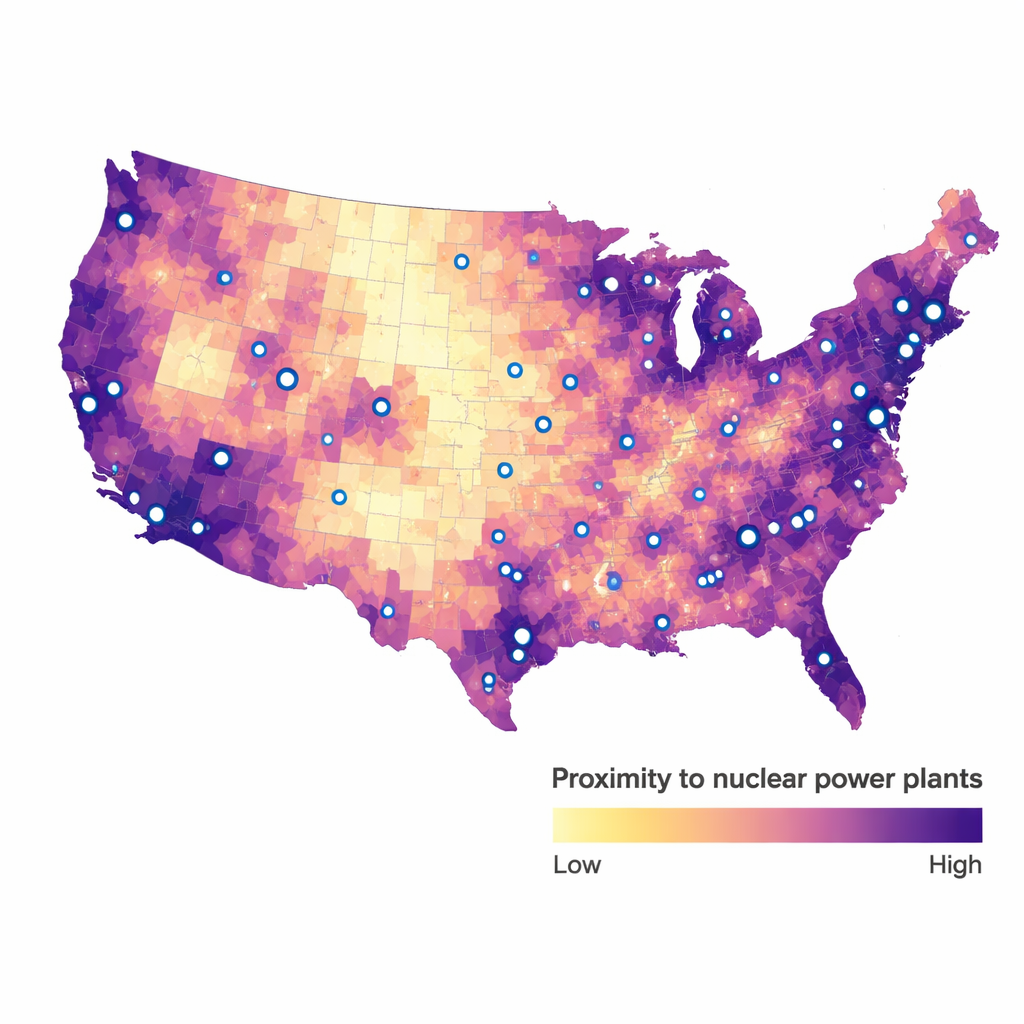
Who lives closest to nuclear plants?
When the team mapped their proximity measure, they found that higher values clustered in parts of the Midwest, Northeast, and Southeast, where many reactors are packed into a relatively small area. Counties in the western United States and the Great Plains generally had much lower proximity, simply because there are fewer plants. Another analysis translated this proximity score into an “equivalent distance” from a single plant and showed how many people live at each level of closeness. Tens of millions of Americans, the study reports, live at distances where combined exposure from one or more plants is not trivial. 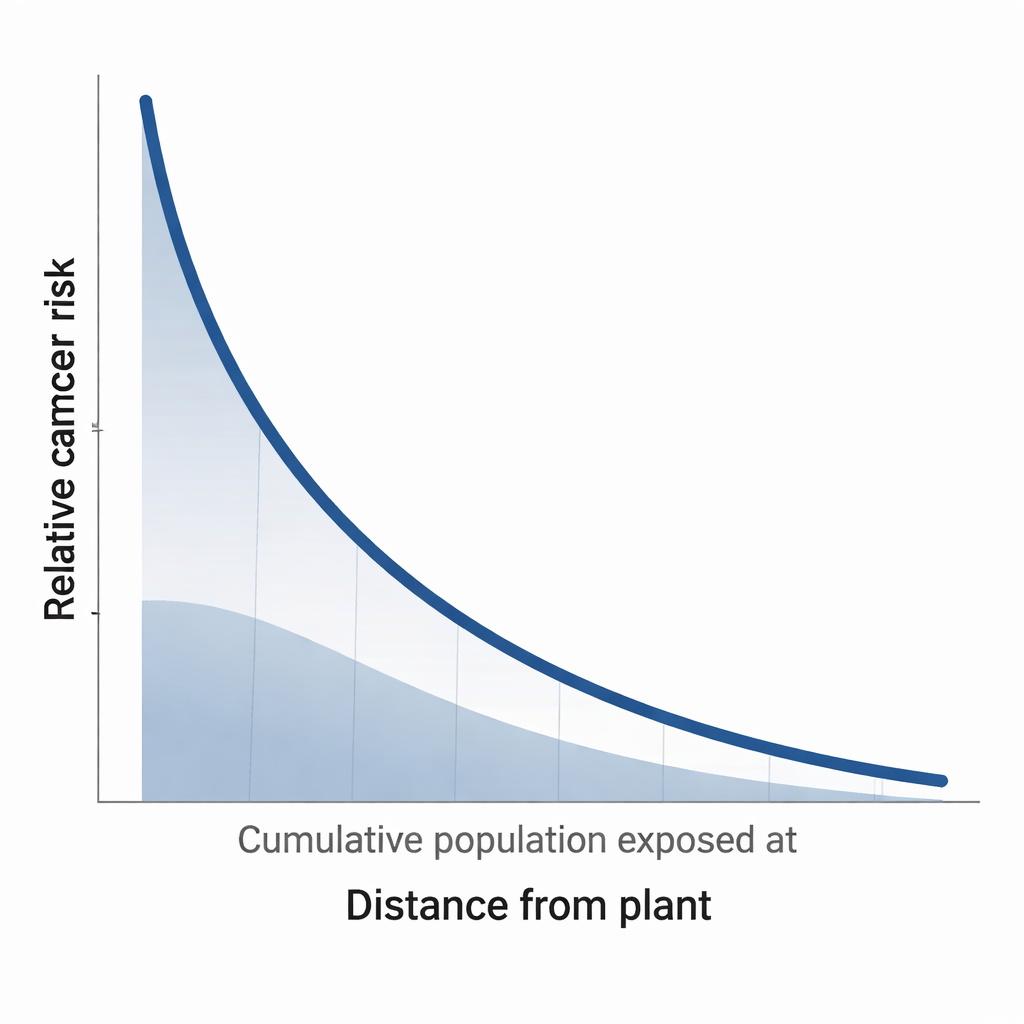
Linking proximity to cancer deaths
To test whether this geographic pattern mattered for health, the authors compared cancer death rates across counties with different levels of proximity, while accounting for many other factors that influence cancer risk. These included income, education, smoking rates, body weight, racial makeup, access to doctors and hospitals, and even local temperature and humidity. Using a statistical approach suited to tracking rates over time, they asked a simple question: holding these other influences constant, do counties closer to nuclear plants have higher cancer mortality?
What the numbers show
The answer, in this national snapshot, was yes. Across multiple age groups and for both men and women, counties with higher proximity to nuclear plants tended to have higher cancer death rates. The strongest associations appeared among older adults: women aged 55–64 and 65–74, and men aged 65–74 and 75–84. In these groups, the relative risk of dying from cancer was roughly 15–20 percent higher in the closest counties than in the farthest ones. When the researchers translated these differences into estimated numbers of deaths, they found that, between 2000 and 2018, more than 115,000 cancer deaths could be statistically linked to living nearer to nuclear plants, with about 4,000 excess deaths per year among people 65 and older.
How solid are these findings?
The team tested whether their results depended on arbitrary choices, such as how far out from a plant to count or how many years of past operation to include. They repeated the analysis using different distance limits and different averaging windows (from 2 to 20 years), and the association between proximity and cancer mortality remained. Still, the authors emphasize important caveats. Their exposure measure is based on distance, not on actual radiation measurements, and they grouped all cancer types together even though some are more sensitive to radiation than others. The study also works at the county level and cannot see who moved in or out, or how any individual person was exposed. For these reasons, the analysis can show patterns but cannot prove that nuclear plants directly caused the excess cancers.
What this means for public health
To put the findings in context, the researchers compared their estimates with a recent national study on deaths linked to coal‑fired power plants. While coal is associated with a larger overall toll, the cancer mortality potentially tied to nuclear plant proximity amounted to about one‑fifth of the coal‑related deaths reported in that study. This suggests that the health risks from nuclear power, though often overshadowed by dramatic accidents, may also arise quietly over long periods in nearby communities.
A cautious takeaway for the public
For a layperson, the bottom line is that this work points to a meaningful association between living closer to nuclear power plants and higher cancer death rates in U.S. counties, especially for older adults. It does not show that nuclear plants are definitively causing these cancers, but it does raise a red flag strong enough to warrant more detailed research, including direct measurements of radiation, tracking of specific cancer types, and studies that follow individuals over time. As societies revisit nuclear power as a low‑carbon energy source, the study argues that any future planning should weigh not only climate benefits and accident risks but also these potential long‑term health impacts on neighboring communities.
Citation: Alwadi, Y., Alahmad, B., Vieira, C.L.Z. et al. National analysis of cancer mortality and proximity to nuclear power plants in the United States. Nat Commun 17, 1560 (2026). https://doi.org/10.1038/s41467-026-69285-4
Keywords: nuclear power plants, cancer mortality, environmental health, radiation exposure, public health risk