Clear Sky Science · en
Bright electron bunches from a plasma-wakefield accelerator with a steep density down-ramp
Making Powerful Particle Beams More Compact
Particle accelerators underpin discoveries in particle physics and power the brightest X‑ray sources used to image matter at the atomic scale. But today’s machines can stretch for kilometres and cost billions. This research explores a different way to accelerate electrons, using plasmas—clouds of charged gas—that can pack much stronger electric fields into a much shorter distance. The study shows how to produce especially “bright” electron bunches in such a plasma accelerator, a key step toward smaller, more affordable machines for science, medicine and industry.
Why Smaller, Brighter Beams Matter
In many experiments, the quality of an electron beam matters as much as its energy. A bright beam is one that combines high current, small size and a very narrow spread in direction and energy. These traits let scientists focus electrons tightly and generate intense, laser‑like X‑ray pulses in free‑electron lasers. Conventional radio‑frequency accelerators struggle to maintain this quality at the start of the beam’s journey because the electrons push on each other electrically, smearing out the bunch. Once the electrons reach very high speeds, these disruptive forces weaken, but by then some damage is already done. A plasma accelerator promises to create and accelerate high‑quality bunches directly inside the plasma, over just centimetres rather than hundreds of metres.
Riding a Wave in a Charged Gas
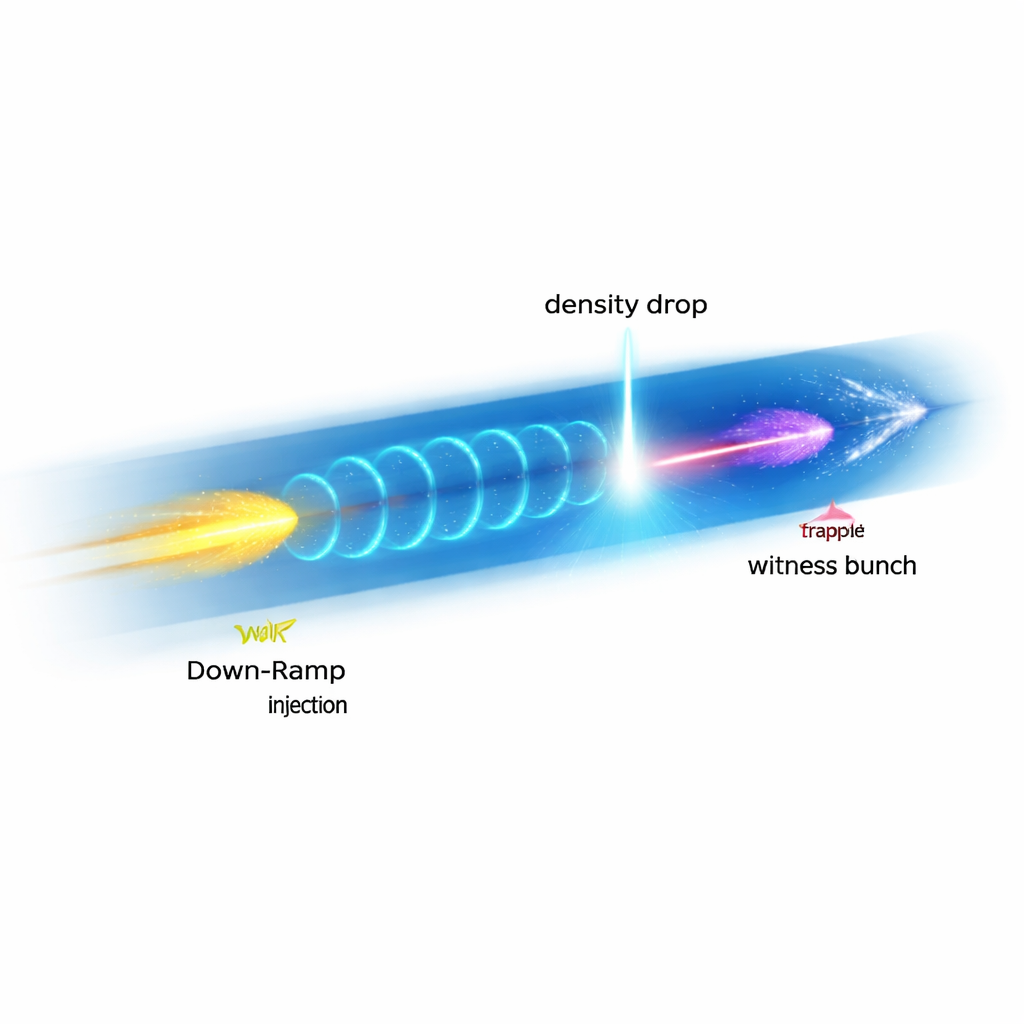
In a plasma wakefield accelerator, a very fast, dense bunch of electrons ploughs through a plasma and pushes plasma electrons aside, leaving behind a trailing pattern of charge—like the wake of a boat on water. This wake carries electric fields strong enough to boost other electrons to high energies over very short distances. The challenge is to inject new electrons into just the right part of this moving wave so that they are captured cleanly and accelerated without being jostled sideways. The technique used here, called density down‑ramp injection, relies on shaping the plasma itself along the beam’s path so that the wake slows down slightly and allows background electrons to slip into a stable, accelerating region of the wave.
Shaping the Plasma to Catch Electrons
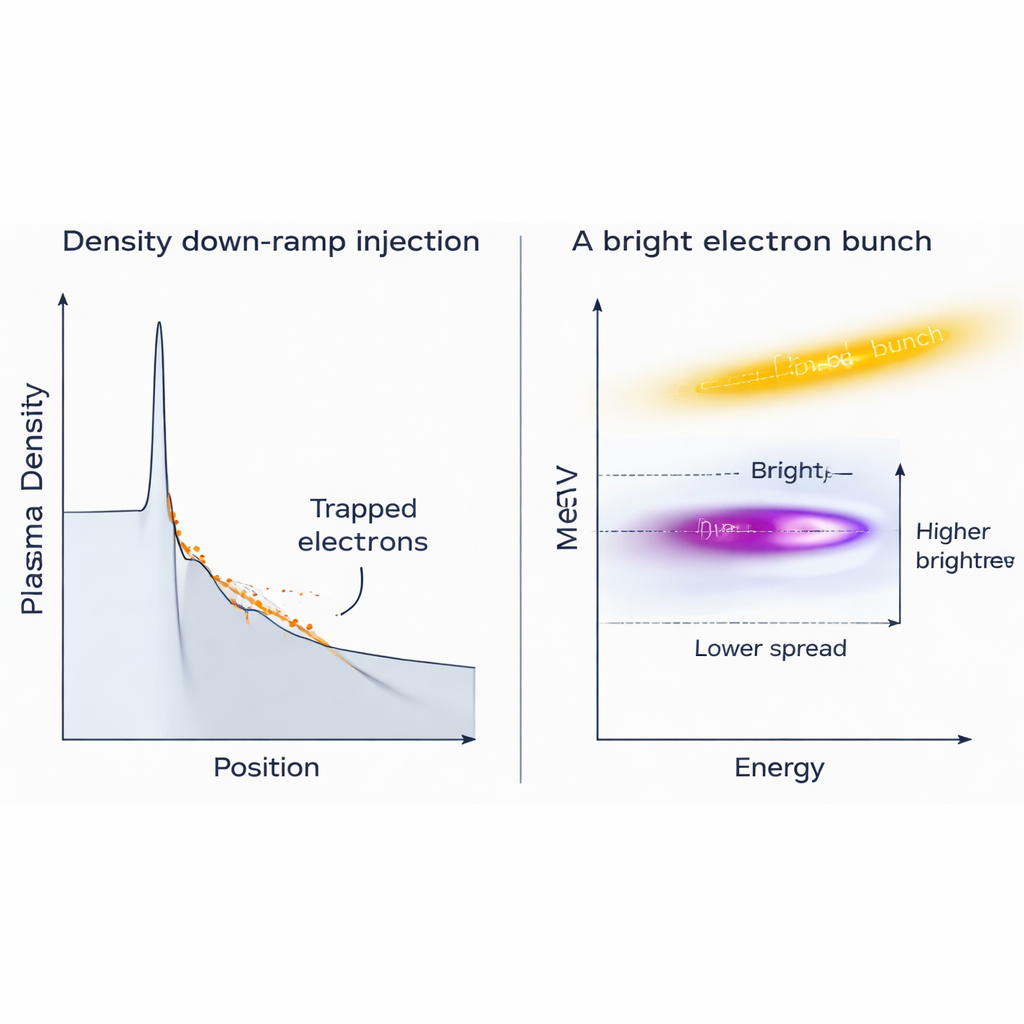
The team conducted their experiments at the FLASHForward facility in Hamburg. They filled a narrow gas‑filled tube with mostly argon and used one laser beam along the tube to create the bulk of the plasma. A second, tightly focused laser beam fired from the side carved a sharp spike in plasma density followed by a steep drop—the “down‑ramp.” As the drive bunch from a conventional accelerator passed through this tailored region, the changing density altered the wake so that some plasma electrons were trapped and formed a new, compact bunch. The researchers carefully tuned the focusing of the drive bunch, the timing and position of the lasers, and the bunch length to maximize the trapped charge while keeping the bunch very small and well behaved.
Measuring Stability and Beam Quality
Using specialised magnetic spectrometers and imaging screens, the team recorded the energy, spread and apparent size of the injected electron bunches over 1000 consecutive shots. They consistently produced electrons at around 30 million electron volts with an energy spread of only about 1.3 percent—remarkably narrow for a plasma‑based source—and with high charge concentrated in that narrow band. From these measurements they inferred that the electrons emerged with a small “emittance,” a measure of how parallel and tightly packed the beam is, comparable to the best conventional injectors. Computer simulations that mimicked the experiment in three dimensions suggested that, under ideal conditions, the beam quality could be even better than the conservative measurements imply.
Path Toward Tabletop X‑Ray Sources
To a lay reader, the key message is that the researchers have found a practical way to make very clean, bright packets of electrons inside a plasma, using smart control of the gas density rather than more brute‑force hardware. Their steep density down‑ramp acts like a finely tuned on‑ramp onto a highway of electric fields, capturing electrons smoothly and sending them off at high speed with minimal wobble. The study also outlines how the same idea could be scaled up to much higher energies while preserving beam quality, pointing the way toward future compact accelerators and next‑generation X‑ray light sources that fit in a laboratory rather than a tunnel.
Citation: Wood, J.C., Boulton, L., Beinortaitė, J. et al. Bright electron bunches from a plasma-wakefield accelerator with a steep density down-ramp. Nat Commun 17, 1588 (2026). https://doi.org/10.1038/s41467-026-69283-6
Keywords: plasma wakefield acceleration, electron beam brightness, density down-ramp injection, compact accelerators, free-electron lasers