Clear Sky Science · en
Global application of radiative cooling in grain storage
Why Cooler Grain Matters for Everyone
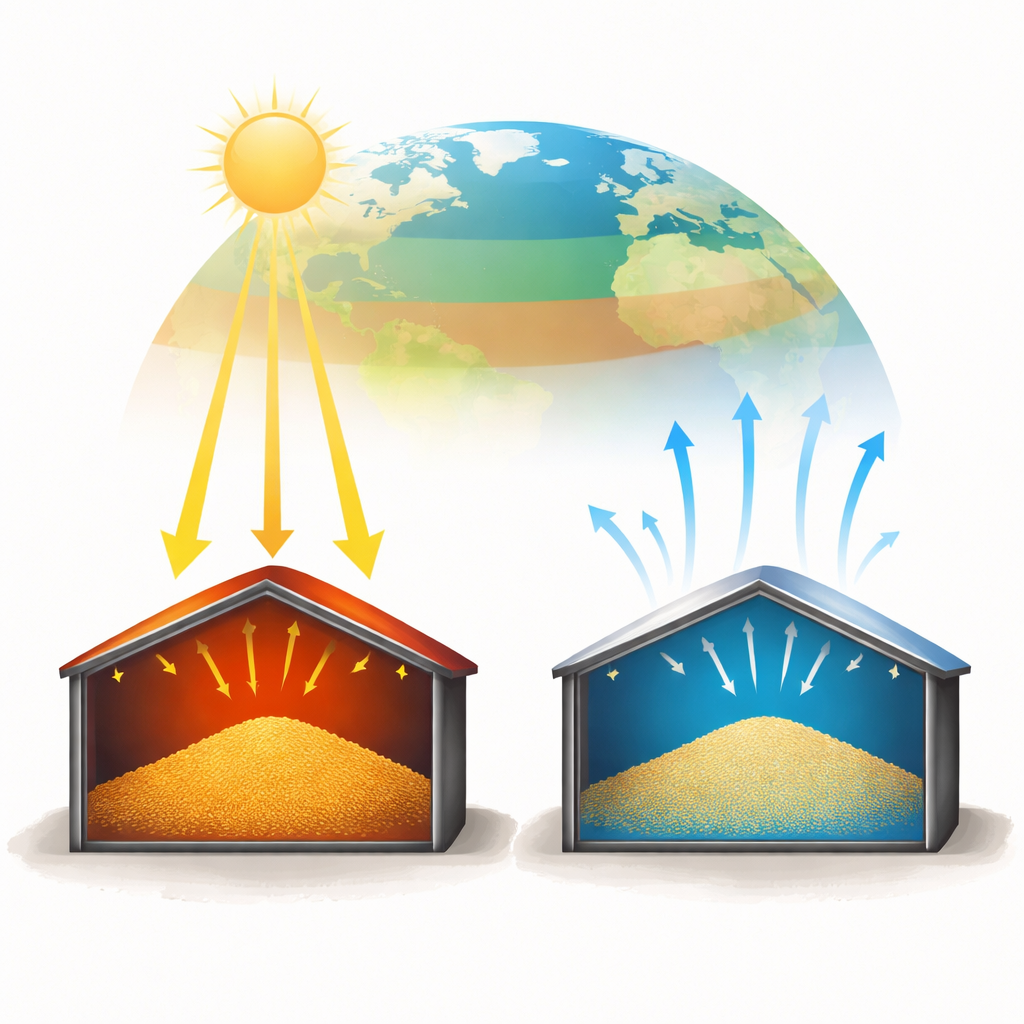
Every year, roughly a third of the world’s food is lost or wasted, and a large share of that disappears quietly in storage. When grain sits for months in hot warehouses or metal silos, it spoils faster, harbors insects and molds, and ultimately never reaches people who need it. This study explores a surprisingly simple idea with global reach: using a special mirror‑like roof film that cools warehouses by radiating heat into space, protecting stored grain while using little or no extra energy.
A Growing Food Supply Still Leaves Many Hungry
Over the past two decades, global harvests of major crops have risen from about 6.2 to 9.6 billion tons, and the value of agriculture has nearly doubled. Yet hundreds of millions of people remain undernourished, especially in Africa and parts of Asia. One major reason is that food must travel and sit in storage for long periods—from village depots to ports, ships, and city warehouses. Along the way, heat and humidity can turn grain into a breeding ground for insects, mites, and molds that not only eat the food but also produce dangerous toxins. Keeping grain cool is one of the most powerful ways to slow this damage, but conventional refrigeration is expensive, power‑hungry, and often out of reach for low‑ and middle‑income countries.
A Roof that Sends Heat Back into Space
The researchers focused on “radiative cooling,” a passive technology that works without electricity. The idea is to cover a roof with a thin, bright film that strongly reflects sunlight while efficiently radiating heat away through a transparent band in Earth’s atmosphere into the cold of outer space. In this study, they used a commercial film with very low solar absorption and very high infrared emission. They first tested it on a full‑scale granary in Chongqing, China, then built a detailed computer model of that building. Using climate data, they simulated how similar coated warehouses would perform in 18 key grain‑related cities across 13 countries, spanning ten distinct climate types from tropical rainforest to temperate prairie and high mountain plateaus.
Cooler Roofs, Cooler Air, Safer Grain
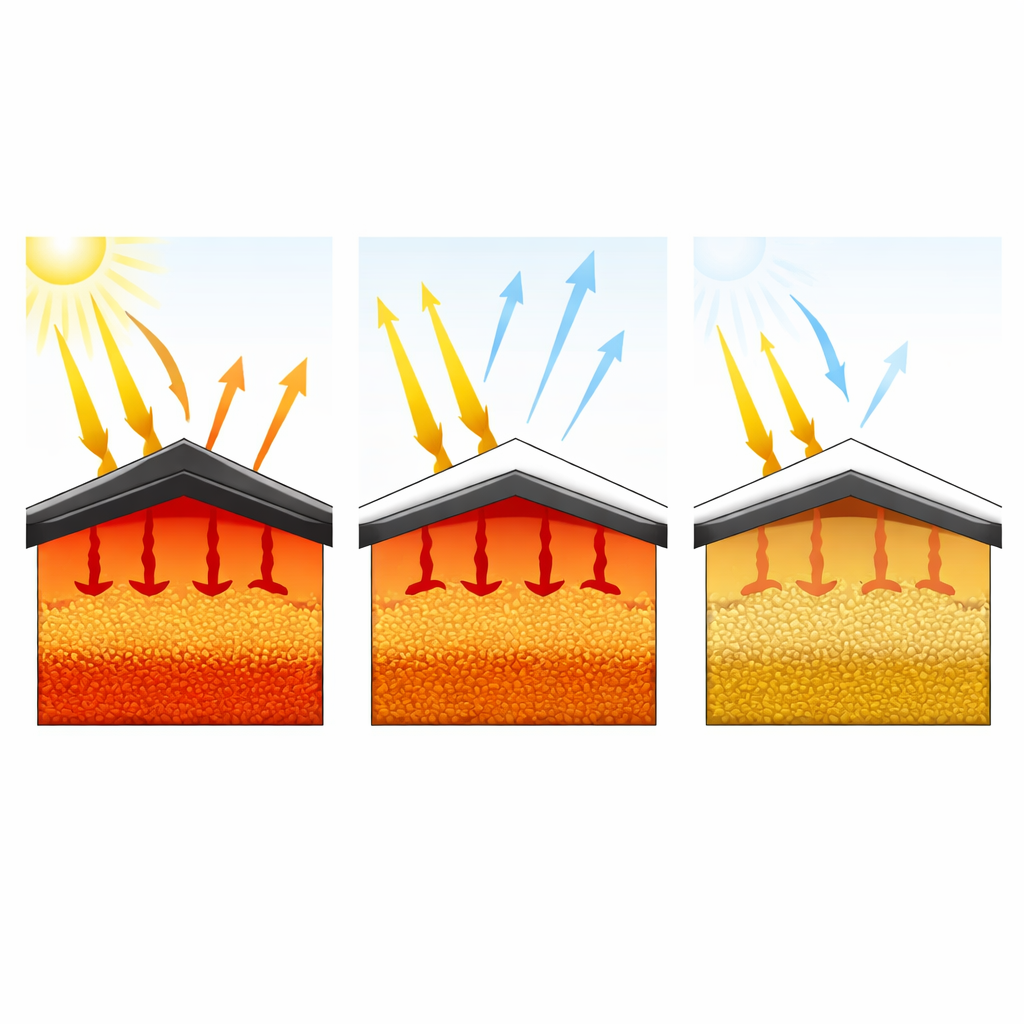
Across all these climates, the radiative cooling film sharply lowered temperatures at three levels: the roof surface, the indoor air, and the grain itself. Under passive conditions—without any air conditioning—the coated roofs ran 18–35 °C cooler than conventional dark roofs. Indoor air temperatures fell by about 4–8 °C, and the top of the grain mass by roughly 3–7 °C. That seemingly modest drop in grain temperature had an outsized impact on how long grain could be stored safely. In hot tropical cities, average grain temperatures fell from near 30 °C into the low 20s, nearly doubling storage lifetimes and adding up to four extra months before quality limits were reached. In cooler or high‑altitude regions, the film still extended safe storage by weeks, which is often enough to bridge seasonal gaps in supply.
Meeting Stricter Safety Standards with Less Energy
Grain managers often aim for official “quasi‑low‑temperature” or “low‑temperature” storage targets, which limit how often grain can exceed 25 °C or 20 °C. The team translated these standards into two simple measures: how many hours per year grain is too warm, and by how many degrees it overshoots the target. In uncooled warehouses, many tropical and subtropical sites spent most of the year above these limits. Adding the radiative film alone was enough to meet the milder standard in all cooler climates and drastically shrink overheating in even the hottest cities. When modest air‑conditioning was added—set at 20 °C or 16 °C—the coated roofs cut annual cooling energy use by about 6–24 kWh per square meter and reduced peak cooling demand by up to 14 kW. That means smaller, cheaper equipment can be installed and run, and in several temperate cities no air conditioning was needed at all to meet the quasi‑low‑temperature goal.
Costs, Carbon, and the Promise for Low‑Income Regions
Beyond comfort and food safety, the study examined money and emissions. Because the film is thin, durable, and easy to install on existing roofs, its upfront cost can be repaid through electricity savings in less than ten years—the expected service life of the material—in all 18 cities studied. In stricter low‑temperature operation, the payback is often just a few years. At the same time, the reduced need for mechanical cooling cuts annual carbon emissions by up to tens of thousands of kilograms of CO2 equivalent per site. These benefits are especially compelling for countries like Ghana, Egypt, and Ethiopia, where electricity is expensive or unreliable and food insecurity is widespread. There, passive roof cooling can support safer grain storage even when power is scarce.
What This Means for the World’s Food
This work shows that simply changing the “skin” of a granary can transform how well it protects food. By reflecting sunlight and quietly radiating heat into the night sky, radiative‑cooling roofs keep grain cooler, slow pests and mold, and reduce the need for energy‑intensive refrigeration. Across climates—from steamy ports to dry deserts and cool plains—the approach makes it easier and cheaper to meet modern storage standards. For a world where more food is grown than ever but hunger persists, such low‑tech, globally applicable cooling offers a practical way to save more of what we already produce.
Citation: Chen, Xn., Li, K., Wang, Wh. et al. Global application of radiative cooling in grain storage. Nat Commun 17, 2574 (2026). https://doi.org/10.1038/s41467-026-69280-9
Keywords: grain storage, radiative cooling, food security, energy efficient cooling, postharvest losses