Clear Sky Science · en
Superior energy storage performance via engineering crossover region with competing orders in high-entropy multilayer capacitors
Why Tiny Power Bricks Matter
Every smartphone, electric car, and fast-charging gadget relies on components that can store and release bursts of electrical energy in a split second. One of the workhorses here is the multilayer ceramic capacitor, a tiny brick that quietly manages power inside our electronics. This study shows a new way to design these bricks so they can pack more energy, waste less as heat, and stay stable under tough conditions—all while avoiding toxic lead. The researchers do this by deliberately building “disorder” into the material at the atomic level and tuning it to a sweet spot where competing internal behaviors balance each other out.
Building Better Capacitors for Modern Electronics
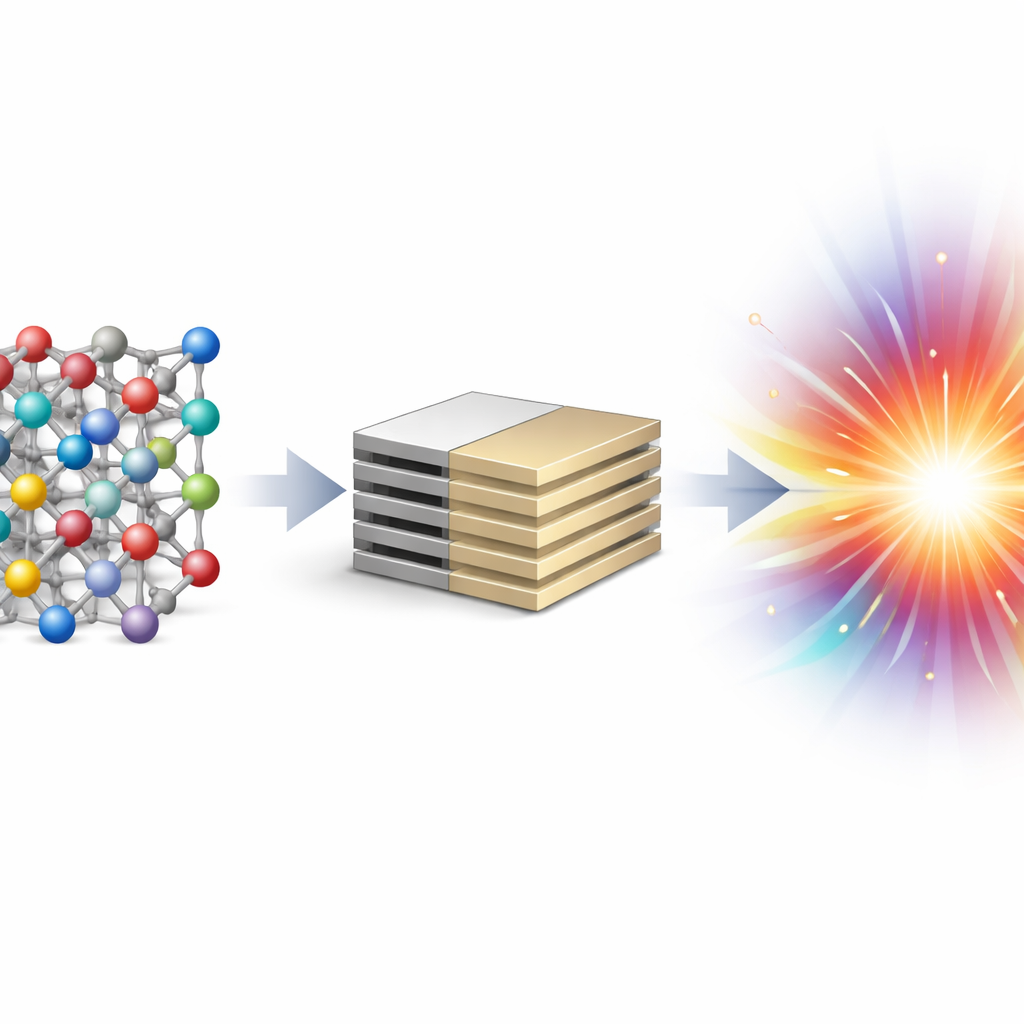
Modern electronics demand components that can both store a lot of energy and release it very quickly, with minimal loss. Traditional ceramic capacitors often face a trade-off: pushing energy density higher usually hurts efficiency, or vice versa. The team focuses on a popular lead-free ceramic family based on bismuth sodium titanate, used in multilayer ceramic capacitors. Instead of relying on a single, orderly crystal structure, they mix in several different oxide ingredients with distinct structural tendencies. This creates a so-called high-entropy material—one with many different atoms randomly sharing the same crystal sites, leading to a rich variety of local environments. The goal is to fine-tune this complexity so that the material sits between two behaviors: a “relaxor” state with very agile tiny polar regions, and a “superparaelectric” state where polarization is almost fully washed out.
Turning Atomic Chaos into Useful Order
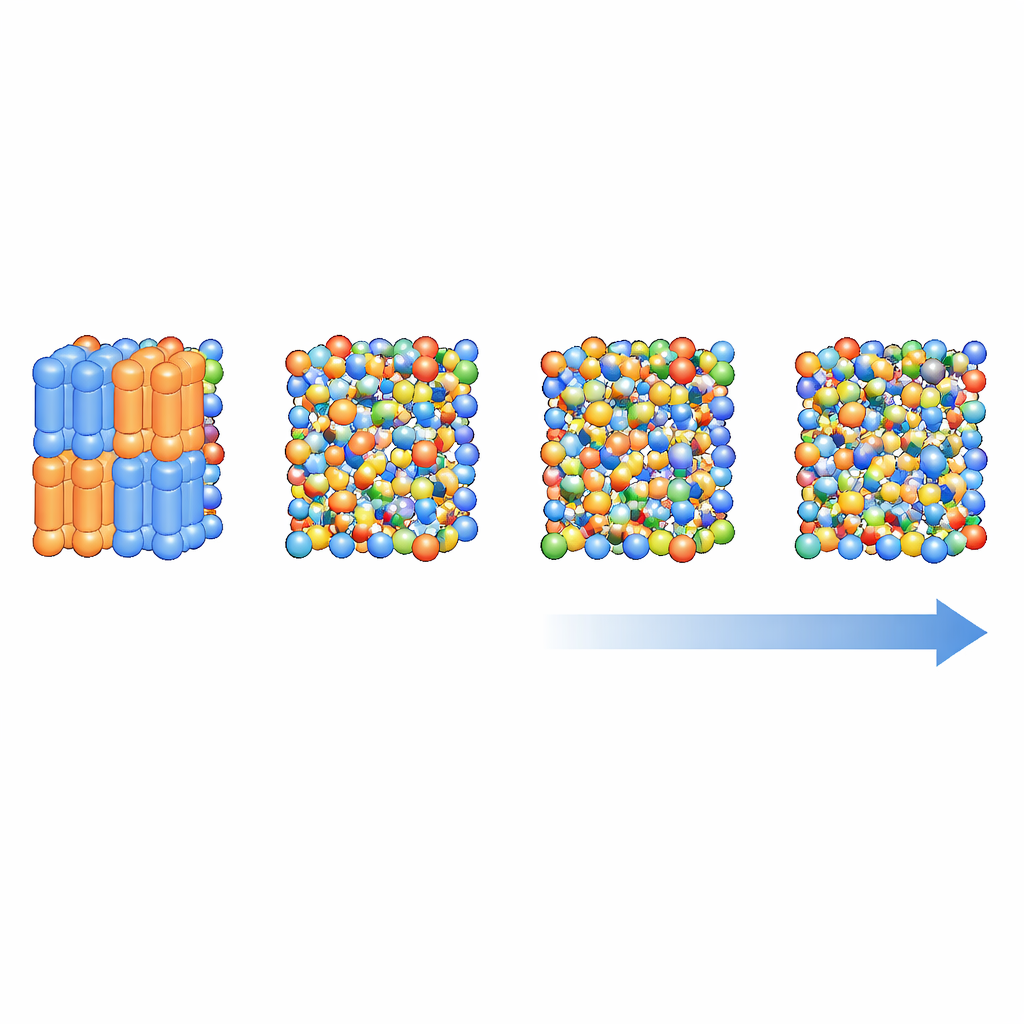
Using computer simulations, the researchers first explored how adding more kinds of oxides changes the internal electric patterns in the ceramic. At low complexity, the material behaves like a classic ferroelectric: large, stable regions all point in similar directions, which leads to energy loss when they are switched back and forth. As the chemical mix becomes more varied, these large regions break up into many tiny polar patches pointing in different directions. This disordered state, rich in nanoscale polar “islands,” lowers the energy barrier for switching and keeps the material from locking into a strongly polarized state when the electric field is removed. The simulations show that there is an optimal level of disorder: too little and the material wastes energy; too much and it stops developing strong polarization at all. At the right point, both stored energy and efficiency peak, and the response stays stable over a broad temperature range.
Seeing the Nanoscale Tug-of-War
To confirm what the simulations predicted, the team made a series of ceramics with gradually increasing complexity and examined their atomic structure using advanced electron microscopy. In the simplest composition, atoms shifted in a fairly uniform way, forming large polar regions. In the more complex, high-entropy version, the shifts were smaller on average but varied strongly from place to place, revealing a patchwork of strongly polar pockets embedded in a weaker background. Measurements of the local electric fields showed three kinds of regions coexisting: well-defined polar areas, fuzzy clusters of tiny polar patches, and nearly non-polar zones. The oxygen cages that surround key metal atoms also rotated in a scattered, non-cooperative way, further breaking long-range order. Together, these structural quirks create a landscape where electric dipoles can reorient easily under an applied field and then relax back with little resistance, which is ideal for efficient energy storage.
From Powder to Practical Devices
The researchers then translated this optimized composition into real multilayer ceramic capacitors, similar in shape and size to commercial parts. These devices, built from several thin ceramic and metal layers stacked together, achieved a recoverable energy density of about 20.6 joules per cubic centimeter while maintaining an efficiency of roughly 94 percent—meaning very little input energy is lost as heat. The capacitors withstood very high electric fields, showed only minor changes in performance from room temperature up to 140 °C, and survived over ten million rapid charge–discharge cycles with almost no degradation. They could also release most of their stored energy in less than a microsecond, with high power density and current output, demonstrating their suitability for demanding pulse-power applications.
What This Means for Future Power Electronics
In simple terms, this work shows that carefully managed atomic “messiness” can be an asset rather than a problem. By engineering a controlled crossover region where different internal electrical orders compete but do not dominate, the authors create lead-free capacitors that store more energy, waste less, and remain robust under heat and repeated use. This strategy is not limited to one material: the same principles of high-entropy design and competing orders could guide the development of a new generation of compact, efficient capacitors and related devices, helping future electronics become smaller, faster, and greener.
Citation: Deng, T., Xie, J., Liu, Z. et al. Superior energy storage performance via engineering crossover region with competing orders in high-entropy multilayer capacitors. Nat Commun 17, 2638 (2026). https://doi.org/10.1038/s41467-026-69279-2
Keywords: high-entropy ceramics, multilayer ceramic capacitors, energy storage, relaxor ferroelectrics, lead-free dielectrics