Clear Sky Science · en
Ultralong octupole moment switching driven by twin topological spin structures
Why this tiny twist of magnetism matters
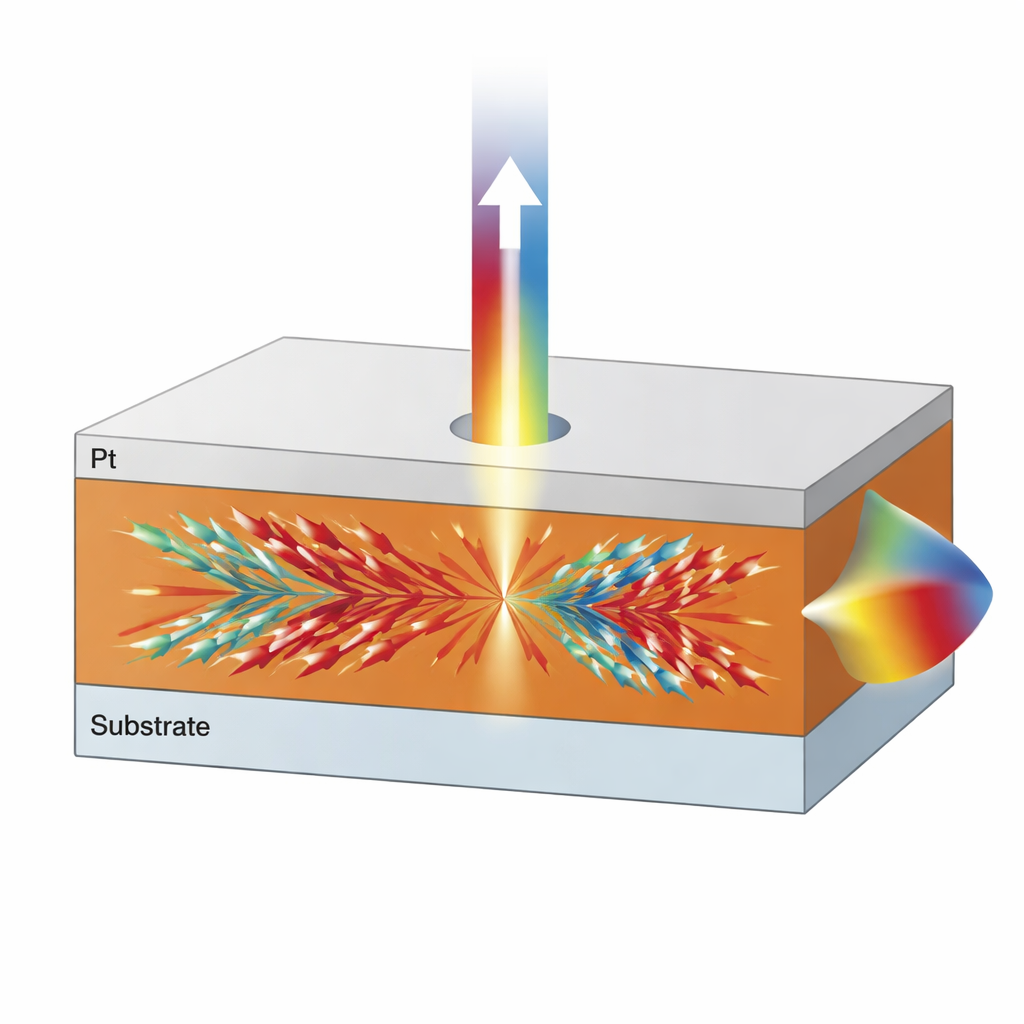
Modern electronics are hitting limits in speed and energy use, pushing researchers to look beyond ordinary electric charges and into the world of electron spins. This study shows how a special magnetic material can carry and flip spin information over distances far longer than previously thought possible, hinting at future memory chips that are faster, cooler, and more compact than today’s technologies.
A new way to store and move information
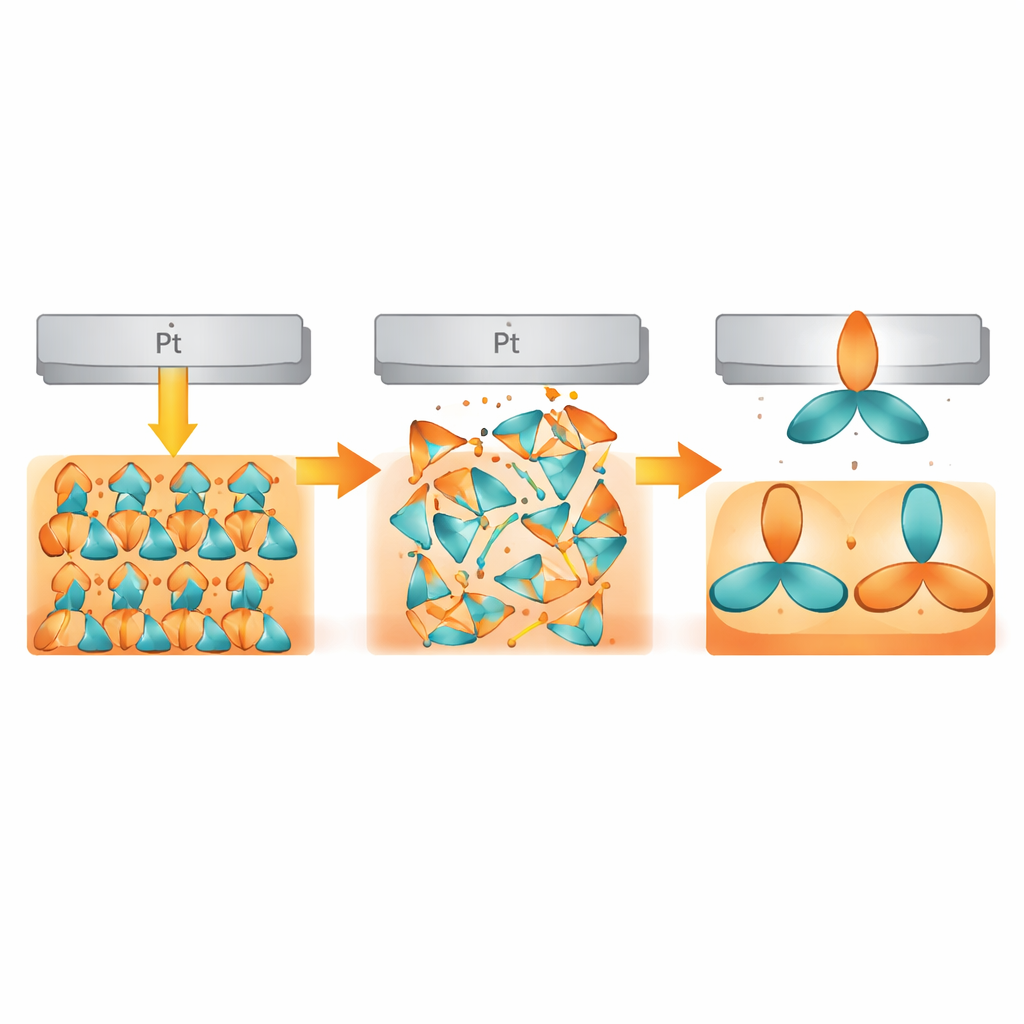
Instead of using the familiar bar-magnet behavior of ferromagnets, the authors focus on an antiferromagnet called Mn3Sn. In this material, tiny magnetic moments on atoms arrange in a triangular pattern, so that no simple “north–south” magnet remains. Instead, the key quantity is a more complex, three-lobed pattern called an octupole moment, which still influences how electric currents flow. Antiferromagnets like Mn3Sn are attractive for future memory because their internal magnetism reacts extremely quickly and produces almost no stray fields that might disturb neighboring bits.
Building a special magnetic sandwich
The team grew high-quality thin films of Mn3Sn on sapphire substrates and capped them with a thin layer of platinum. Careful structural measurements showed that the Mn atoms form a highly ordered “Kagome” network of corner-sharing triangles, all oriented so their spins tilt slightly out of the film plane. This tilt, or canting, gives Mn3Sn a small built-in magnetic component and a robust octupole moment. At the interface with the substrate, strain and atomic arrangements generate “twin” spin structures—mirror-related versions of the triangular pattern—that play a central role in how spin information travels through the film.
Pushing spin currents deep into the film
When an electric current is sent through the platinum overlayer, it converts part of that flow into a spin current that injects spins perpendicularly into the Mn3Sn below. By monitoring the anomalous Hall effect, which is sensitive to the orientation of the octupole moment, the researchers could see when the internal magnetic pattern had flipped. They found that this spin torque switching works even when the Mn3Sn layer is as thick as 60 nanometers—about six times thicker than typical ferromagnetic devices. Moreover, the efficiency of switching doesn’t just weaken with thickness: it rises as the film grows thicker, peaks around 40 nanometers, and only then begins to fall.
How twin spin patterns extend the reach
To understand this unusual thickness dependence, the team combined spin-diffusion theory with large-scale computer simulations of the atomic spins. In a simple ferromagnet, differences between majority and minority spins cause injected spins to lose their coherence after traveling only a few atomic layers. In Mn3Sn, the non-collinear triangular arrangement and slight canting create nearly balanced spin populations, so the spin coherence length becomes much longer. The simulations show that the twin spin structures at the interface subtly reduce how quickly transverse spins decay, effectively stretching the distance over which the spin torque remains strong. This explains why the switching becomes most efficient at an intermediate thickness before gradually fading deeper in the film.
What this means for future devices
By proving that spin currents can flip complex magnetic patterns over tens of nanometers in Mn3Sn, this work challenges the view that spin–orbit torque is mainly a surface effect confined to ultra-thin layers. Instead, it reveals that carefully engineered antiferromagnets can act as bulk spin conduits, carrying and transforming spin information deep into a device. For a layperson, the takeaway is that cleverly arranged spins in materials like Mn3Sn could enable memory and logic circuits that are both extremely compact and remarkably energy-efficient, moving us closer to a new generation of spin-based electronics.
Citation: Xu, S., Zhang, Z., Dai, B. et al. Ultralong octupole moment switching driven by twin topological spin structures. Nat Commun 17, 2503 (2026). https://doi.org/10.1038/s41467-026-69275-6
Keywords: antiferromagnetic spintronics, spin orbit torque, Mn3Sn, spin transport, magnetic memory