Clear Sky Science · en
Phase engineering of relaxor ferroelectricity in van der Waals crystal
Why tiny crystals could change future electronics
Today’s smartphones and computers rely on materials that can flip tiny internal electric switches to store and process information. But as devices shrink, many of these “ferroelectric” materials stop working well when made extremely thin. This study shows a way around that problem by carefully reshaping the internal structure of a layered crystal so that it behaves like a special kind of soft, tunable ferroelectric—called a relaxor—even at very small sizes. The work points toward new, energy‑efficient memory and brain‑like computing elements built from ultrathin crystals.
Tuning a crystal like a mixing board
The researchers focus on a family of two‑dimensional crystals known as van der Waals materials, which naturally form stackable atomic sheets. Their material, CuInP2(S1−xSex)6, lets them gradually swap sulfur atoms for slightly larger selenium atoms without breaking the overall structure. By changing how much selenium they add, they can dial the crystal through different internal arrangements, or “phases.” At low selenium levels, the material sits in a single ordered phase with strong, well‑aligned electric dipoles—classic ferroelectric behavior. At just the right mix, however, two phases (monoclinic and trigonal) coexist, and the electric order becomes patchy and locally disordered, a hallmark of relaxor ferroelectrics. Pushing the selenium content further makes the material behave more like a weakly polar or non‑polar insulator, called a superparaelectric or paraelectric state. 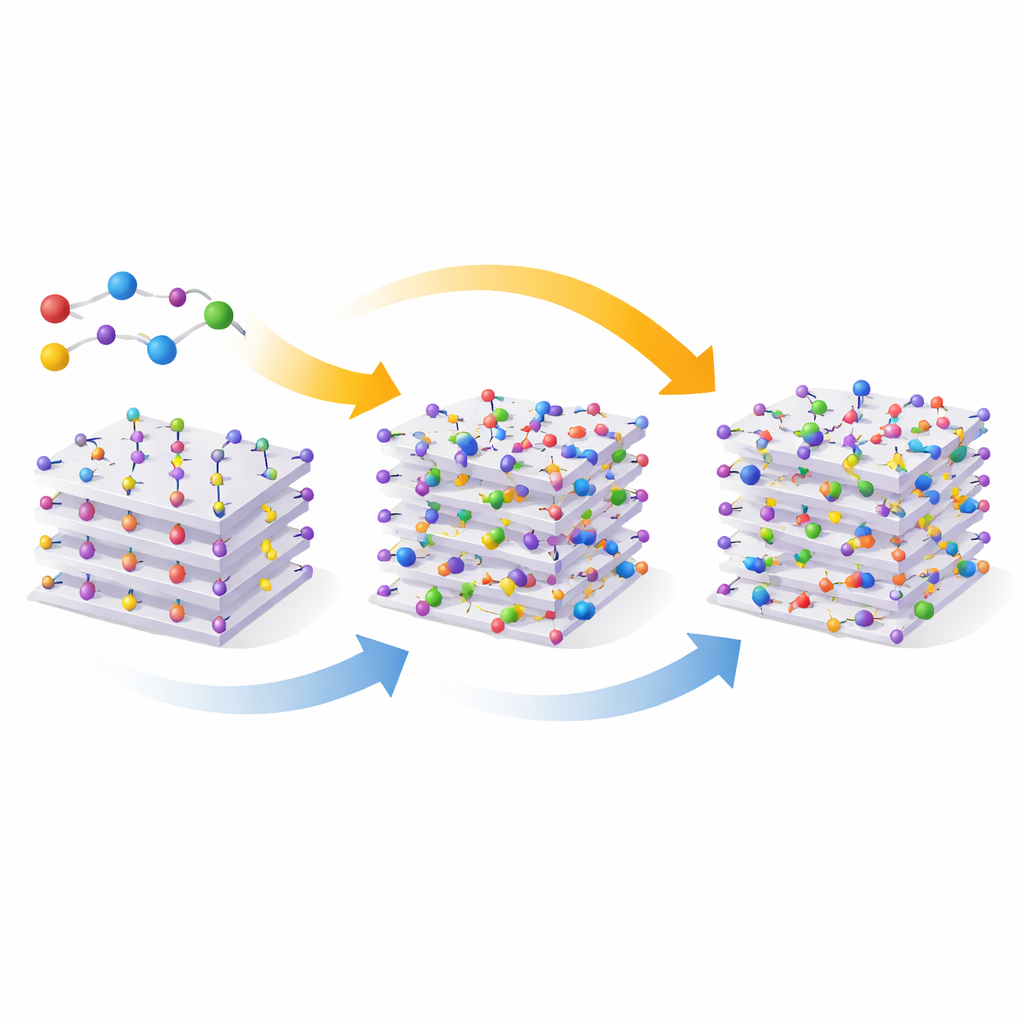
Creating tiny polarized islands inside the crystal
To understand what is happening inside, the team uses a suite of advanced microscopes and scattering techniques. X‑ray diffraction and electron diffraction show that, near a particular selenium content, the crystal no longer has a single, uniform structure. Instead, dislocations—tiny line defects—appear where the lattice is strained by the larger selenium atoms. Around these defects, regions of the monoclinic and trigonal phases interleave to form a nanoscale superlattice. High‑resolution electron microscopy reveals that these mixed regions are only a few to a few tens of nanometers across. Optical measurements that are sensitive to broken symmetry confirm that the material still has local polarization, but now concentrated in many small, weak patches rather than in large uniform domains. In effect, the crystal turns into a dense landscape of polar nanoregions embedded in a less ordered background.
From rigid switching to gentle, tunable response
Electrical tests show how this nanostructuring changes the way the material responds to an applied voltage. In the pure, single‑phase crystal, polarization switches sharply between two states, producing a strong hysteresis loop typical of ferroelectrics. As selenium content increases and the two phases coexist, the remanent polarization drops while the maximum possible polarization stays relatively high, and the switching loop becomes slimmer and less hysteretic—behavior characteristic of relaxor ferroelectrics. At even higher selenium levels, the loop becomes almost linear, signaling a superparaelectric‑like state. Temperature‑dependent measurements further reveal that the peak in the dielectric constant broadens and shifts with measurement frequency, and a quantitative fitting shows the material evolving from normal ferroelectric to strong relaxor behavior as selenium increases. Theoretical calculations back up these observations, showing that the trigonal phase has weaker polarization but lower switching barriers than the monoclinic phase, making polarization easier to reorient once the phases are mixed.
Turning a soft crystal into a smart memory element
The team then exfoliates thin flakes of the mixed‑phase crystal and builds simple two‑terminal devices—memristors—by sandwiching the flakes between metal contacts. In these devices, changing the polarization changes the electrical resistance, which can be used to store information. Compared with the conventional ferroelectric version, the relaxor crystal with many nanodomains offers two key advantages: it supports a larger number of intermediate resistance levels and it switches at lower voltages. When the researchers apply sequences of voltage pulses, the device’s conductance increases in small, nearly continuous steps, mimicking the gradual strengthening of connections in biological synapses. This analog, multi‑level response is exactly what is needed for energy‑efficient neuromorphic, or brain‑inspired, computing. 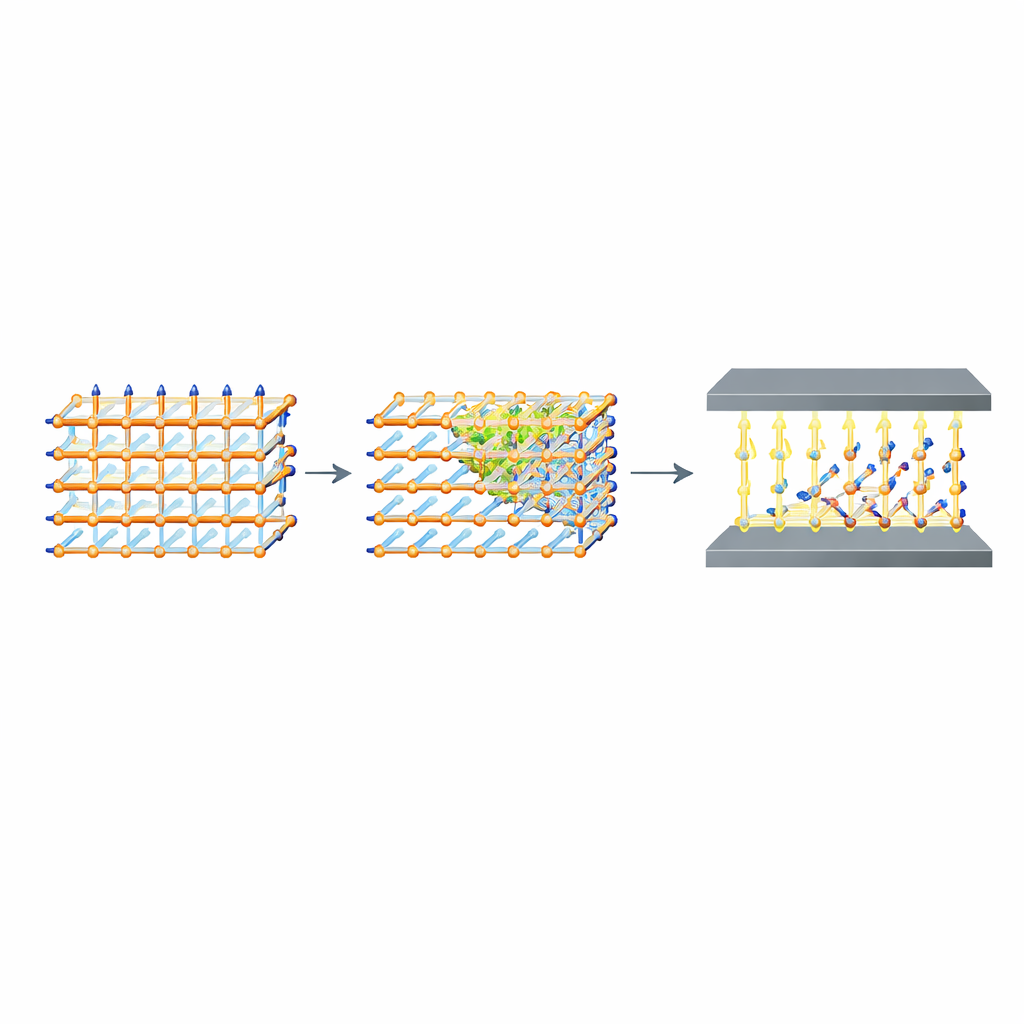
What this means for future technology
By carefully mixing crystal phases in an ultrathin van der Waals material, this work transforms a rigid, binary ferroelectric into a soft, tunable relaxor that still functions down to very small thicknesses. The key is the engineered coexistence of structural phases and the resulting polar nanoregions around defects, which flatten the energy landscape for switching and enable many gentle, low‑voltage resistance changes. For non‑specialists, the message is that we can now design atomically thin crystals whose internal electric behavior is not just on or off, but richly adjustable. That opens a path to compact, low‑power memory and computing devices that behave less like simple switches and more like adaptable, learning networks.
Citation: Yang, T., Ma, Y., Zheng, D. et al. Phase engineering of relaxor ferroelectricity in van der Waals crystal. Nat Commun 17, 2546 (2026). https://doi.org/10.1038/s41467-026-69272-9
Keywords: relaxor ferroelectrics, van der Waals materials, phase engineering, memristor devices, two-dimensional crystals