Clear Sky Science · en
Converse flexoelectric two-dimensional MoS2 actuator
Why Tiny Moving Machines Matter
From telescopes in deep space to medical tools that position a single cell, many modern technologies depend on parts that can move with nanometer precision. Shrinking these "muscle" components, called actuators, is challenging: they must move far, respond quickly, and keep working in harsh environments like deep cold and vacuum. This study introduces a new kind of ultrathin actuator made from a single-atom-thick sheet of molybdenum disulfide (MoS₂) that meets these demands far better than previous designs.
A New Way to Make Materials Move
Most high-precision motion today relies on piezoelectric actuators, which move when an electric field is applied. These work well but have drawbacks: only certain crystals can be used, many contain toxic heavy metals such as lead, their motion is small compared with their size, and their performance collapses at very low temperatures. The authors instead harness a related but more universal effect called flexoelectricity, where a material responds to an electric field that changes from place to place, rather than just to a uniform field. Crucially, this effect becomes dramatically stronger as the material becomes thinner, suggesting that atomically thin two-dimensional materials could make especially powerful flexoelectric actuators.

Building an Ultrathin Flexing Beam
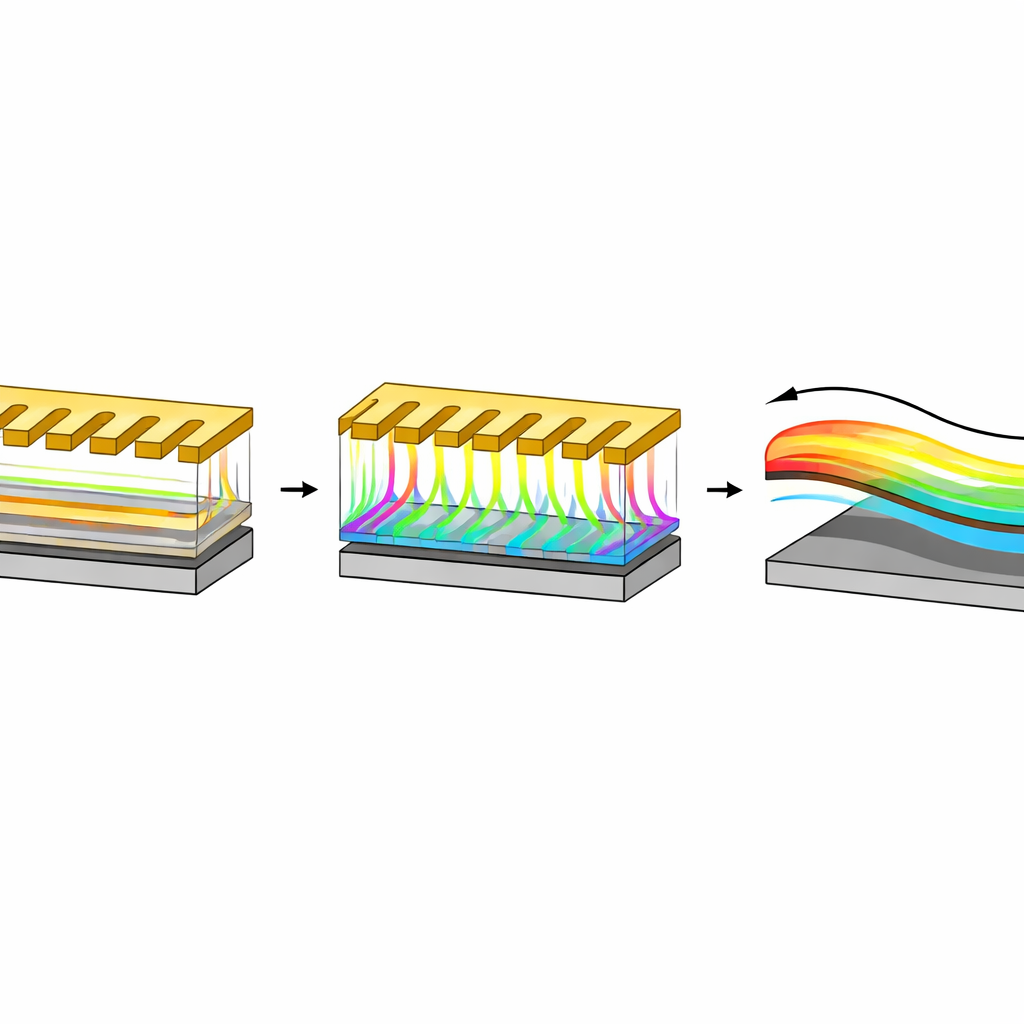
To put this idea into practice, the team built a tiny beam made of four stacked layers: a solid silver bottom electrode, a thin insulating and supporting film, a monolayer of MoS₂, and a gold top electrode patterned like a comb. When an alternating voltage is applied, the comb pattern creates a steep electric field gradient within the MoS₂ sheet. This uneven field produces in-plane strain gradients in the monolayer, which in turn cause the whole beam to bend up and down. Using a laser-based vibrometer, the researchers measured how far the beam’s surface moved as they swept the driving frequency and voltage.
Surprisingly Large Motion from an Atomically Thin Sheet
Near a resonant frequency around 19–20 kilohertz, the MoS₂ device produced out-of-plane displacements of about 45 nanometers while the active layer itself was less than a nanometer thick. When the authors compared this motion to that of other flexoelectric and piezoelectric devices, after accounting for active-layer thickness and applied electric field, their actuator outperformed previous flexoelectric systems by more than an order of magnitude and rivaled state-of-the-art piezoelectric beams. The displacement increased linearly with voltage, meaning the motion can be finely and predictably controlled. Tests on control devices without MoS₂, as well as devices with one versus two layers of MoS₂, showed that the effect came primarily from the flexoelectric response of the monolayer rather than from ordinary piezoelectricity or simple heating.
Peering Inside the Mechanism
To confirm how the actuator worked, the researchers built detailed computer models that coupled electric fields and mechanical motion. Simulations showed that the comb-shaped top electrode concentrates electric field gradients near its edges inside the MoS₂ layer. These gradients generate in-plane stresses that bend the beam, matching the size of the motion seen in experiments when realistic flexoelectric coefficients are used. The models also revealed that adding extra MoS₂ layers increases stiffness and slightly reduces motion, in line with measurements. Alternative explanations such as piezoelectric effects, electromagnetic forces, or heating contributed only weakly, reinforcing the central role of converse flexoelectricity in the device’s behavior.
Built for Harsh Conditions and Long Life
Beyond raw performance, the new actuator proves remarkably tough. When cooled from room temperature down to just 10 kelvin in vacuum, it still delivered about 70% of its original displacement. A commercial lead-based piezoelectric actuator tested under the same conditions lost around 60% of its motion. The MoS₂ device also survived at least ten billion operation cycles at both room and cryogenic temperatures with less than 12% variation in performance. This combination of endurance, low-temperature robustness, and nanoscale thickness makes it especially attractive for applications in space, quantum technologies, and other environments where conventional actuators struggle.
What This Means Going Forward
In simple terms, this work shows that an almost unimaginably thin sheet of material can act as a powerful, reliable artificial muscle when driven by carefully shaped electric fields. By exploiting flexoelectricity, which is available in all insulators and becomes stronger at small scales, the authors create a lead-free actuator that moves far relative to its size, remains controllable with voltage alone, and continues to function in extreme cold and vacuum. These results suggest that two-dimensional materials like MoS₂ could underpin a new generation of tiny moving parts for robots, instruments, and devices operating where traditional piezoelectric technology reaches its limits.
Citation: Lee, Y., Bae, H.J., Haque, M.F. et al. Converse flexoelectric two-dimensional MoS2 actuator. Nat Commun 17, 2519 (2026). https://doi.org/10.1038/s41467-026-69271-w
Keywords: flexoelectric actuator, two-dimensional materials, molybdenum disulfide, nanoscale motion, cryogenic devices