Clear Sky Science · en
Coherence transfer from optically induced THz magnons to charges
Why ultrafast spin waves matter for our data-hungry world
Modern life runs on data, from streaming video to artificial intelligence. Behind the scenes, data centers are straining to move and process information ever faster while wasting less energy. Today’s electronics rely on moving electric charges, which inevitably generate heat. This study explores a radically different carrier of information—tiny ripples in magnetism called “magnons”—and shows how their ultrafast, wave-like motion can be turned into an electronic signal, a key step toward cooler, faster computing hardware.
From electric currents to magnetic waves
Conventional computer chips are built around charge-based CMOS technology, where bits are represented by the presence or absence of electric current. This works well but runs into limits: pushing charges around at ever higher speeds wastes energy as heat. Spintronics, an emerging field, aims to encode information not in moving charges but in the “spin” of electrons—the tiny magnetic moments that make materials magnetic. In particular, antiferromagnets, in which neighboring spins point in opposite directions, can support collective spin waves, or magnons, that oscillate naturally at terahertz (THz) frequencies—thousands of times faster than today’s processors—while generating minimal heat.
A magnetic crystal under the laser spotlight
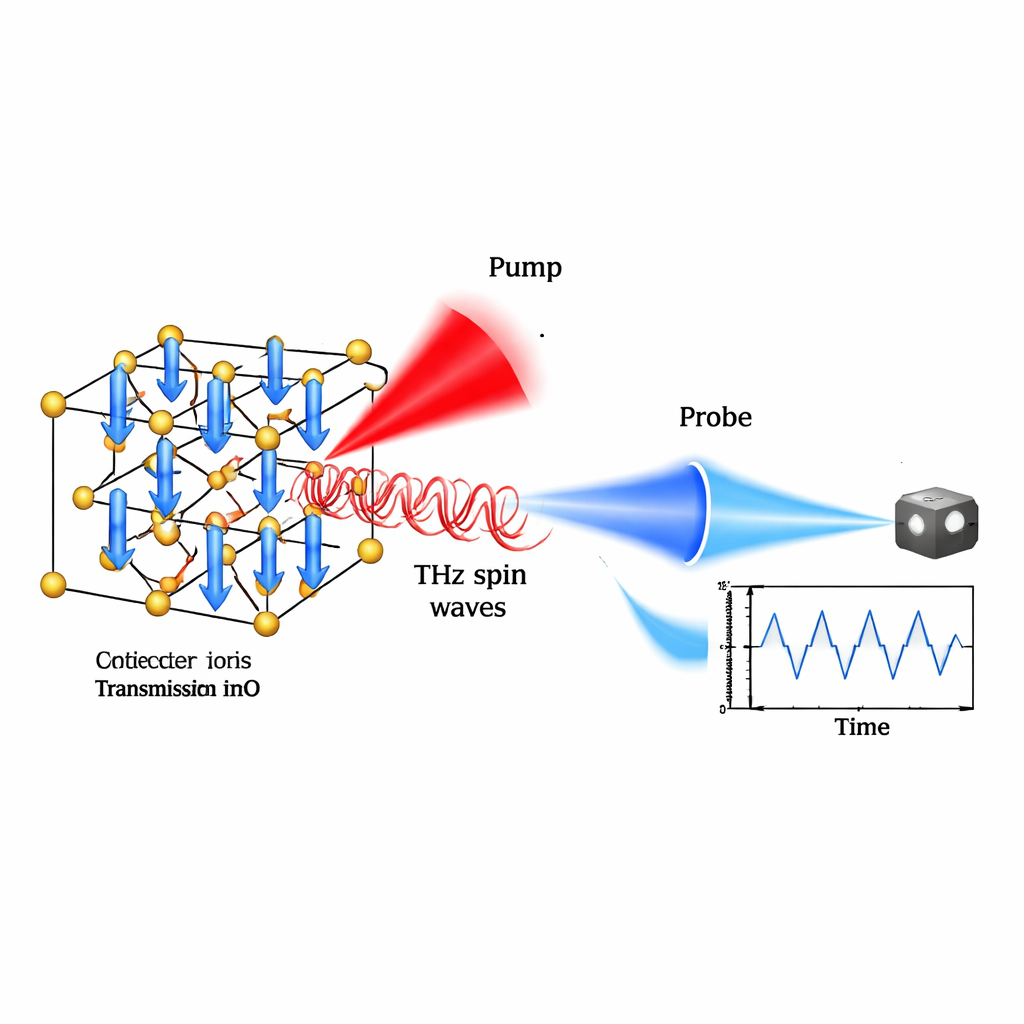
The researchers focused on nickel oxide (NiO), a widely studied insulating antiferromagnet. In NiO, spins on neighboring nickel ions form two opposing sublattices, creating a highly ordered magnetic state. Using ultrashort laser pulses lasting only a few dozen femtoseconds (one quadrillionth of a second), they excited a special combined state of an electron and a magnon known as an exciton-magnon. This process efficiently launches coherent THz spin waves in the crystal without promoting electrons into the usual conducting states. A second laser pulse then probes how much light passes through the sample, allowing the team to monitor subtle, time‑dependent changes in its transparency.
Seeing spin waves in the flow of light
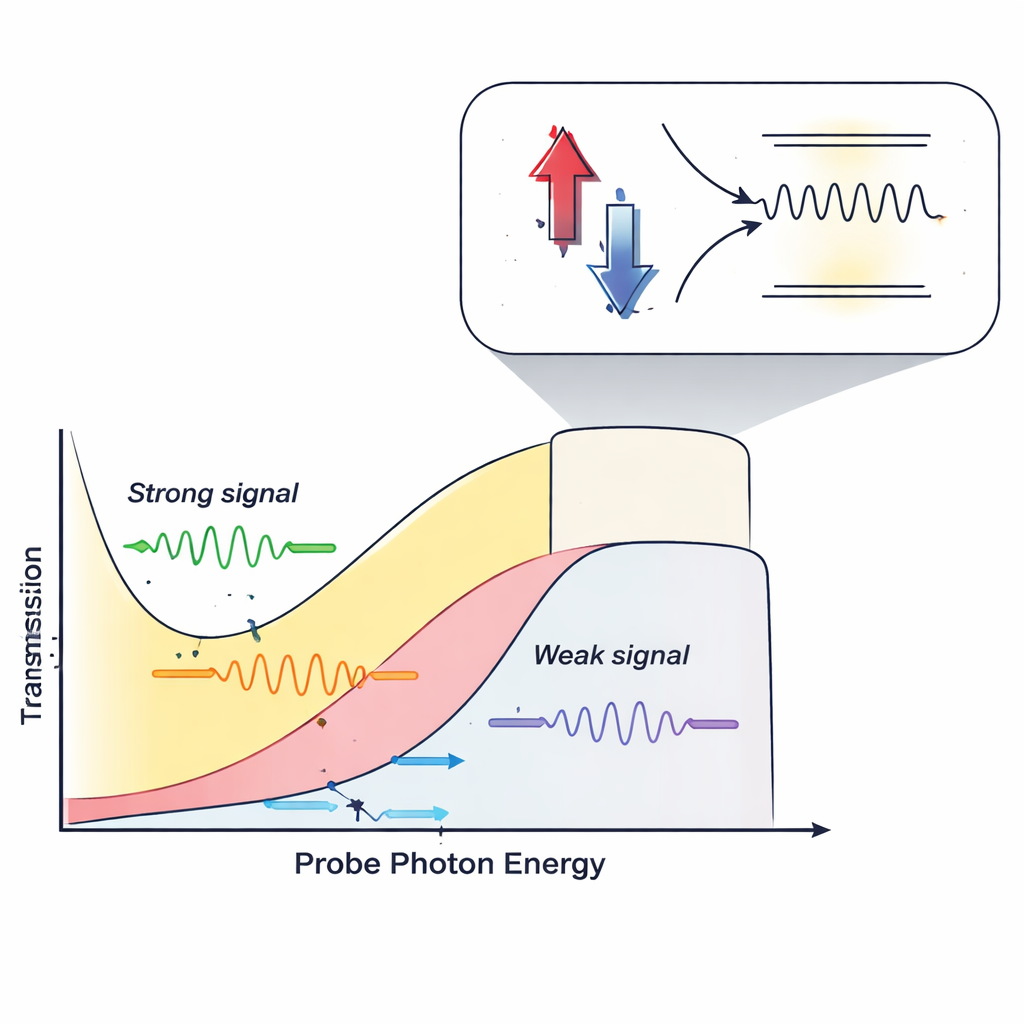
By measuring the transmitted light with a highly sensitive, balanced detection scheme, the authors observed periodic oscillations in the crystal’s transparency at about 1.07 THz—the same frequency as a known magnon mode in NiO. These oscillations appeared as tiny ripples in the transmitted signal and scaled linearly with the strength of the excitation, indicating that they directly tracked the driven spin waves. Crucially, the effect depended strongly on the color (photon energy) of the probe light. Only when the probe overlapped spectral regions where NiO’s transmission changed steeply with energy did the THz oscillations show up clearly; in flat regions of the spectrum, they nearly vanished. This pattern ruled out a simple “overall brightening or dimming” of the crystal and pointed instead to a periodic shift in the energies of specific internal electronic transitions.
Ruling out optical tricks and revealing the hidden coupling
Many magnetic materials show magneto‑optical effects, where magnetism alters the polarization of light rather than how much gets through. The team carefully analyzed four such effects and systematically varied the polarization of their probe beam over multiple colors. In most cases, the behavior of the THz oscillations could not be explained by known magneto‑optical mechanisms; only at one probe energy did a standard effect (magnetic linear dichroism) contribute appreciably. To go beyond symmetry arguments, the authors built a microscopic model of a single nickel ion in NiO, including the crystal environment, the mutual repulsion of electrons, and a key ingredient: spin‑orbit coupling, which ties an electron’s magnetic orientation to its orbital motion around the atom.
How spin waves tug on electronic levels
In the model, the THz magnon mode makes the opposing sublattice spins tilt periodically by a small angle away from their equilibrium directions. Because of spin‑orbit coupling, this tiny tilt shifts the energies of the so‑called d–d electronic transitions inside NiO—transitions that lie well below the main absorption edge but still strongly influence how the crystal transmits visible and near‑infrared light. When these transition energies oscillate, the amount of probe light transmitted through steep parts of the spectrum oscillates too, producing the observed THz modulation. With parameter values taken from past literature and no fine‑tuning, the computed energy shifts and resulting transmission changes matched the measurements across multiple probe colors.
A step toward cooler, faster information technology
For non‑specialists, the key message is that the researchers have shown a direct, coherent link between ultrafast spin waves and electronic states in an ordinary magnetic insulator. They can launch THz spin oscillations with light and then watch those oscillations imprint themselves on the flow of transmitted light through tiny shifts of internal energy levels. This demonstrates a practical way to convert magnon “wave information” into an optical charge‑based signal, compatible with existing technologies. Because similar spin‑orbit‑assisted transitions occur in many other magnetic materials, this mechanism opens a path toward energy‑efficient devices that use THz‑speed spin dynamics to process information while greatly reducing waste heat.
Citation: Cimander, M., Wiechert, V., Bär, J. et al. Coherence transfer from optically induced THz magnons to charges. Nat Commun 17, 1480 (2026). https://doi.org/10.1038/s41467-026-69261-y
Keywords: spintronics, antiferromagnets, terahertz magnons, nickel oxide NiO, ultrafast optics