Clear Sky Science · en
Unconventional bipartite entanglement in the quantum dimer magnet Yb2Be2SiO7
Why this strange magnet matters
Quantum technologies, from future computers to ultra-precise sensors, rely on a fragile resource called entanglement—subtle links between particles that behave as a single unit. Most known quantum magnets that host entanglement follow well-understood rules. This paper explores a new magnetic crystal, Yb2Be2SiO7, that breaks those rules, revealing an unusual kind of entangled state. Understanding such materials could open new routes to controlling quantum information in solids.
A checkerboard of tiny pairs
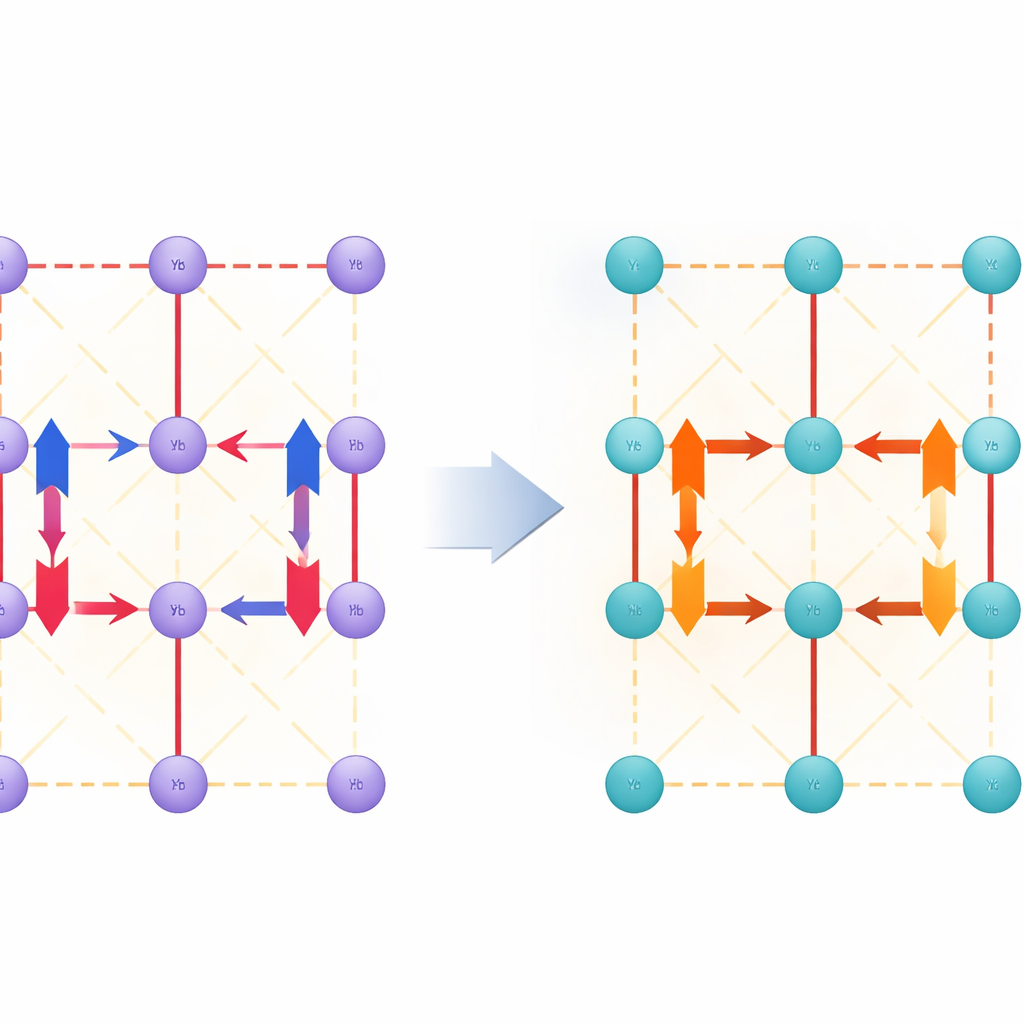
In Yb2Be2SiO7, the magnetic atoms are ytterbium ions arranged in a neat two-dimensional pattern known as the Shastry–Sutherland lattice. In this layout, the ions naturally group into tiny pairs, or “dimers,” linked more strongly to each other than to their neighbors. At low temperatures these dimers act as the basic building blocks of the magnet, with each pair behaving like two interacting quantum bits. The team first confirmed the crystal structure and the arrangement of these dimers using x-ray and neutron diffraction, ensuring that the material really hosts the desired network of pairs with only weak connections between them.
Spins that refuse to line up
The researchers then probed how the tiny magnetic moments of the ytterbium ions behave as the crystal is cooled and exposed to magnetic fields. Measurements of magnetization and heat capacity down to a few tenths of a degree above absolute zero revealed no sign of conventional magnetic order—the spins never freeze into a simple up–down pattern, even at 50 millikelvin. Instead, the data show that each ytterbium ion behaves effectively like a spin-1/2 quantum object, and that these spins have a strong directional preference: they want to point along one specific axis of the crystal. This “Ising-like” behavior is a hallmark of strong spin–orbit coupling, where the motion of electrons around the nucleus locks their magnetism to the crystal’s geometry.
Peeking at quantum motion with neutrons
To see how the dimers themselves are entangled, the team turned to neutron spectroscopy, which tracks how incoming neutrons exchange energy and momentum with the spins. At very low temperatures they observed a set of sharp, nearly non-dispersing excitation energies—fingerprints of localized dimers rather than extended spin waves. By comparing the measured pattern of energies and their dependence on the neutron scattering angle with detailed simulations, the authors showed that most of the ytterbium ions form isolated dimers whose behavior is dominated by interactions within each pair. A few higher-energy features likely arise from rare defects where the local environment changes, consistent with a small amount of atomic mixing between beryllium and silicon sites.
An entangled state that breaks the usual rule
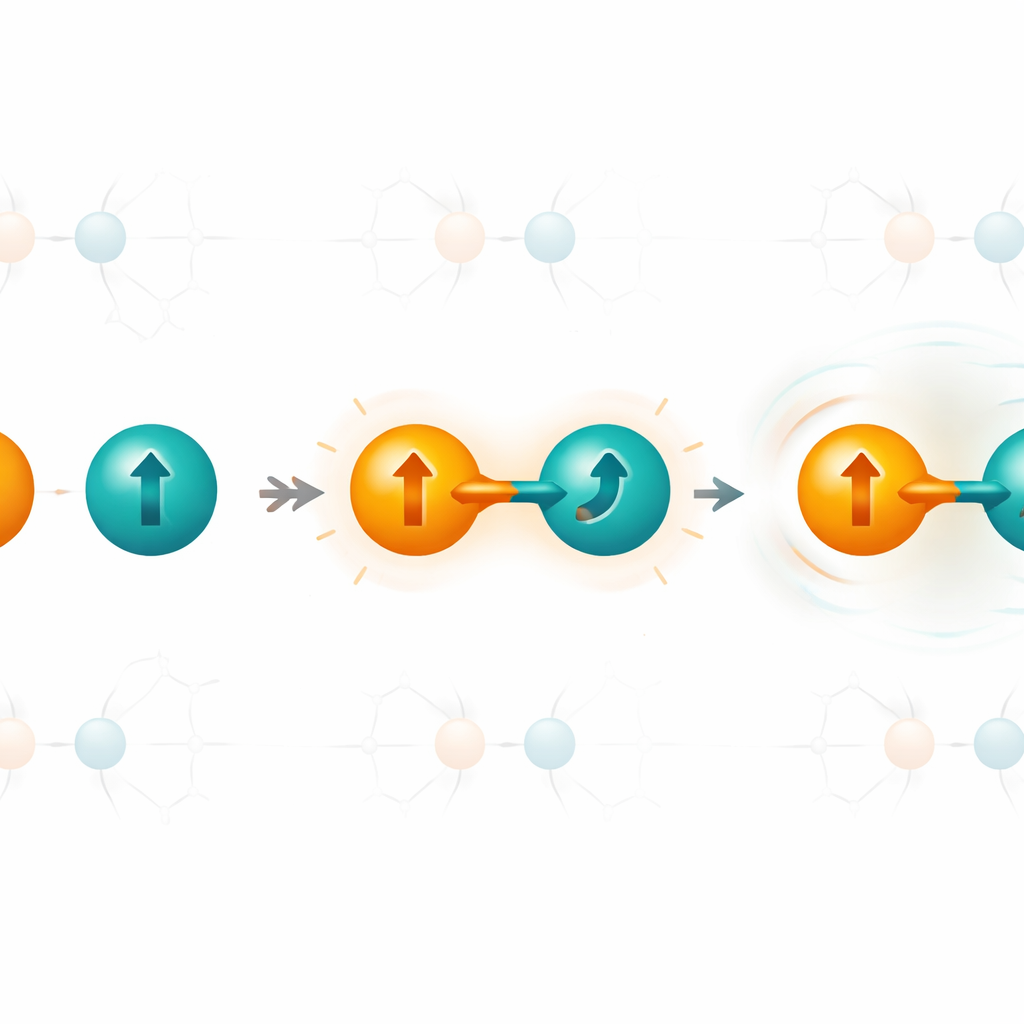
In standard quantum dimer magnets built from spin-1/2 ions, the strongest interaction is usually of the “Heisenberg” type, favoring a perfectly balanced entangled singlet state with zero net magnetization on each dimer. Yb2Be2SiO7, however, behaves differently. Because spin–orbit coupling makes the interaction strongly direction-dependent, the best description is an “XYZ” model in which each spatial direction contributes differently. When the authors tuned this model to match all of their data—neutron spectra, magnetization curves along different directions, and heat capacity in various fields—they found that the ground state of each dimer is an entangled superposition with a nonzero net spin, rather than the usual zero-spin singlet. In everyday language, the two spins in a pair are still deeply linked, but they lock together in a partially aligned configuration instead of perfectly canceling each other out.
New playgrounds for quantum entanglement
The work shows that strong spin–orbit coupling can stabilize an unconventional, bipartite entangled state in a clean crystalline magnet. Yb2Be2SiO7 realizes a case that recent theory had predicted but had not yet been clearly seen in experiment: an entangled dimer with a built-in magnetic moment. This discovery suggests that many other rare-earth-based dimer materials, especially those with similar lattice structures, may hide comparably exotic states. As researchers learn to tune the balance between different directional interactions, such systems could offer rich new playgrounds for engineering and manipulating entanglement in solid-state devices.
Citation: Brassington, A., Ma, Q., Duan, G. et al. Unconventional bipartite entanglement in the quantum dimer magnet Yb2Be2SiO7. Nat Commun 17, 2751 (2026). https://doi.org/10.1038/s41467-026-69258-7
Keywords: quantum dimer magnet, spin entanglement, Shastry-Sutherland lattice, spin-orbit coupling, rare-earth magnetism