Clear Sky Science · en
Velocity sensitivity of mechanotransduction in the afferent terminal underlies vibration detection in the Pacinian corpuscle
Why fast vibrations matter to our sense of touch
When you run your fingers over a fine fabric or use a tool with delicate control, specialized sensors in your skin quietly go to work. Among the most important are Pacinian corpuscles—tiny onion‑shaped structures buried deep in the skin that excel at detecting rapid vibrations. This study reveals that these sensors are tuned not simply to how often something vibrates, but to how quickly the skin moves back and forth—its velocity—offering a new way to think about how we feel the world.
Hidden vibration sensors under the skin
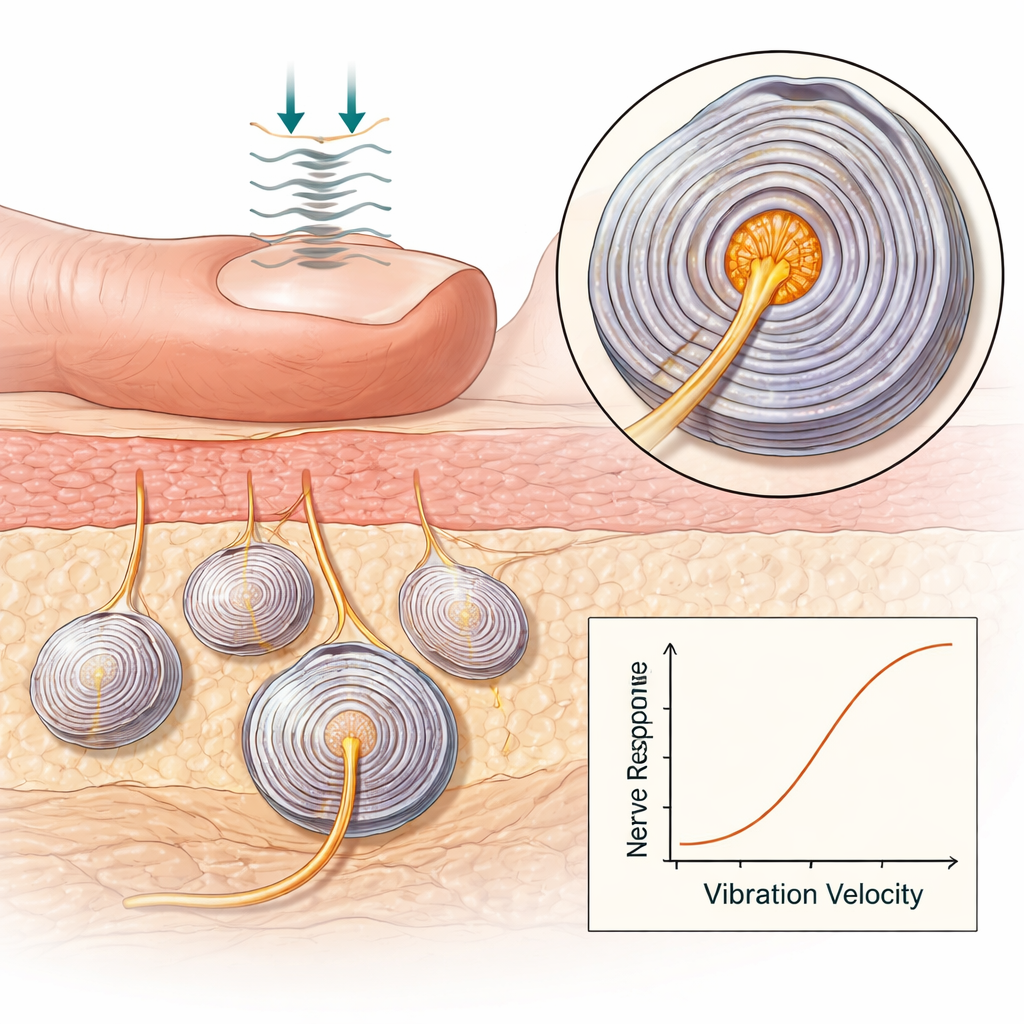
Pacinian corpuscles are found in many land animals, including humans and birds. They help us notice distant footsteps through the ground, sense the texture of objects, and guide our grip when we handle tools. Each corpuscle looks like a miniature pearl onion: a layered outer capsule surrounds an inner core, which in turn wraps around a central nerve ending called the afferent terminal. For decades, scientists believed the outer layers acted as a mechanical filter, blocking slow changes in pressure and passing only high‑frequency vibrations to the nerve ending inside.
The nerve ending steals the spotlight
The researchers challenged this traditional view by directly recording electrical signals from single Pacinian corpuscles in the sensitive bills of ducks, a bird that relies heavily on touch to find food. By gently vibrating the corpuscles at different frequencies, they confirmed a long‑known pattern: higher‑frequency vibrations require less indentation of the skin to trigger nerve impulses. But a closer look showed something surprising. When they calculated the speed of each vibration cycle, they found that the nerve responded whenever the skin moved at roughly the same velocity, regardless of how many times per second it oscillated. This suggested that the inner nerve ending itself, not the outer capsule, was the real source of the “high‑frequency” tuning.
Velocity, not just frequency, drives the signal
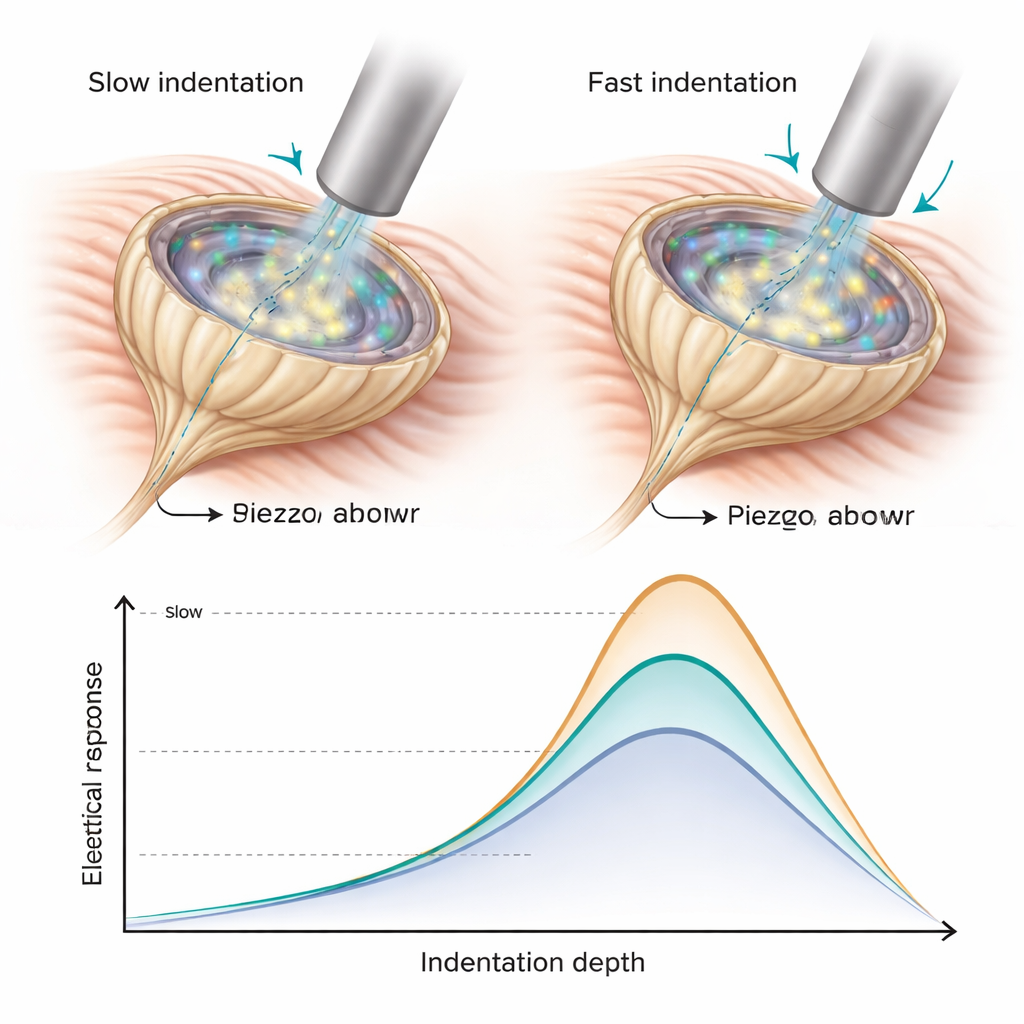
To test this idea more rigorously, the team removed parts of the outer capsule and used patch‑clamp techniques to measure the tiny currents flowing through ion channels in the afferent terminal. They then separated two features of vibration that usually change together: cycle rate (frequency) and velocity. When they varied frequency while keeping velocity high and constant, the size and threshold of the mechanically activated currents barely changed. In contrast, when they increased velocity at a fixed overall displacement, currents grew larger and activated at shallower indentations. Faster movements also sped up the rise and decay of the currents, allowing the nerve terminal to depolarize quickly—an electrical “jolt” that makes firing an action potential much more likely, even though the total charge entering the cell stayed about the same.
A built‑in velocity sensor in touch neurons
Next, the authors asked whether this velocity sensitivity depended on the full corpuscle structure or was an intrinsic property of the neuron. They studied isolated trigeminal neurons from duck embryos—the same nerve cells that normally innervate Pacinian corpuscles—and found a subset with fast, vibration‑like responses that behaved just like the terminals in intact corpuscles: strongly tuned to velocity but not to cycle rate. Similar behavior appeared when they expressed Piezo2, a known touch‑sensing ion channel, in engineered human cells. In these simplified cells, raising the speed of mechanical stimulation increased Piezo2 currents and lowered their activation threshold, while changing frequency alone at constant velocity had little effect. Together, these results point to Piezo2 and related channels as the key hardware that converts rapid skin motion into electrical signals.
A new picture of how we feel fine vibrations
This work proposes a revised model of Pacinian corpuscles. Rather than acting mainly as a mechanical filter, the layered capsule appears to protect and support the inner structures, while the nerve ending—equipped with velocity‑sensitive ion channels like Piezo2—performs both the filtering and sensing. High‑frequency vibrations are simply those that tend to move the skin fast enough to cross this velocity threshold. For everyday experience, this means our exquisite ability to feel subtle textures and tool vibrations arises from nerve endings that are wired to notice how quickly the skin is being pushed and released, not just how often.
Citation: Chikamoto, A., Meng, M., Gracheva, E.O. et al. Velocity sensitivity of mechanotransduction in the afferent terminal underlies vibration detection in the Pacinian corpuscle. Nat Commun 17, 2122 (2026). https://doi.org/10.1038/s41467-026-69251-0
Keywords: touch, vibration, Pacinian corpuscle, Piezo2, mechanotransduction