Clear Sky Science · en
Ecological partitioning enables phage–antibiotic cooperation in a human Pseudomonas infection
Why this story of germs and viruses matters
For people living with cystic fibrosis, lung infections can become a lifelong battle that standard antibiotics eventually fail to win. This study follows one older patient whose infection by a stubborn Pseudomonas bacterium no longer responded to many drugs. Doctors added carefully prepared viruses that specifically attack these bacteria, called phages, to his treatment. By tracking not just symptoms but also the microbes and immune responses inside his lungs over time, the researchers show how antibiotics, phages, and the patient’s own defenses worked together to tame – but not completely erase – a dangerous infection.
A lung locked in a long standoff
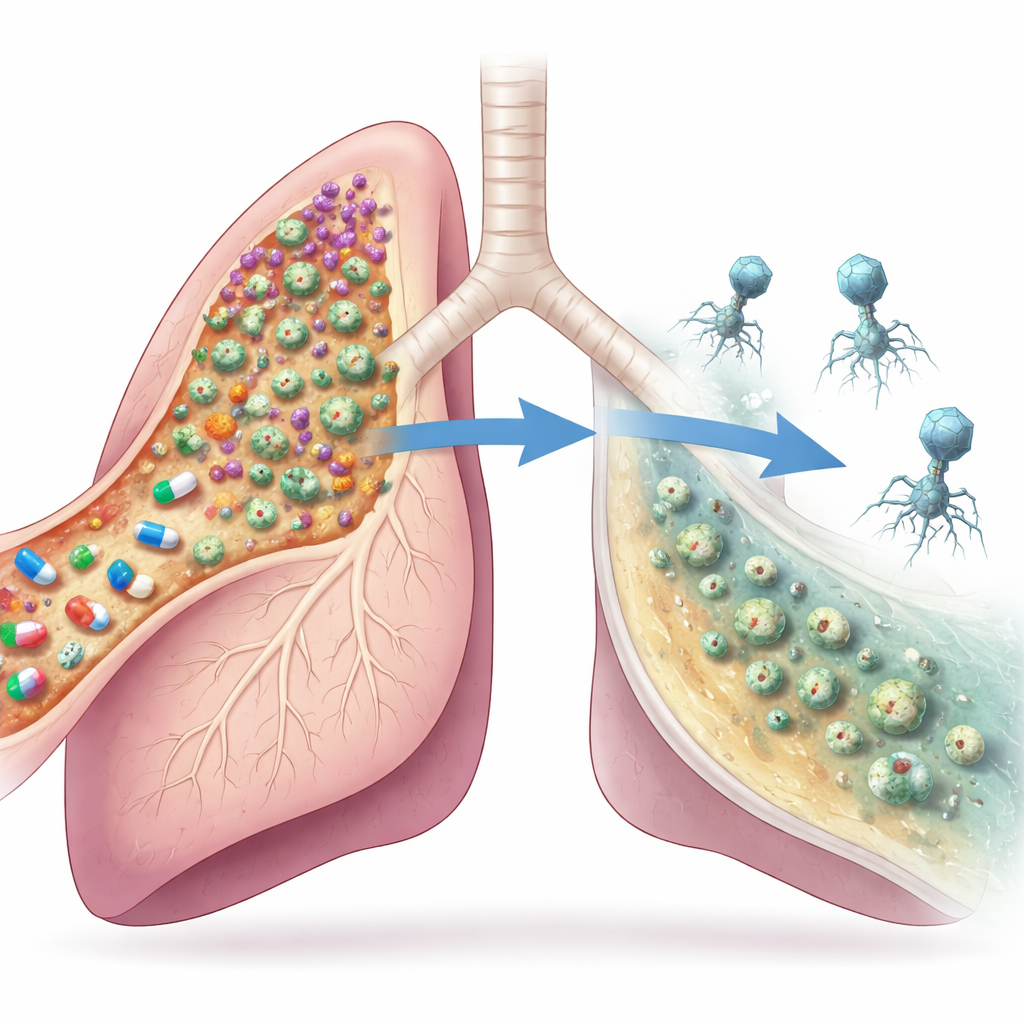
In advanced cystic fibrosis, the airways are thick with mucus, and Pseudomonas bacteria settle in for the long haul. Over years, they split into different forms: some wrapped in slime and less aggressive but easier for antibiotics to hit, others bare, fast‑growing, and highly drug resistant. In this patient, two such subpopulations coexisted. First‑line antibiotics helped briefly but had to be stopped due to kidney damage. A second drug, ciprofloxacin, improved breathing somewhat but allowed the hardier, multidrug‑resistant bacteria to surge. Rather than a simple infection, the lung had become a patchwork of bacterial niches that responded very differently to the same medicine.
Viruses join forces with drugs
To tip the balance, clinicians introduced an intravenous cocktail of two phages alongside ciprofloxacin. Within days, the patient’s lung function improved beyond what antibiotics alone had achieved, chest scans showed clearer airways, and measures of air trapping fell in several lung regions. At the microscopic level, the total number of Pseudomonas cells in sputum first rose and then dropped more than tenfold within a week. The mix of bacteria also shifted: the fast‑growing, drug‑resistant cells collapsed, while the slimy, less virulent cells again became dominant at a lower overall level. Instead of wiping out every bacterium, treatment pushed the infection back toward a quieter, chronic state that the patient’s body could live with.
A hidden tug‑of‑war between phages and immunity
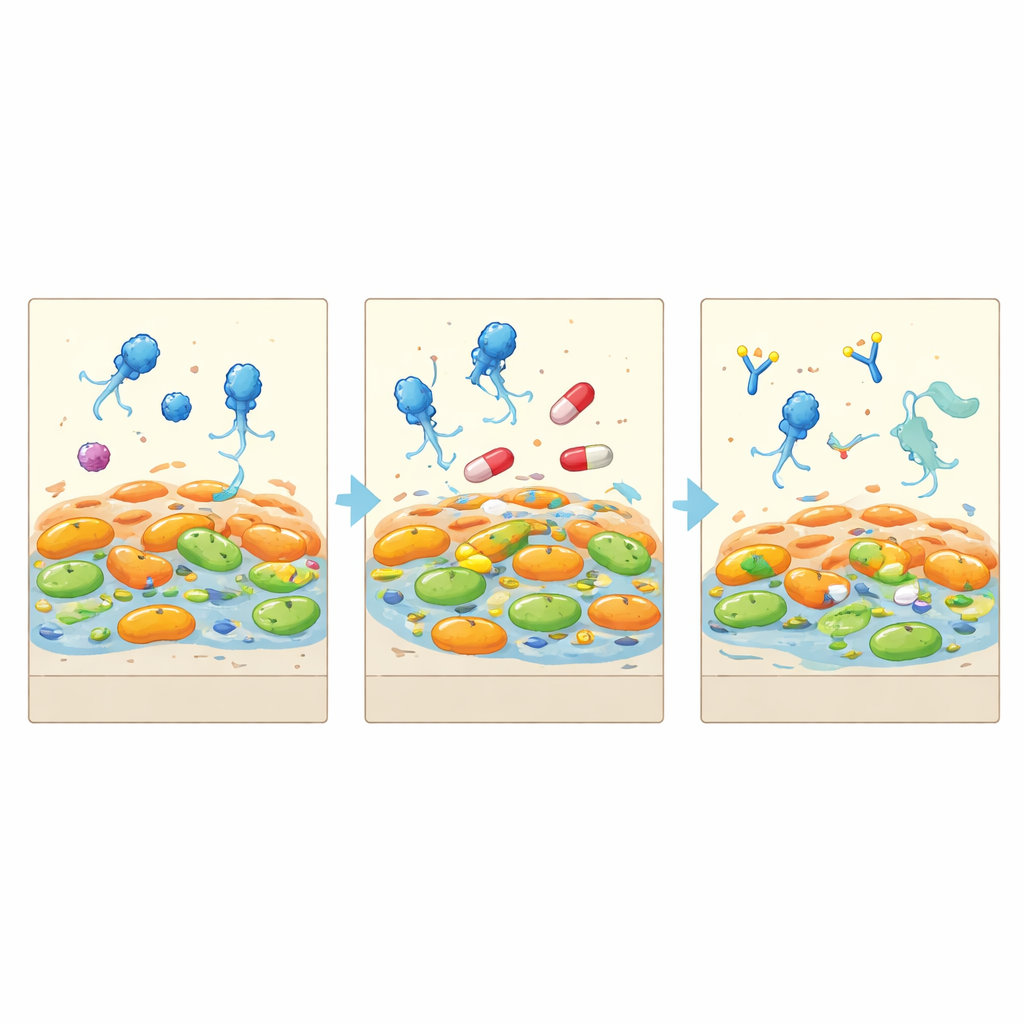
The researchers also sequenced viral genetic material in the sputum to follow the fate of the two therapeutic phages. One phage thrived early on, multiplying in the airways and closely tracking the crash in the aggressive bacterial group. The other barely got started. Blood tests revealed why: the patient already carried antibodies that recognized one phage and quickly made more, neutralizing it almost as soon as treatment began. Antibodies against the more successful phage appeared later, after it had expanded in the lungs, and then steadily rose, eventually cutting its activity as well. Throughout this period, standard measures of inflammation stayed acceptable, showing that the immune response limited phage action without causing harmful flare‑ups.
How the bacteria changed to survive
By isolating bacteria before, during, and after therapy and reading their genomes, the team showed that the infection came from a single long‑term Pseudomonas lineage that had splintered into multiple branches. Under phage attack, some drug‑resistant cells disappeared entirely, while others remodeled their outer surface molecules to block phage entry. These survivors paid a price: they grew 25–40 percent more slowly and showed molecular signs of adapting to stress rather than rapid expansion. Meanwhile, the slimy mucoid bacteria followed their own evolutionary path, tuning up drug‑pumping systems and thick coatings that made them naturally less exposed to phages. The end result was not a “superbug” takeover but a community biased toward slower, less damaging forms.
A new way to think about combination treatment
Looking across the clinical, microbial, and immune data, the authors argue that the patient’s recovery did not arise from simple drug–phage “super‑killing.” Instead, antibiotics and phages acted in different corners of the infection landscape. The chemical drugs broadly trimmed back more accessible bacteria and calmed inflammation, while phages homed in on the hidden, drug‑resistant pockets that were driving the flare‑up. As antibodies and bacterial defenses mounted, phage activity naturally waned, leaving behind a re‑organized, lower‑risk community that the patient’s immune system could keep in check. The authors call this coordinated but not strictly synergistic strategy “chemobiotherapy”: using chemicals and living viruses together to reshape the infection ecosystem so that lasting control, rather than total eradication, becomes possible.
What this means for future care
For people with hard‑to‑treat infections, especially in cystic fibrosis, this case suggests that phages can function as true biological medicines inside the human body, even when given through the bloodstream and in the face of immune defenses. It also highlights that success may depend less on blasting every microbe than on steering the whole system – bacteria, viruses, and host immunity – into a more stable, less damaging configuration. If confirmed in larger studies, this ecosystem‑based view of treatment could guide how we time and dose phages alongside antibiotics, and how we account for each patient’s existing viral residents and antibody landscape when designing personalized therapies.
Citation: Luong, T., Kharrat, L., Champagne-Jorgensen, K. et al. Ecological partitioning enables phage–antibiotic cooperation in a human Pseudomonas infection. Nat Commun 17, 2615 (2026). https://doi.org/10.1038/s41467-026-69247-w
Keywords: phage therapy, cystic fibrosis, Pseudomonas infection, antibiotic resistance, microbiome ecology