Clear Sky Science · en
Discovery of the most compact 3+1-type quadruple star system TIC 120362137
A Solar System With Four Suns
Imagine replacing our single Sun with four stars, all packed inside a space smaller than the orbit of Jupiter. That is what astronomers have uncovered in a distant corner of the constellation Cygnus: the most compact known system of four gravitationally bound stars in a special “3+1” configuration. Studying this tightly choreographed stellar dance helps scientists understand how multiple stars form, interact, and ultimately die, and it may even illuminate how some exotic objects like pairs of dead stellar cores are born.
Four Stars in a Tiny Neighborhood
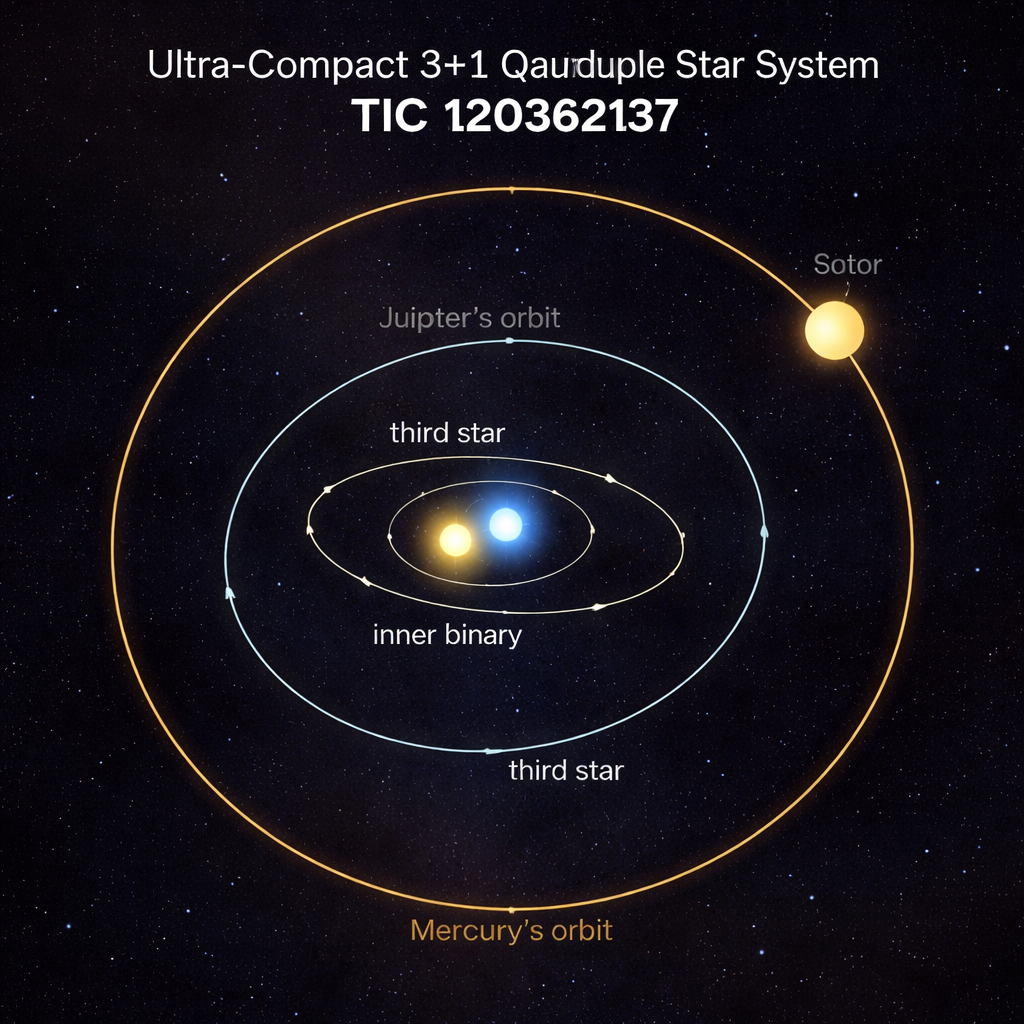
The system, called TIC 120362137, is what astronomers term a hierarchical quadruple. Two stars form a tight eclipsing pair that orbit each other every 3.28 days. A third star loops around this inner pair every 51.3 days, and together these three stars are all squeezed well inside a region comparable to Mercury’s orbit around the Sun. A fourth, Sun-like star circles this compact triple in about 2.9 years, on a path that lies well inside a distance similar to Jupiter’s orbit in our own solar system. Despite four separate orbits, the whole system is remarkably flat and orderly: all the orbital planes are aligned to within only a few degrees, suggesting that all four stars were born from the same thin, rotating disk of gas and dust.
How Astronomers Spotted the Hidden Partners
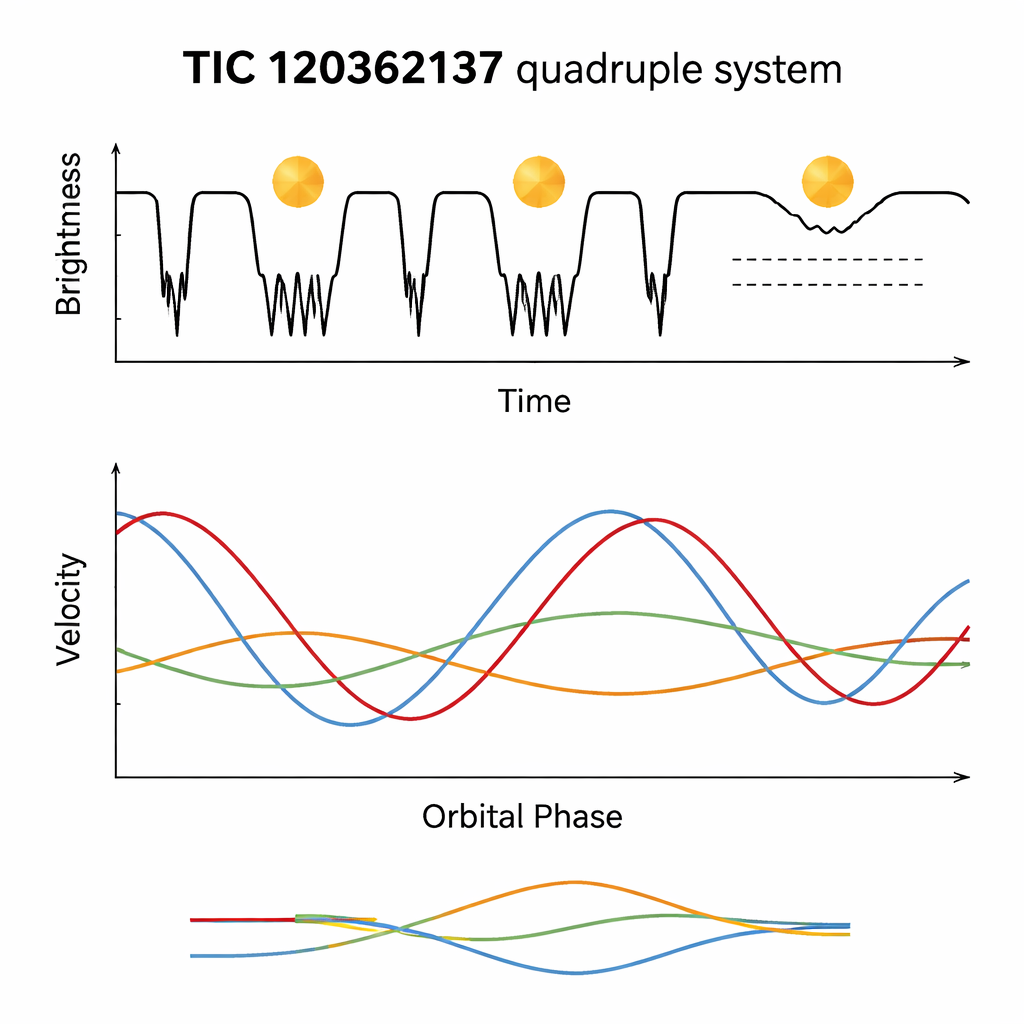
The story began with NASA’s Transiting Exoplanet Survey Satellite (TESS), which watches large patches of the sky for tiny dips in starlight. TESS saw regular, sharp eclipses every 3.28 days, revealing a close binary where one star passes in front of the other. But the light curve also showed rarer, longer dimmings lasting one to two days: extra eclipses where the inner pair and a third star alternately pass in front of each other. By carefully timing these events and tracking subtle shifts in the exact moments of eclipse, astronomers inferred the presence of the third star on a 51.3‑day orbit. Still more puzzling, additional slow variations in the eclipse timings hinted that gravity from an unseen fourth star was tugging on the inner trio.
Weighing and Measuring All Four Stars
To confirm the system’s true nature, the team organized a worldwide campaign of ground‑based telescopes. They recorded more eclipses in different color filters and took high‑resolution spectra, splitting the starlight into its component wavelengths. Using sophisticated computer techniques that can untangle overlapping spectral lines, they detected the signatures of all four stars separately and measured how fast each one moves toward or away from Earth. Combining these radial‑velocity curves with the TESS and ground‑based light curves in a single “spectro‑photodynamical” model allowed them to solve for the stars’ masses, sizes, temperatures, and orbits with striking precision—often to better than one percent.
A System Pushed to the Edge of Stability
The three inner stars are all hotter and more massive than the Sun: the primary weighs about 1.75 times the Sun’s mass and has already begun to evolve off the main sequence, while its companion and the third star have masses of roughly 1.36 and 1.48 solar masses. The fourth, outer star is very Sun‑like, with a mass close to one solar mass and a similar surface temperature. Despite their cramped arrangement, the system passes widely used tests for long‑term gravitational stability, and its current configuration appears to have survived for over a billion years. The tight orbits make the gravitational nudges between stars strong enough that their paths slowly precess and wobble in measurable ways, offering a natural laboratory for testing theories of multiple‑star dynamics.
From Four Bright Suns to Two Faint Embers
Using modern stellar evolution calculations, the authors also explored the distant future of TIC 120362137. As the most massive stars swell into giants and begin to transfer material to their companions, the orbits are expected to shrink and rearrange. Over time, mass exchange and stellar winds should strip the stars of their outer layers. The simulations suggest that, after a complex series of interactions and likely mergers, the original four stars will end up as just two dense white dwarfs orbiting each other. In other words, this unusually compact four‑star system is likely to finish its life as a close binary of stellar remnants—an outcome that helps explain how some of the tight pairs of dead stars observed elsewhere in the galaxy might have formed.
Citation: Borkovits, T., Rappaport, S.A., Chen, HL. et al. Discovery of the most compact 3+1-type quadruple star system TIC 120362137. Nat Commun 17, 1859 (2026). https://doi.org/10.1038/s41467-026-69223-4
Keywords: quadruple star system, eclipsing binary, multiple star dynamics, TESS observations, white dwarf evolution