Clear Sky Science · en
Multi-centennial internal variability in the North Atlantic could drive additional warming over Europe
Why this matters for everyday life
Europe has been heating up faster than much of the rest of the world, with recent summers and winters alike breaking records. This study asks a deceptively simple question with big implications: how much of this extra European warming is due not just to rising greenhouse gases, but also to slow, natural swings in the Atlantic Ocean that play out over centuries? The answer helps explain why observations are outpacing many climate model projections, and suggests that Europe could be riding a natural warm “boost” on top of human‑driven climate change over the next few decades.

A hidden rhythm in Europe’s climate
The authors dig into a very slow kind of climate variation, unfolding over 100–300 years, that is hard to see in the short thermometer record. To uncover it, they combine three lines of evidence: long climate reconstructions from tree rings, lake and marine sediments, and ice cores; state‑of‑the‑art climate model simulations that span the last 6000 years; and a recent “reanalysis” that blends proxy data with models to reconstruct past temperatures. Across these independent sources, a consistent signal emerges over Europe and Greenland: temperatures have a tendency to rise and fall in broad swings on multi‑century timescales, not just in the familiar decade‑to‑decade ups and downs.
The ocean engine behind the swings
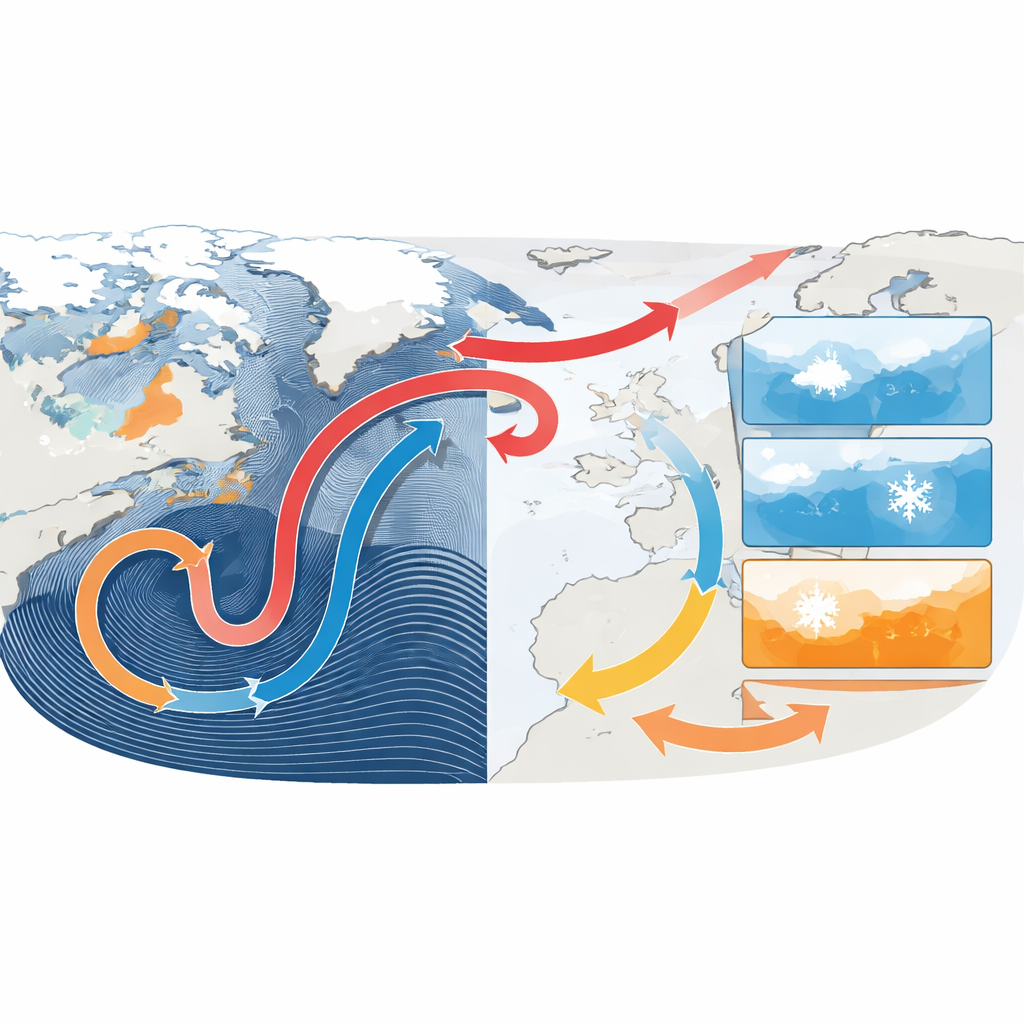
These slow pulses line up with changes in a major Atlantic circulation system that moves warm surface waters northward and returns colder deep waters southward. When this overturning circulation is stronger, more heat is carried into the North Atlantic and toward Europe, especially in winter, and the continent tends to be warmer. When it weakens, Europe cools. The study shows that models and reconstructions alike display multi‑century fluctuations in this circulation that match the timing and scale of the European temperature swings, pointing to the Atlantic as a key driver of long‑term regional climate variations.
Why models and reality diverge over Europe
Most global climate models used in international assessments agree that greenhouse gases are the main cause of global warming. Yet, over Europe, especially in the north, observed warming in recent decades has been stronger than the average model projection. Previous work has blamed factors such as changes in air pollution or atmospheric weather patterns. This study adds another piece: when the Atlantic circulation is in a naturally warm‑favoring phase, its internal variability can add substantially to the human‑driven warming signal. In some detailed simulations that best resemble observations, the internal upswing in this circulation boosts recent Northern European warming on top of the effect of greenhouse gases.
How much extra warming are we talking about?
By comparing many model runs that share the same external influences but start from slightly different initial states, the authors can separate the “forced” warming due to greenhouse gases from the purely internal ups and downs of the climate system. They then scale the model’s internal variability to match the amplitude seen in real‑world temperature records. For the period 2000–2035, they estimate that this slow Atlantic rhythm could add roughly 15–37% extra warming in certain parts of Europe, with the strongest amplification in Lapland and across Northern Europe. Globally, over land, the same internal variability contributes a more modest ~15% on top of the forced warming, underscoring that the effect is particularly pronounced over Europe.
What this means for the near future
The study concludes that Europe’s recent rapid warming is not only the result of rising greenhouse gases, but is being amplified by a long‑lived, internal warm phase of North Atlantic circulation. This internal boost does not lessen the role of human influence; instead, it means that, for the coming decades, Europe may experience stronger warming than one would infer from greenhouse gases alone. For planners and societies, the message is clear: adaptation strategies in Europe, especially in the north, should assume that the deck is temporarily stacked toward more warming than standard model averages suggest, because the continent is currently sitting on top of both a human‑made trend and a naturally warm‑leaning ocean background.
Citation: Al-Yaari, A., Swingedouw, D., Braconnot, P. et al. Multi-centennial internal variability in the North Atlantic could drive additional warming over Europe. Nat Commun 17, 2614 (2026). https://doi.org/10.1038/s41467-026-69209-2
Keywords: European warming, North Atlantic circulation, internal climate variability, Atlantic Meridional Overturning Circulation, Holocene climate