Clear Sky Science · en
Humidity-induced dynamic coordination drives the oscillatory migration of ions for sustainable energy harvesting
Power from the air around us
Air is never truly dry. Even on clear days, invisible water vapor is constantly rising and falling with temperature and weather. This everyday ebb and flow of humidity carries a quiet but continuous source of energy. The research in this article shows how a soft, jelly-like material can tap into those natural humidity swings to generate electricity for weeks at a time, hinting at future gadgets that might one day run simply on the changing air around them.
A new way to use wet and dry cycles
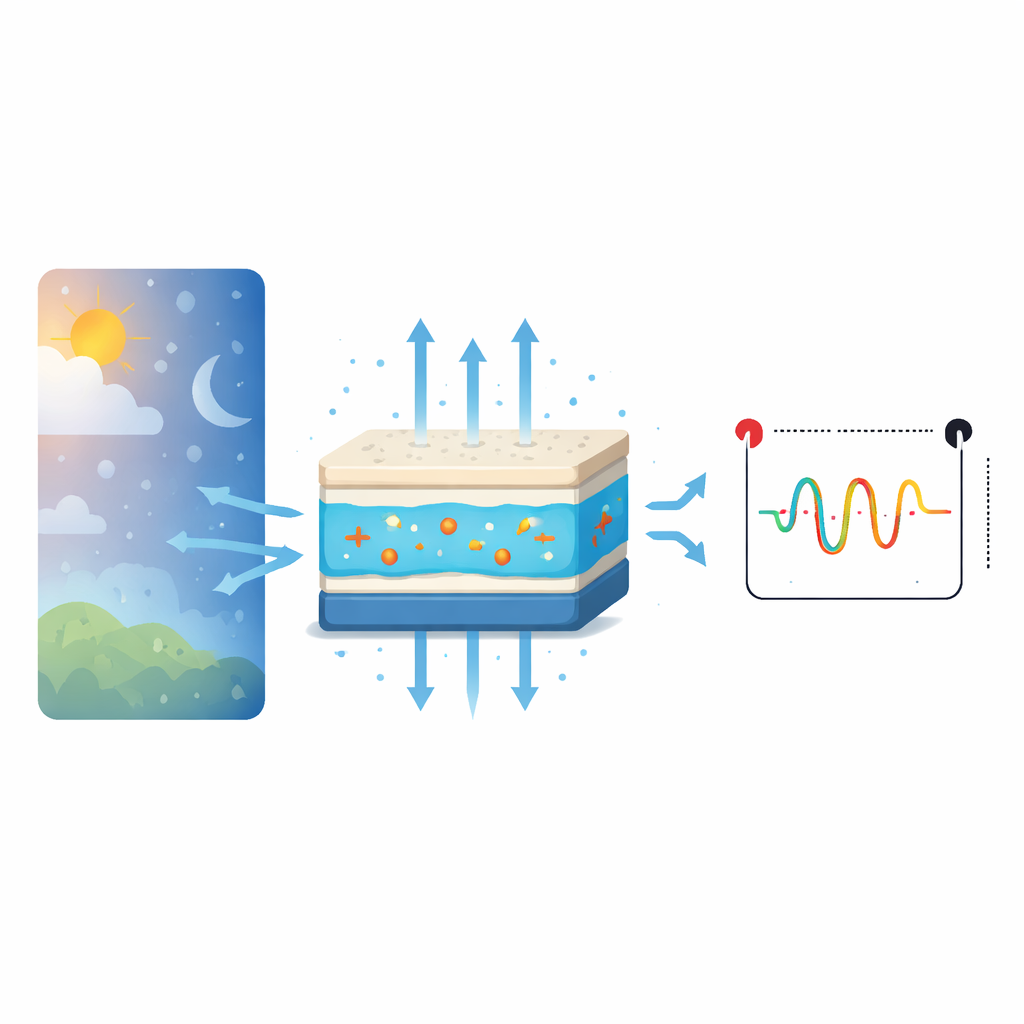
Most existing “moisture power” devices work a bit like one-shot batteries: water and charged particles drift in one favored direction through a material, creating an electric signal that fades once everything has evened out. To keep them going, engineers usually need sharp differences in wetness or extra chemicals that are gradually used up. This study tackles that limitation by aiming for a system that never truly settles. Instead of a one-way flow, the authors design a device where ions — tiny charged particles — move back and forth every time the air becomes more or less humid, producing a steady alternating current that restarts with each humidity cycle.
A soft gel that breathes with the air
At the heart of the device is a hydrogel, a water-rich polymer similar in feel to soft contact lenses or jelly candy. This gel is sandwiched between a porous carbon electrode that faces the air and a solid carbon layer that is sealed from it. The team mixes into the gel a salt containing iodine and builds in acidic groups that help create several forms of iodine inside: single iodide ions, neutral iodine molecules, and three-atom triiodide ions. Because iodide is “chaotropic” — it loosens the gel structure and attracts water — the material can quickly soak up and release moisture. The result is a sponge-like layer where water and ions can move rapidly as the surrounding humidity changes.
How humidity makes ions dance
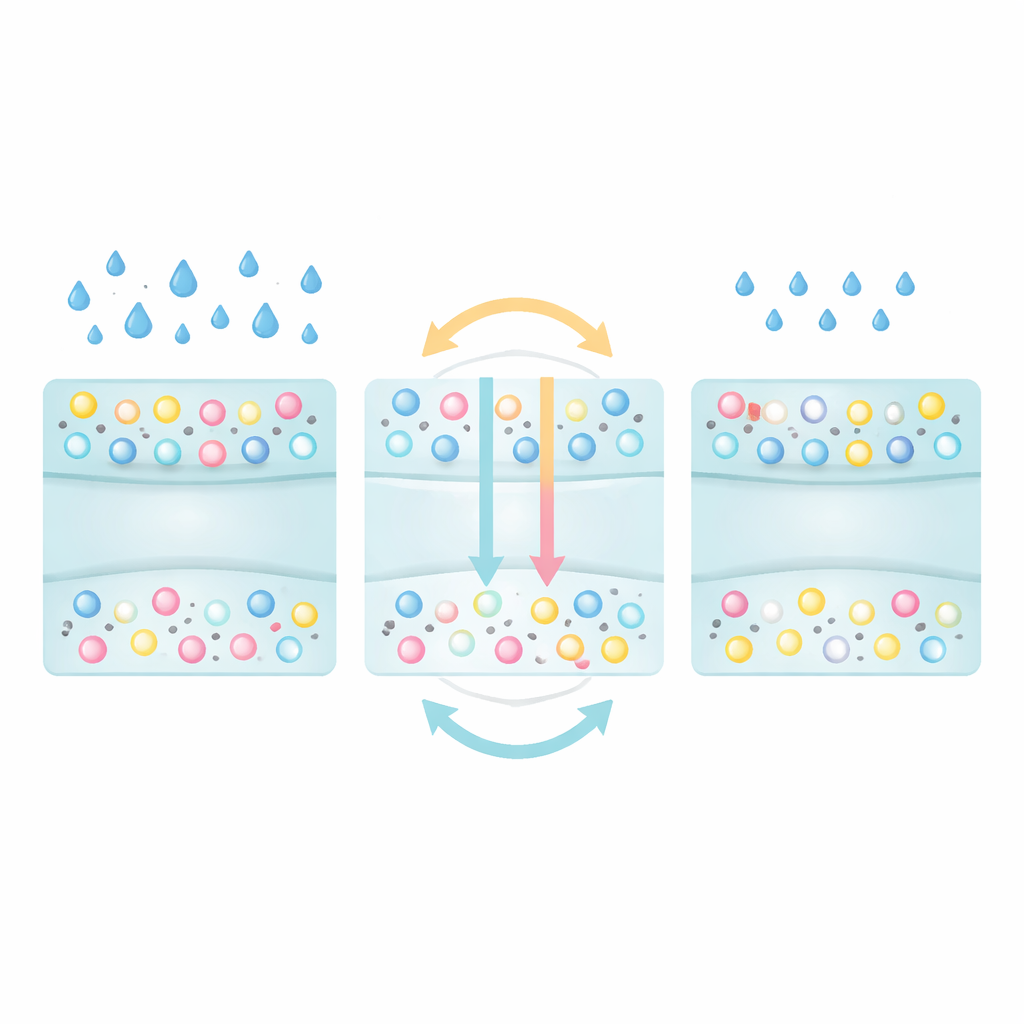
The key trick is a reversible dance between these iodine species. Under drier conditions, iodide and iodine tend to join into triiodide. Under wetter conditions, triiodide falls apart again into its simpler pieces. When the air becomes more humid, water penetrates the top of the gel first, favoring the breakup of triiodide near the exposed surface and leaving behind extra iodide there. Because iodide ions are small and mobile, they rush downward through the still-drier interior toward the lower electrode, creating a burst of current that slowly fades as the system rebalances. When the air dries out again, the chemical balance tips the other way at the surface, drawing iodide back upward and reversing the ion flow — and the direction of the current — without consuming electrodes or fuel.
Tuning and proving the effect
To show that this mechanism really drives the electricity, the researchers systematically vary the gel recipe and test many control samples. Only gels loaded with the iodine salt produce strong back-and-forth currents; similar salts based on other elements fail to do so. Stronger acidity in the gel leads to more triiodide and higher electrical output, up to a saturation point. Making the gel thicker increases the size and duration of the current until moisture gradients are fully used. Using Raman spectroscopy, which reads the vibrational “fingerprints” of molecules, the team tracks how triiodide concentrations rise and fall inside the gel as humidity cycles, matching the direction and timing of the measured electrical signals. Computer simulations back this up by showing that water-rich conditions favor triiodide breakup, while dry conditions favor its re-formation.
Built for real weather, not just the lab
Crucially, the device keeps working under realistic, gentle humidity swings rather than only in extreme “desert versus fog” conditions. In cycling tests between very dry and nearly saturated air, the current repeats for almost two weeks without noticeable decay, and similar behavior continues even after the device is stored for months. The gel responds to humidity changes as small as a few percent and can still reverse its current when the humidity difference is only about 13 percent, a range typical of day–night weather changes. Tests in a chamber that mimics daily cycles, and even outdoors, show that the device can ride on natural humidity rhythms to deliver a persistent trickle of power.
What this means for future small devices
In simple terms, the researchers have turned the everyday breathing of the atmosphere into a tiny but steady electrical pump, powered only by shifting moisture and a reversible chemical shuffle of iodine inside a soft gel. While the present devices produce modest power and still face challenges such as slow loss of iodine, the underlying idea is powerful: instead of fighting the tendency of ions to spread out and stop moving, the design repeatedly rebuilds imbalances using nothing more than natural humidity cycles. This approach could form the basis for long-lived, maintenance-free power sources for small sensors and electronics in remote or hard-to-access places where sunlight, wind, or batteries are impractical.
Citation: Lu, X., Liu, J., Fu, C. et al. Humidity-induced dynamic coordination drives the oscillatory migration of ions for sustainable energy harvesting. Nat Commun 17, 2687 (2026). https://doi.org/10.1038/s41467-026-69206-5
Keywords: moisture electricity, hydrogel generator, humidity energy harvesting, ionic oscillation, triiodide coordination