Clear Sky Science · en
Interfacial dipole engineering by self-assembled molecules in n-i-p and p-i-n perovskite solar cells
Smarter Surfaces for Better Solar Power
Solar panels made from perovskites—crystal-like materials that convert sunlight to electricity—are racing toward the efficiency of today’s silicon panels but still struggle with losses at their internal boundaries. This study shows how a carefully designed layer of self-arranging molecules can tidy up those boundaries, helping electric charges escape more easily and making perovskite solar cells not only more efficient but also more durable in heat and humidity.
Where Solar Cells Quietly Lose Power
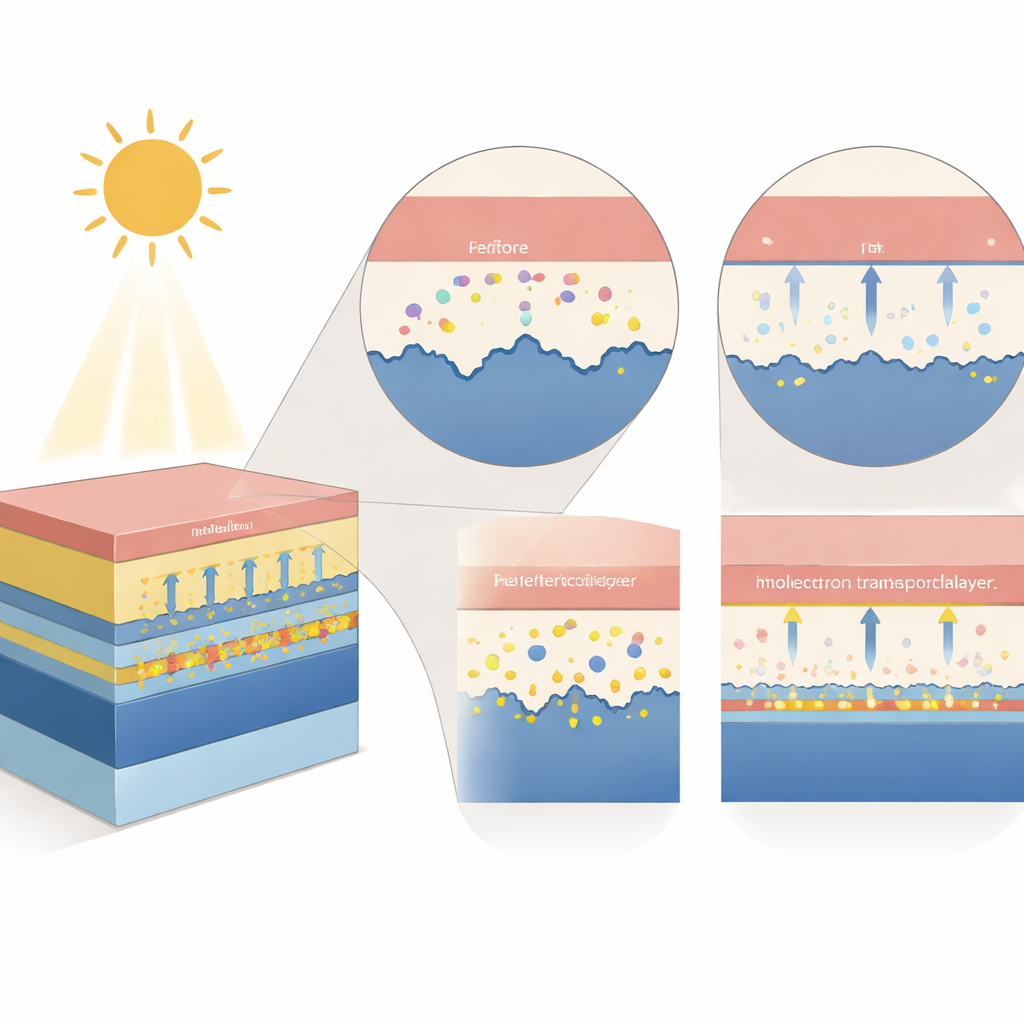
Modern perovskite solar cells are built like a layer cake: a light-absorbing perovskite film is sandwiched between layers that carry negative and positive charges away. Even when the perovskite itself is high quality, its top surface—where it meets the layer that extracts positive charges (holes)—can be messy. Tiny defects and poor energy matching at this junction act like potholes and speed bumps, causing charges to recombine before they can do useful work. The result is a lower voltage, reduced current, and faster aging of the device.
Self-Assembling Molecules as Microscopic Bridge Builders
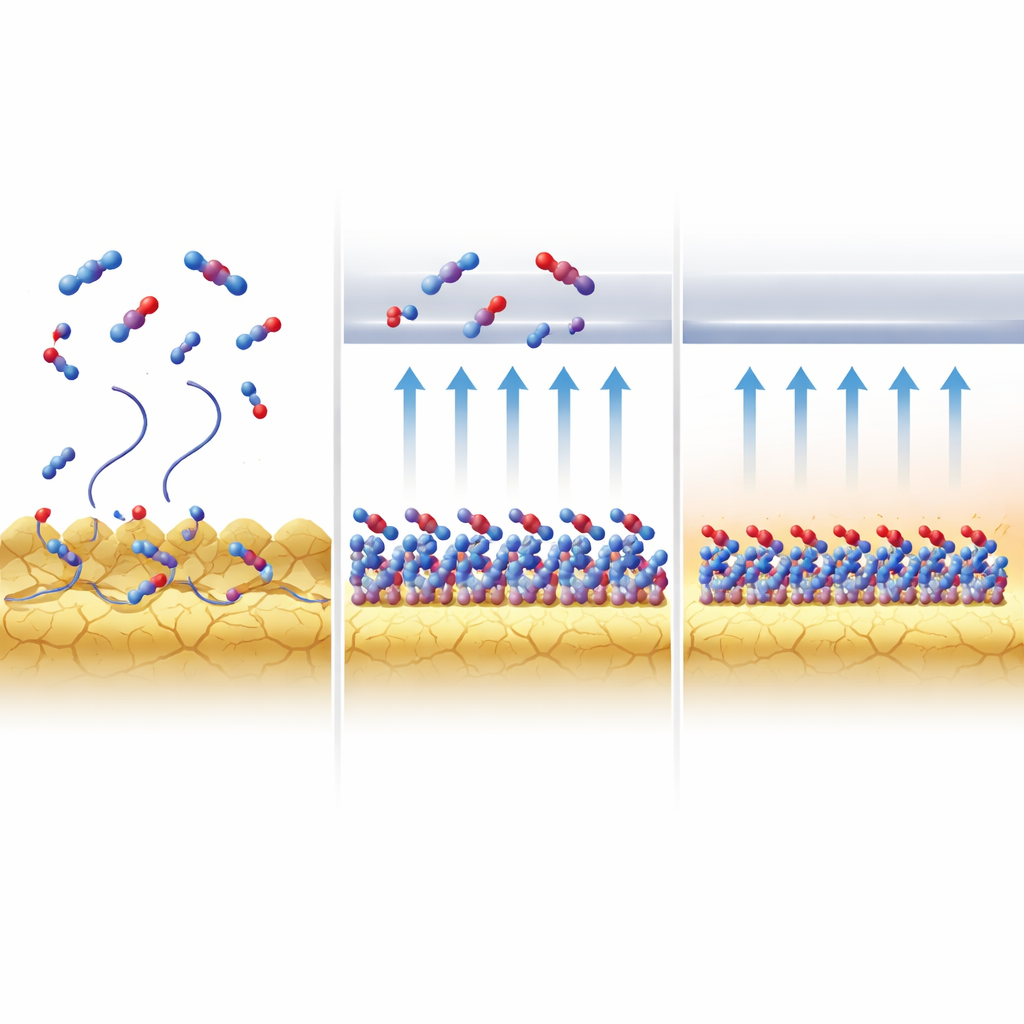
The researchers designed two related molecules, called SFX-P1 and SFX-P2, that naturally line up and attach themselves to the perovskite surface. One end of each molecule grips the perovskite, while the other end resembles the material used in the hole-transport layer above. In effect, this creates a molecular “bridge” that links the crystal below to the charge-collecting layer above. By choosing the right solvent when coating these molecules, the team can persuade them to pack more neatly, forming an ordered, ultra-thin interfacial sheet rather than a patchy, disordered film.
Shaping Invisible Electric Fields at the Interface
These molecules carry built-in electric dipoles—tiny charge separations that act like nanoscopic batteries. When many such molecules stand in an organized layer, their combined dipoles shift the local energy landscape at the perovskite surface. Measurements and computer simulations show that the best-performing molecule, SFX-P1, creates a stronger and more favorable shift than SFX-P2. This tuning shrinks the energy mismatch between the perovskite and the hole-transport layer, making it easier for holes to flow across the interface while blocking electrons from leaking the wrong way. As a result, charges are separated more cleanly and recombine less often.
Higher Efficiency and Longer Life in Real Devices
When the team inserted this self-assembled layer into standard perovskite solar cell designs, they saw immediate gains. In the so-called n-i-p configuration, cells using SFX-P1 reached a power conversion efficiency of 26.18%, with lower electrical hysteresis and excellent performance even in larger-area devices. The same strategy also worked in the inverted p-i-n design, confirming that the approach is broadly applicable. Detailed optical and electrical tests revealed faster extraction of charges and reduced energy losses at the critical junction. Beyond efficiency, the molecular layer also acted as a protective skin: it made the surface more water-repellent and slowed the movement of unwanted ions, greatly improving stability under heat, moisture, and prolonged illumination.
What This Means for Future Solar Panels
By engineering a single molecular layer at a hidden interface, the researchers show that subtle control over electric fields and surface chemistry can deliver big gains in performance and lifetime. Their best molecule, SFX-P1, organizes into a dense, ordered film that guides charges out of the perovskite while shielding it from environmental stress. Because this approach works in multiple device layouts and relies on solution-based processing, it offers a practical route to more efficient, longer-lasting perovskite solar modules. In simple terms, tidying up the atomic-scale handshake between layers brings perovskite technology closer to real-world, commercial-ready solar power.
Citation: Zhai, M., Wu, T., Du, K. et al. Interfacial dipole engineering by self-assembled molecules in n-i-p and p-i-n perovskite solar cells. Nat Commun 17, 2374 (2026). https://doi.org/10.1038/s41467-026-69198-2
Keywords: perovskite solar cells, self-assembled molecules, interfacial engineering, energy-level alignment, solar cell stability