Clear Sky Science · en
High-speed graphene-based sub-terahertz receivers enabling wireless communications for 6G and beyond
Why Faster Wireless Matters to Everyday Life
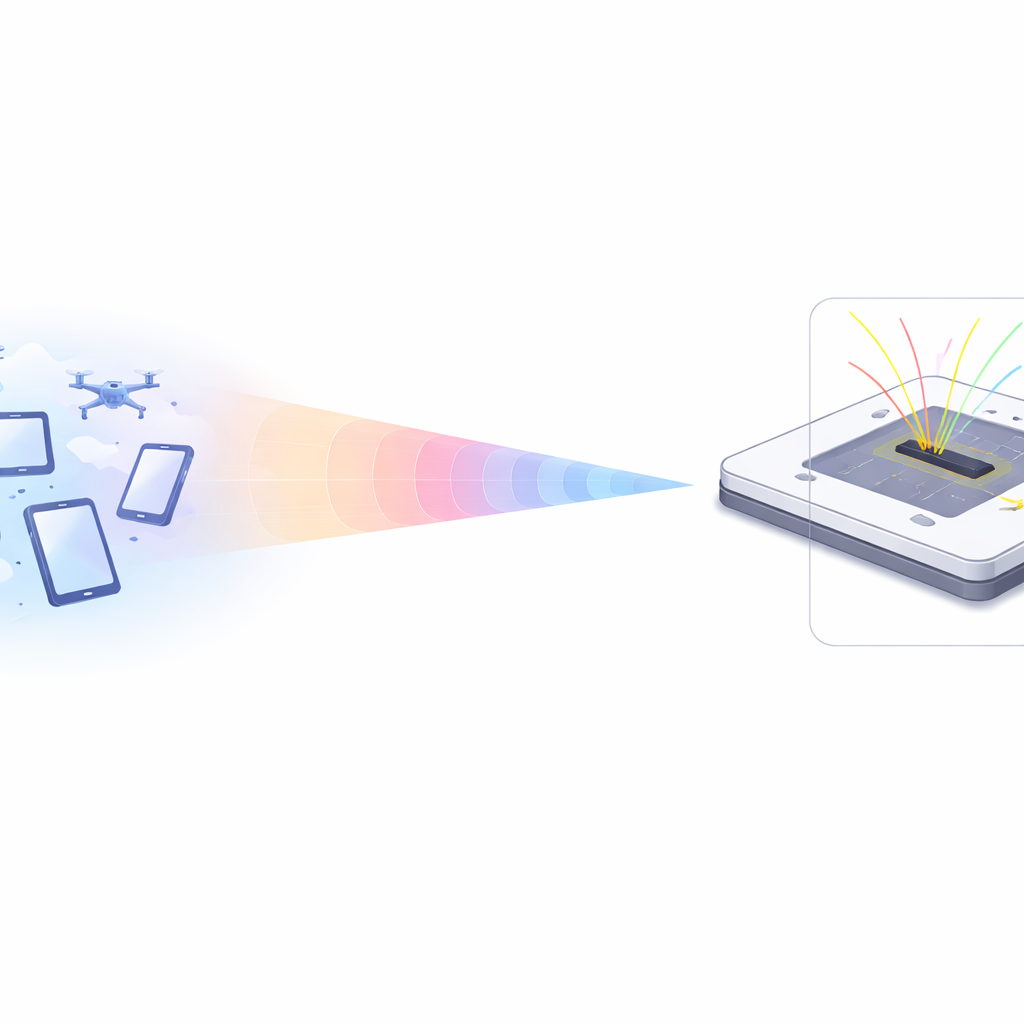
Our phones, laptops, and connected gadgets are sending more data than ever before—from streaming movies and cloud gaming to remote surgery and autonomous drones. Current 5G networks are already being pushed to their limits, and engineers expect that by the mid-2030s we will need wireless links that can handle trillions of bits every second. This study explores how an ultra-thin material called graphene can unlock a new slice of the radio spectrum, just below the terahertz range, to build tiny, low‑power receivers suited for the coming 6G era and beyond.
Moving Up the Wireless Speed Ladder
Today’s fastest wireless links rely on complex electronic or optical receivers that work at very high frequencies but need many supporting parts: local oscillators, mixers, amplifiers, bulky antennas, and lenses. These systems can reach impressive data rates over long distances, yet they are hard to shrink, power‑hungry, and not easily integrated onto standard silicon chips. The authors argue that sub‑terahertz frequencies—about 200 to 300 billion cycles per second—offer a sweet spot for short‑range connections such as chip‑to‑chip links inside data centers or close‑range device‑to‑device communication. The challenge is to build receivers in this band that are simple, compact, and compatible with existing microchip technology.
A Tiny Sheet of Carbon as the Sensing Heart
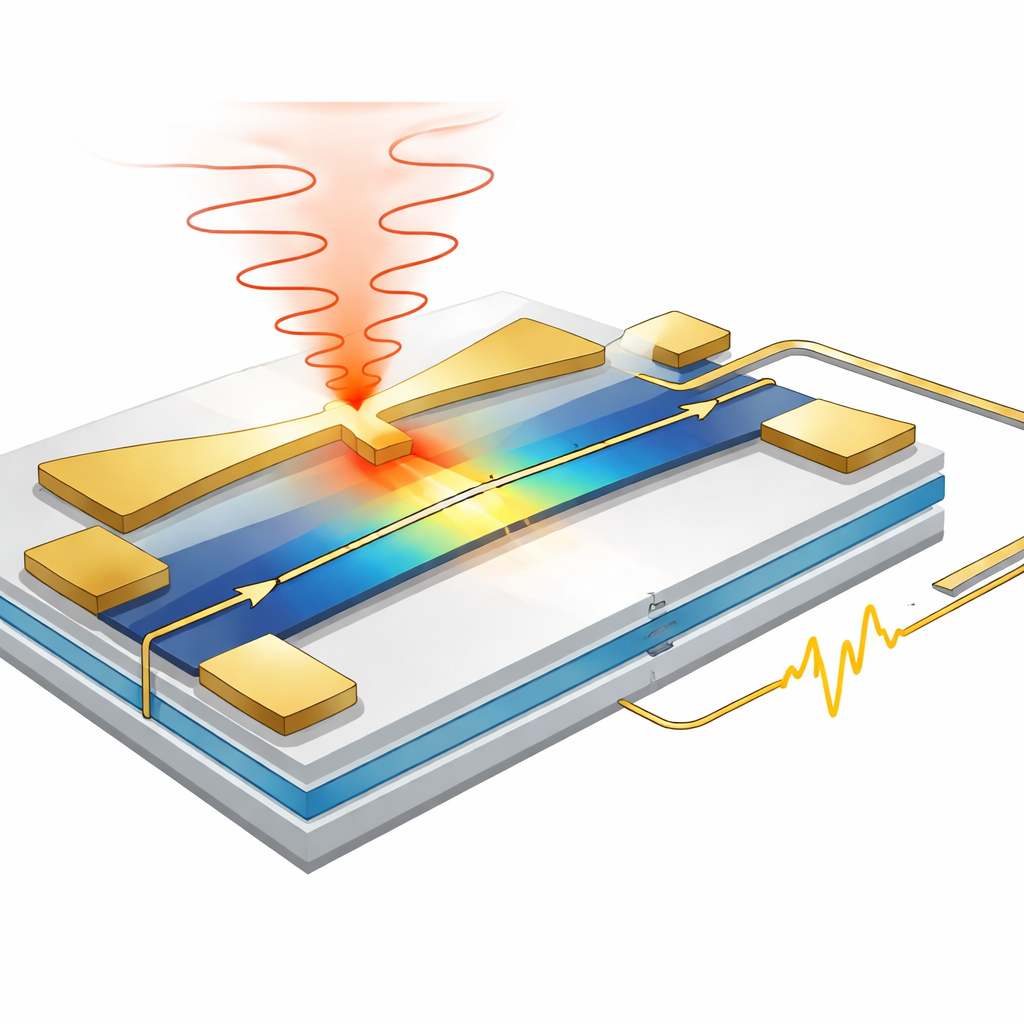
The researchers turn to graphene, a one‑atom‑thick sheet of carbon with exceptional electronic and thermal properties. Instead of using the usual active amplification schemes, they exploit a passive effect: when sub‑terahertz waves warm up one side of a graphene strip more than the other, an internal voltage arises because different parts of the strip conduct heat and charge slightly differently. By deliberately making the left and right halves of the graphene channel behave unlike each other—using separate electrodes underneath—they create a built‑in imbalance that converts tiny temperature differences directly into an electrical signal, all without applying any external voltage. This “self‑powered” operation eliminates dark current and cuts down on electronic noise.
Solving the Problem of Weak Signals
Because a single atomic layer absorbs very little incoming radiation, the team had to design a clever structure around the graphene to gather and concentrate sub‑terahertz energy. They integrate a metal dipole antenna whose small central gap sits exactly above the active graphene region; this antenna acts as a resonator tuned around 0.23 terahertz. Beneath the silicon chip they add a reflective metal layer, forming a sort of cavity that bounces the waves back and forth. Simulations and measurements show that this combination boosts the field intensity at the graphene by several‑fold. As a result, their best device, built from high‑quality graphene wrapped in an insulating crystal called hexagonal boron nitride, reaches a responsivity of about 0.16 amperes per watt with very low intrinsic noise, enough to detect multi‑gigabit data streams over distances of up to roughly three meters.
Trading Bandwidth for Sensitivity
One of the central findings of the work is a clear trade‑off between how strongly the receiver responds and how fast it can operate. Devices that make heavy use of the antenna‑plus‑mirror cavity show strong signals but are limited to bandwidths of only about 1 to 2 gigahertz around their resonance, because the cavity selects a narrow slice of frequencies. A specially designed variant without this resonant structure responds much more weakly but achieves bandwidths up to 40 gigahertz, limited only by the test equipment. This suggests that graphene itself can handle extremely rapid changes—its internal cooling times are just trillionths of a second—and that the main speed bottleneck comes from how the incoming waves are coupled into the device, not from the material.
What This Means for Future Networks
To a non‑specialist, the key takeaway is that the authors have built a working prototype of a sub‑terahertz wireless receiver that is unusually simple, small, and energy‑efficient, yet already capable of multi‑gigabit data rates. Because it operates without active bias, matches standard 50‑ohm electronics, and can be fabricated on silicon using graphene grown at scale, it is well suited to integration directly onto communication chips. With further improvements—such as arrays of receivers to collect more power, broader antennas to widen the usable frequency band, and more advanced data encoding schemes—the same concept could support tens or even hundreds of gigabits per second. Graphene‑based receivers of this kind may therefore become an important building block in the compact, low‑power hardware that will underpin 6G and later generations of wireless technology.
Citation: Soundarapandian, K.P., Castilla, S., Koepfli, S.M. et al. High-speed graphene-based sub-terahertz receivers enabling wireless communications for 6G and beyond. Nat Commun 17, 2627 (2026). https://doi.org/10.1038/s41467-026-69186-6
Keywords: graphene receivers, sub-terahertz wireless, 6G communications, high-speed photodetection, CMOS-integrated nanotechnology