Clear Sky Science · en
Genomics of rafting crustaceans reveals adaptation to climate change in tropical oceans
Riding the Waves on Floating Wood
Along many tropical beaches, tiny sand-hopper crustaceans live hidden in and under driftwood. When storms or tides sweep their wooden homes out to sea, these animals can raft for months across vast stretches of ocean. This study asks a timely question: as climate change alters ocean currents and saltiness, can these hitchhiking beach dwellers still follow their preferred environments—and can their genomes keep up with the pace of change?
Ocean Highways for Beach Hoppers
The researchers focused on a common sand-hopper, Talorchestia martensii, found on shorelines across the Indo-Australian Archipelago, from Vietnam and Thailand down to Borneo and Sulawesi. Unlike many marine creatures, these amphipods do not have free-swimming larvae; instead, adults disperse only when the driftwood they occupy is carried away by currents. By sequencing whole genomes from over a hundred individuals and comparing them across the region, the team identified five main geographic populations and reconstructed how they have split and mixed over millions of years. They then combined these genetic patterns with computer models of ocean circulation to test whether present-day currents could explain how genes move between distant beaches.
Summer Currents and One-Way Journeys
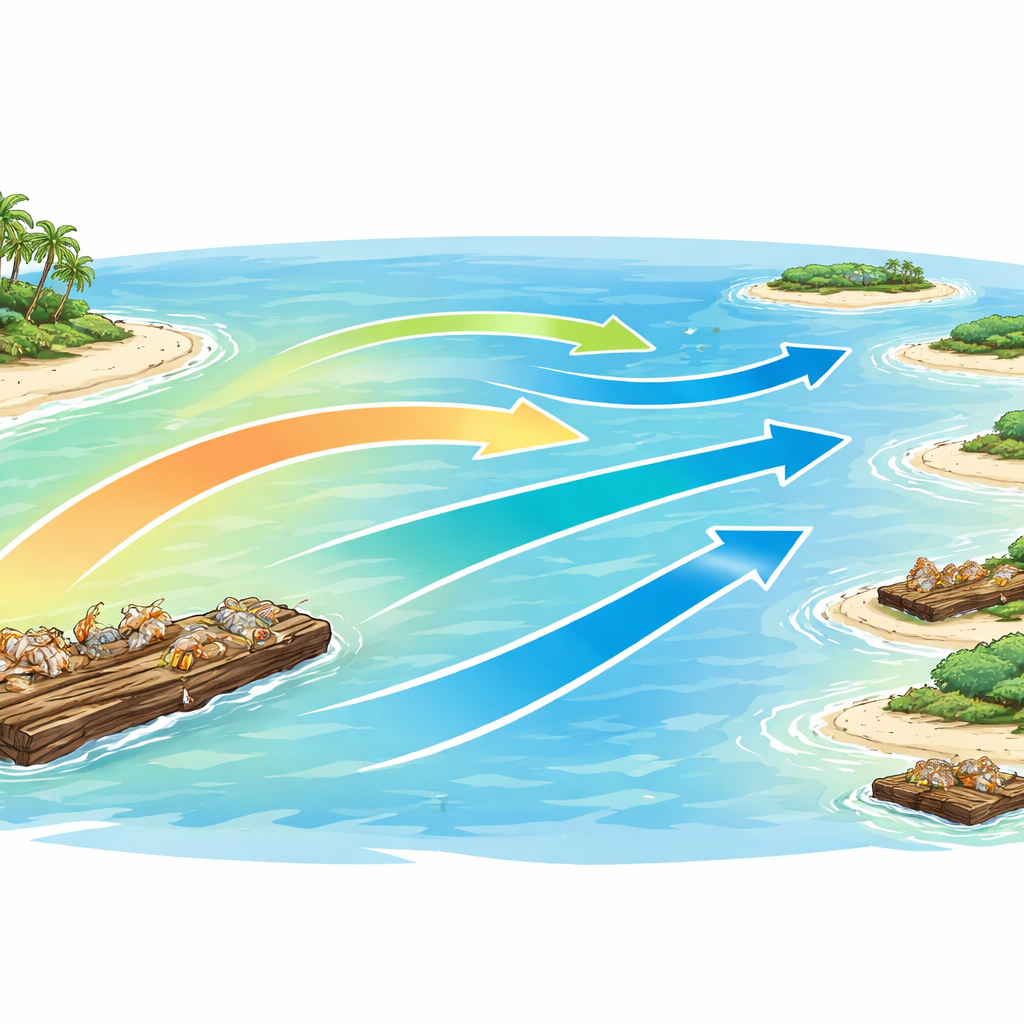
Simulations showed that gene flow among these beach hoppers is strongly “one-way.” In particular, genetic data and modelled migration scenarios point to much stronger northward movement—from South Sulawesi and East Borneo up toward Vietnam and Thailand—than in the opposite direction. Ocean models helped explain this: during the boreal summer, surface waters flow northward through narrow straits and along the Malay Peninsula, providing a seasonal express route for driftwood rafts. Virtual particles released from southern sites in summer frequently reached northern coasts, whereas winter flows rarely delivered rafts back south. This means the animals’ genetic connections follow the shape and seasonality of tropical currents, rather than simple geographic distance.
Future Seas, Shifting Salt, and Genetic Mismatch
Climate change is expected to speed up some currents and alter sea surface salinity—how salty the water is—especially in the tropics. Using a machine‑learning approach, the authors linked thousands of genetic variants to present‑day environmental conditions, finding that variation in these crustaceans’ DNA is particularly tied to local salinity. They then projected how well today’s genomes would match future conditions under high‑emissions scenarios later this century. Many populations, especially in the central and southern part of the range, are predicted to become genetically mismatched with their future environments unless they can shift northward. While models suggest that long‑distance rafting might allow some tracking of suitable habitats, changing current directions and speeds will make these journeys more difficult or less reliable for the majority of populations.
Surviving Wild Swings in Salt and Finding Food
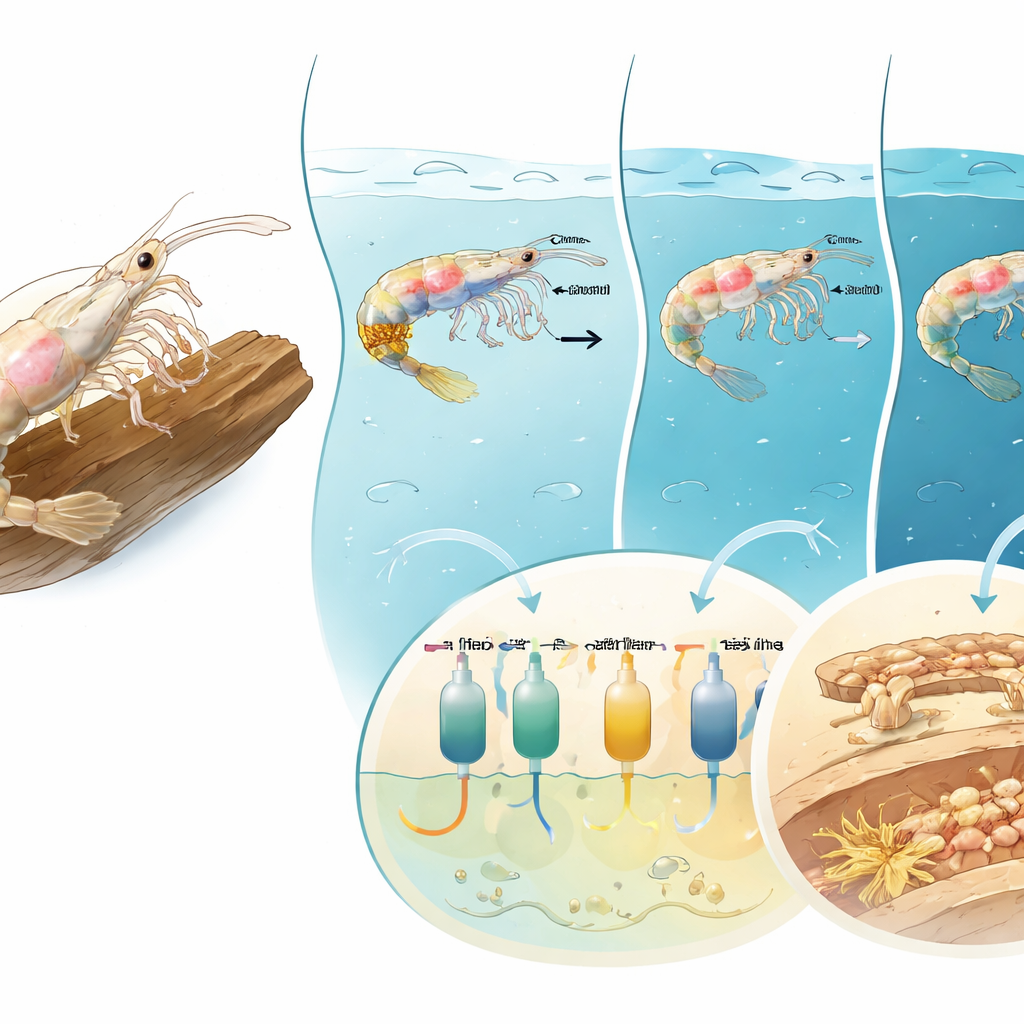
Long rafting voyages expose these animals to large swings in salinity, which can be deadly if they cannot maintain internal water and salt balance. By exposing amphipods to different salt levels in the lab and sequencing RNA from their gills, legs, and whole bodies, the team showed that key ion-transport genes switch their activity up or down depending on salinity and exposure time. Gills, in particular, act as the main control centers, rapidly changing expression of genes that move sodium, potassium, and other ions across cell membranes. The authors also traced the animals’ ability to feed on driftwood itself. Genomic analyses revealed expanded families of wood‑digesting enzymes—some likely acquired long ago from fungi—allowing these tiny rafters to break tough cellulose into usable sugars while at sea, an essential energy source during months‑long trips.
What This Means for Life on a Warming Coast
Taken together, the study paints a picture of small coastal crustaceans finely tuned to life on drifting wood in a changing ocean. Seasonal currents provide natural conveyor belts that can carry populations toward cooler, more suitable waters, while flexible gene activity and specialized digestive tools help them withstand shifting salt levels and scarce food. Yet the same climate change that creates new pathways can also scramble ocean circulation, increasing the risk that future currents will no longer line up with the directions these species need to travel. For lay readers, the message is that even humble sand-hoppers are sophisticated navigators of Earth’s fluid, connected seas—and that preserving their future will depend not only on their remarkable biology, but also on how much we alter the physical highways they rely on.
Citation: Liu, H., Waters, J.M., Huang, M. et al. Genomics of rafting crustaceans reveals adaptation to climate change in tropical oceans. Nat Commun 17, 2431 (2026). https://doi.org/10.1038/s41467-026-69173-x
Keywords: marine rafting, climate change adaptation, ocean currents, genomics, salinity tolerance