Clear Sky Science · en
Simulating fluid vortex interactions on a superconducting quantum processor
Why swirling flows and quantum chips matter
From hurricanes and ocean eddies to the tiny currents in microfluidic devices, swirling structures called vortices help shape how fluids move and mix. Simulating these whirling motions in detail quickly overwhelms even powerful supercomputers, especially when scientists want to follow every twist and turn over long times. This study shows how a new approach, run on a superconducting quantum processor, can capture these complex vortex dances more efficiently, hinting at a future where quantum hardware becomes a practical tool for studying fluid motion in nature and technology.
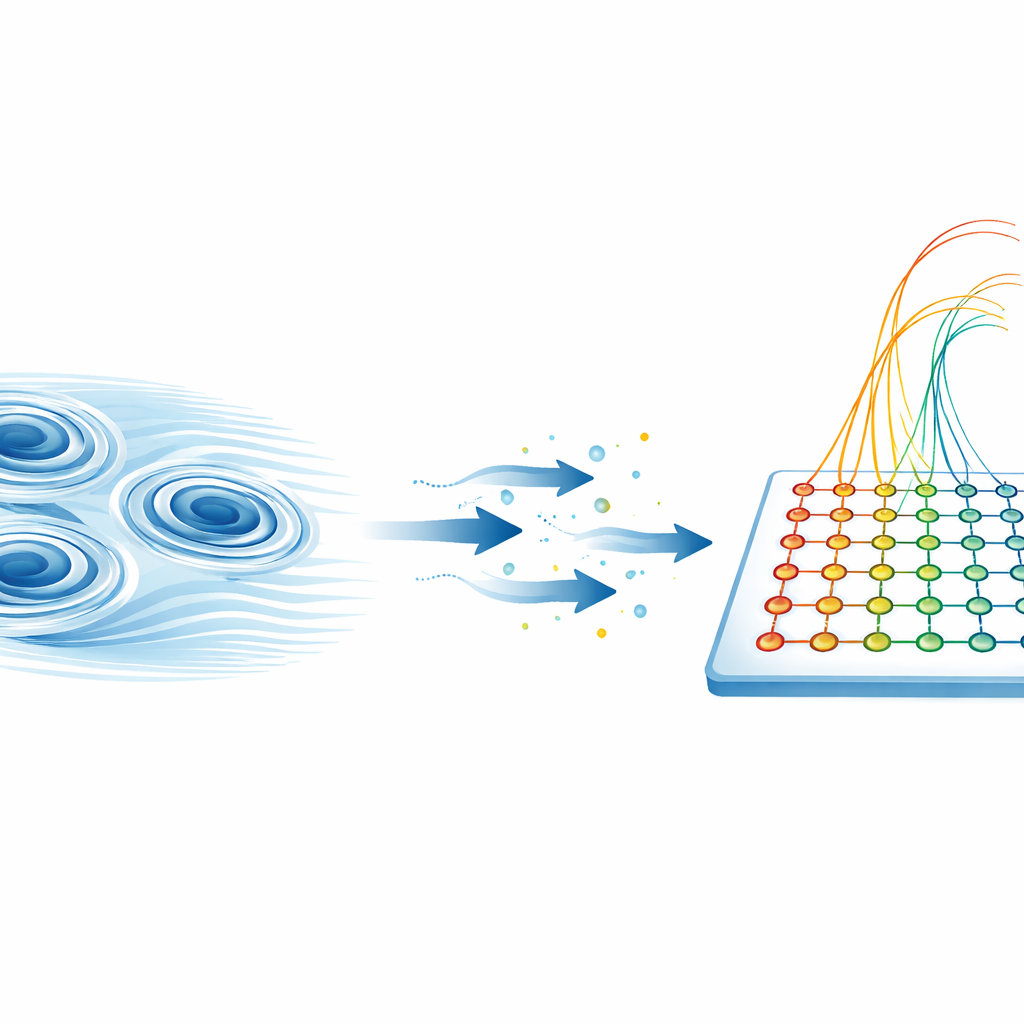
Swirling patterns all around us
Vortices are the circular motions you see in everything from tropical cyclones and ocean currents to plasma in space and flows in small channels. When several vortices interact, they can pair up, swap positions, or even “leapfrog” over each other in a repeating pattern. These interactions control how energy and momentum are passed around in a fluid and are central to understanding turbulence. But capturing these fine-scale details for long periods requires extremely high spatial and temporal resolution, turning traditional computer simulations into heavy, sometimes impractical tasks.
Turning vortex motion into a quantum-friendly picture
Most conventional fluid solvers describe the flow on a fixed grid, recording the velocity and pressure at many points in space. That description does not naturally fit onto today’s noisy quantum devices, because the number of quantum bits would have to grow with the number of grid points. The authors instead focus directly on the vortices themselves, following their positions in a so-called Lagrangian way. They introduce a "quantum vortex method" that mathematically rewrites the motion of these vortex particles as the evolution of a normalized wave-like state, similar in spirit to how quantum systems are described. This reformulation keeps key conservation laws of fluid motion while making the dynamics compatible with the unitary evolution of a quantum computer.
Storing space and time together in a quantum state
A central innovation of the work is a spatiotemporal encoding scheme that lets a quantum processor represent many time steps at once. A small set of spatial qubits stores the state of all vortices at a given instant, while additional temporal qubits are prepared in a superposition so that each of their possible configurations corresponds to a different time. Carefully designed evolution modules act on the spatial qubits under the control of the temporal qubits, causing the state to “branch” like a tree and simultaneously contain information about the vortex system at many moments. In practical terms, this allows the circuit to generate the entire time history of the flow in one coherent run, rather than repeatedly re-preparing and evolving the state step by step.
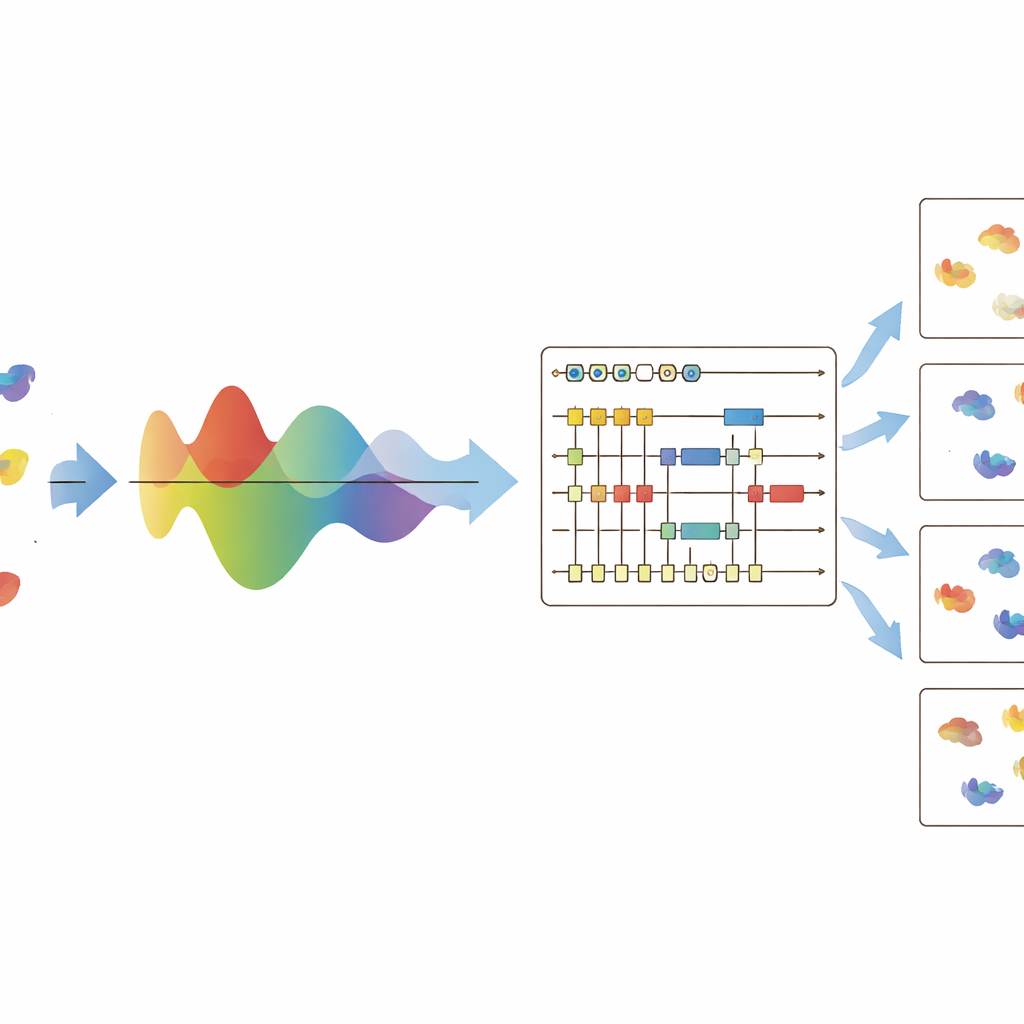
Putting the method on a real quantum chip
To test the idea, the team implemented their scheme on an eight-qubit superconducting quantum processor where individual qubits are arranged in a square grid and coupled to their nearest neighbors. Some qubits represented the positions of vortex particles, while others encoded time. Using a data-driven strategy, they trained effective evolution modules that mimic how the vortex wave-like state should change. With this hardware, they recreated a classic fluid phenomenon known as leapfrogging, where two vortex rings (represented in two dimensions by four point vortices) repeatedly pass through each other. The experimentally reconstructed vortex paths closely matched both ideal numerical simulations and more realistic noisy simulations, with high agreement in the underlying quantum state and only small deviations in particle positions.
From simple tests to complex, turbulent flows
Beyond the leapfrogging case, the researchers explored more challenging examples in numerical simulations. They modeled an eight-vortex system with randomly placed vortices that resembles a turbulent patch of fluid, showing that their quantum circuit can follow the evolution while preserving coherent structures. They also tackled flows where viscosity, or internal friction in the fluid, matters. In a two-vortex system where viscous effects cause the vortices to drift and deform, their quantum framework captured the true motion far more accurately than a standard vortex method, because the learned quantum evolution module can implicitly encode how viscosity modifies the dynamics over time.
What this means for the future of fluid modeling
For everyday readers, the key message is that the authors have found a way to translate the swirling motion of fluids into a language that quantum computers can handle, and they have shown it working on an actual superconducting chip. Their method scales with the number of vortices rather than the number of grid points in space, and it uses quantum superposition to store many time steps compactly, so the cost of following the flow grows only slowly with simulation length. While important pieces of real-world fluid behavior—such as detailed viscous merging and splitting of vortices—remain to be fully captured, this work provides a concrete path toward using quantum devices as specialized engines for simulating complex flows in the atmosphere, oceans, plasmas, and engineered systems.
Citation: Wang, Z., Zhong, J., Wang, K. et al. Simulating fluid vortex interactions on a superconducting quantum processor. Nat Commun 17, 2602 (2026). https://doi.org/10.1038/s41467-026-69168-8
Keywords: quantum computing, fluid dynamics, vortices, superconducting qubits, turbulence simulation