Clear Sky Science · en
Ancient DNA and spatial modeling reveal a pre-Inca trans-Andean parrot trade
Colorful Birds, Silent Evidence
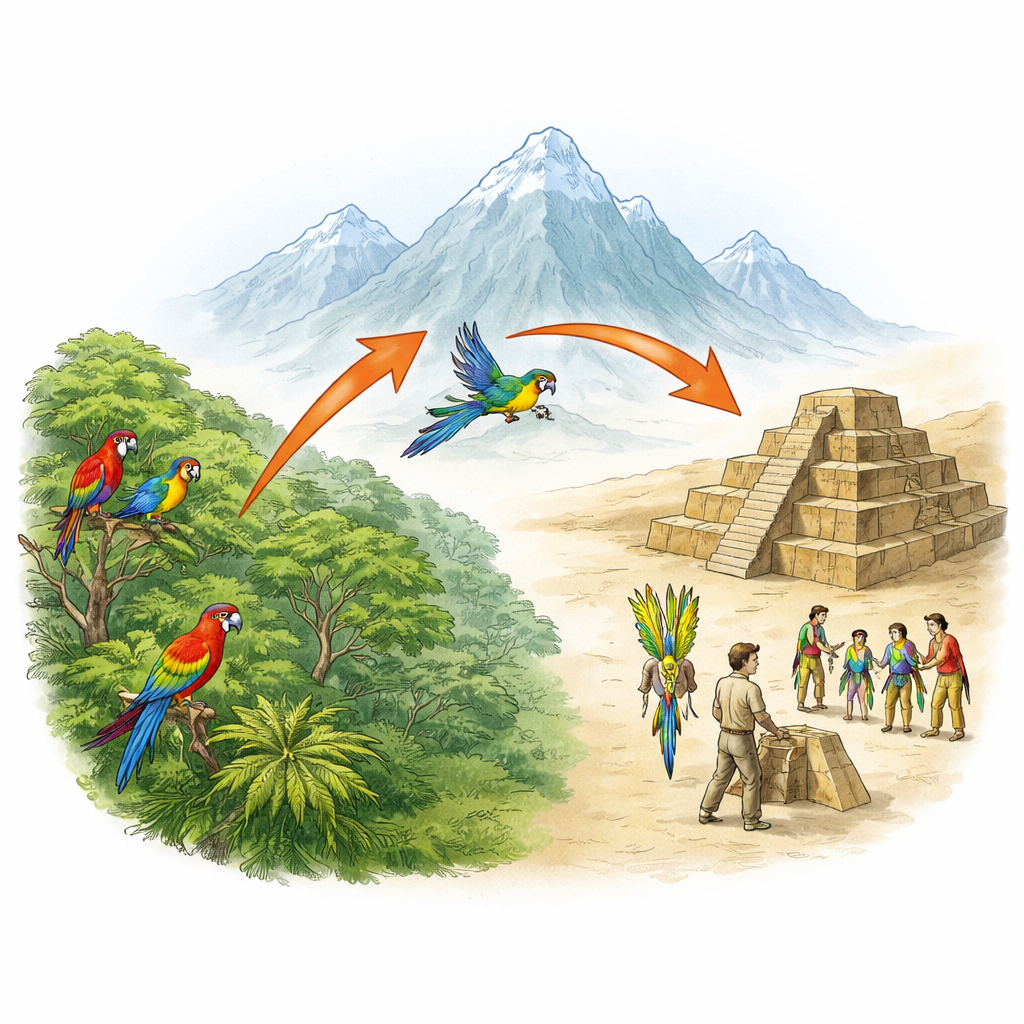
Centuries before the Inca Empire rose to power, people living on Peru’s dry Pacific coast treasured the brilliant feathers of Amazonian parrots as symbols of status and spirituality. But those birds lived far away, across one of the world’s toughest mountain ranges, the Andes. This study follows the trail of those feathers—from tropical rainforest to a stone tomb by the sea—using a mix of genetic testing, chemical clues, and digital mapping to show how an unexpected long-distance trade network thrived in pre-Inca times.
A Hidden Story in a Desert Tomb
The investigation begins at Pachacamac, a major religious center on Peru’s central coast that flourished between about 1000 and 1470 CE under the Ychsma culture. In 2005, archaeologists uncovered a rare, intact stone-lined tomb packed with 34 funerary bundles belonging to high-status individuals. Several of the largest bundles were crowned with spectacular feather ornaments attached to artificial “false heads” that symbolized the deceased in their full ceremonial attire. These bright feathers clearly came from tropical birds, but their exact species and homelands were impossible to determine by sight alone, because processed feathers often lose the distinctive traits used in bird identification.
Reading DNA Traces in Ancient Feathers
To push beyond guesswork, the researchers turned to ancient DNA. They carefully sampled 25 fragile feathers from different parts of the tomb and used specialized techniques to capture and sequence tiny fragments of mitochondrial DNA, which is well suited for studying degraded remains. Genetic comparisons with modern birds showed that most colorful feathers came from four large Amazonian parrot species: the Scarlet Macaw, Red-and-green Macaw, Blue-and-yellow Macaw, and Mealy Amazon parrot. One white feather turned out to be from Sabine’s Gull, a seabird that visits the Peruvian coast. The parrots, in contrast, are native to lowland tropical forests and palm swamps far to the east of the Andes. Moreover, the macaw DNA displayed high genetic diversity, matching wild populations rather than the low diversity expected from small, inbred captive flocks. This indicates the birds were originally taken from free-ranging Amazonian populations, not bred locally on the coast.
Chemical Clues to a Coastal Life
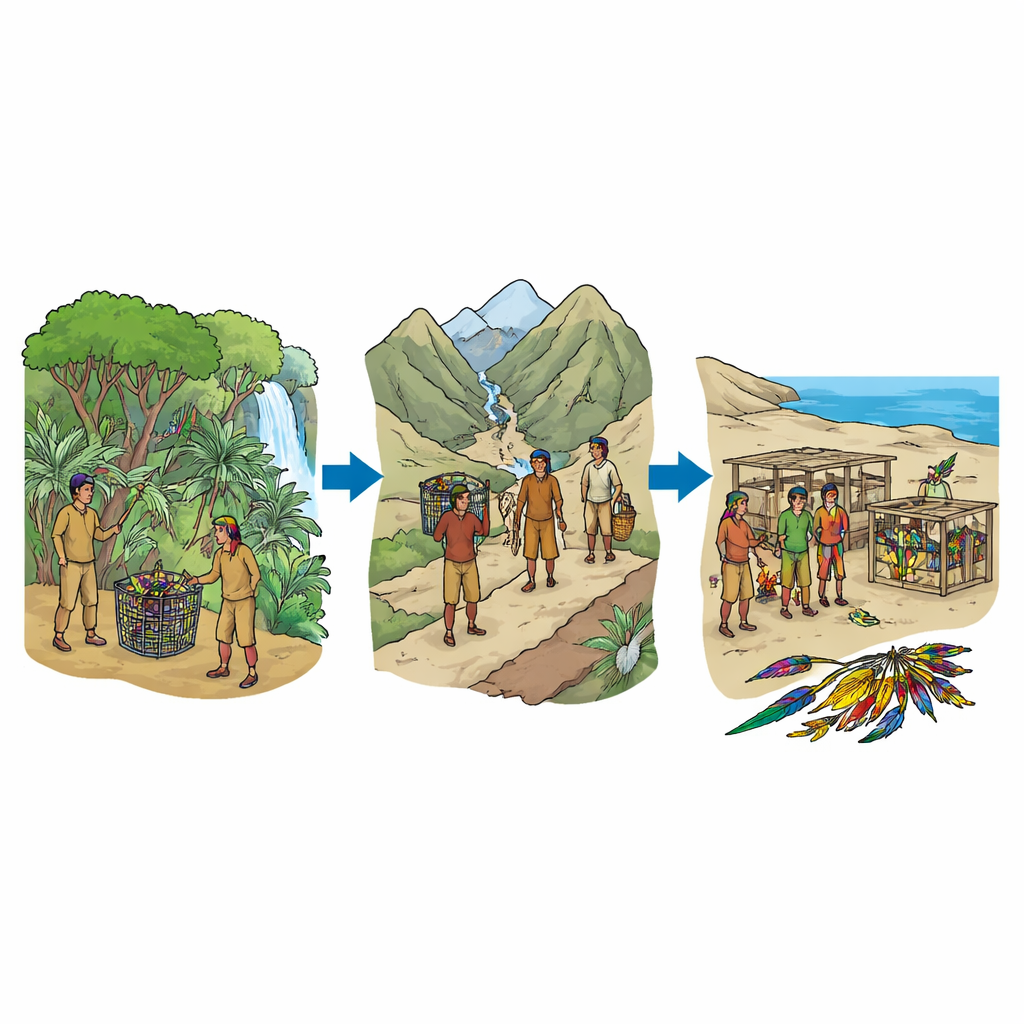
Yet the parrots’ DNA told only part of the story. The team also measured stable forms of carbon and nitrogen in the feathers, which record what the birds were eating while those feathers were growing. The results did not match the chemical signatures of parrots living in the rainforest today. Instead, they pointed to a diet rich in so-called C4 plants—especially maize—likely grown with fertilizer from seabird guano along the coast. This combination of wild genetic origins and coastal dietary signals suggests a two-stage life history: the parrots hatched in the Amazon, were captured there as live birds, carried across the mountains, and then kept and fed for some time in coastal settlements before their feathers were harvested for elite regalia.
Mapping Ancient Trade Routes Across the Andes
To find how such birds could realistically travel from rainforest to desert, the researchers used computer models that combine climate, elevation, rivers, and potential seafaring routes. First, they reconstructed where the four parrot species were likely to have lived around the year 1000 CE, based on past climate data. These maps placed all suitable habitats east of the Andes, with no natural populations near the coast. Next, they treated the landscape like an electrical circuit to identify the “paths of least resistance” that people might have followed while transporting goods. The models highlighted two main corridors: a northern route that linked Pachacamac to powerful coastal states such as the Chimú and Sicán, which in turn connected to bird-rich regions in the highland forests; and a more direct central route, crossing the Andes toward areas like Cerro de la Sal, long known as hubs where Indigenous Arawak-speaking groups traded rainforest products with highland and coastal communities.
What These Feathers Tell Us About the Past
Together, the ancient DNA, chemical fingerprints, and spatial modeling paint a vivid picture of a managed, long-distance trade system that moved live Amazonian parrots hundreds of kilometers to the Pacific shore well before the Inca Empire unified the Andes. The Ychsma people, often portrayed as part of a fragmented era of regional rivals, were in fact plugged into far-reaching networks that linked rainforest, mountains, and coast. Beyond revealing how prized feathers reached an elite tomb, this work showcases a powerful toolkit for tracing ancient exchange of organic materials—from birds and animals to plants and textiles—and reminds us that humanity’s fascination with colorful parrots, which today fuels illegal wildlife trafficking, has deep and complex roots.
Citation: Olah, G., Bover, P., Llamas, B. et al. Ancient DNA and spatial modeling reveal a pre-Inca trans-Andean parrot trade. Nat Commun 17, 2117 (2026). https://doi.org/10.1038/s41467-026-69167-9
Keywords: ancient trade networks, Amazonian parrots, pre-Inca Andes, ancient DNA, Pachacamac archaeology