Clear Sky Science · en
Strong long-term variability in active galactic nuclei affects virial black hole mass measurements
Weighing the giants at galaxy centers
At the heart of many galaxies lurk supermassive black holes, millions to billions of times the mass of the Sun. These dark giants power active galactic nuclei (AGN), where gas spirals inward and glows so brightly that it can outshine the whole galaxy. Astronomers would like to know how massive these black holes are to understand how they formed and grew over cosmic time. But because they are far away and too small to see directly, their masses must be inferred from how surrounding gas moves and shines. This study asks a deceptively simple question: if we "weigh" the same black hole decades apart using standard methods, do we get the same answer?
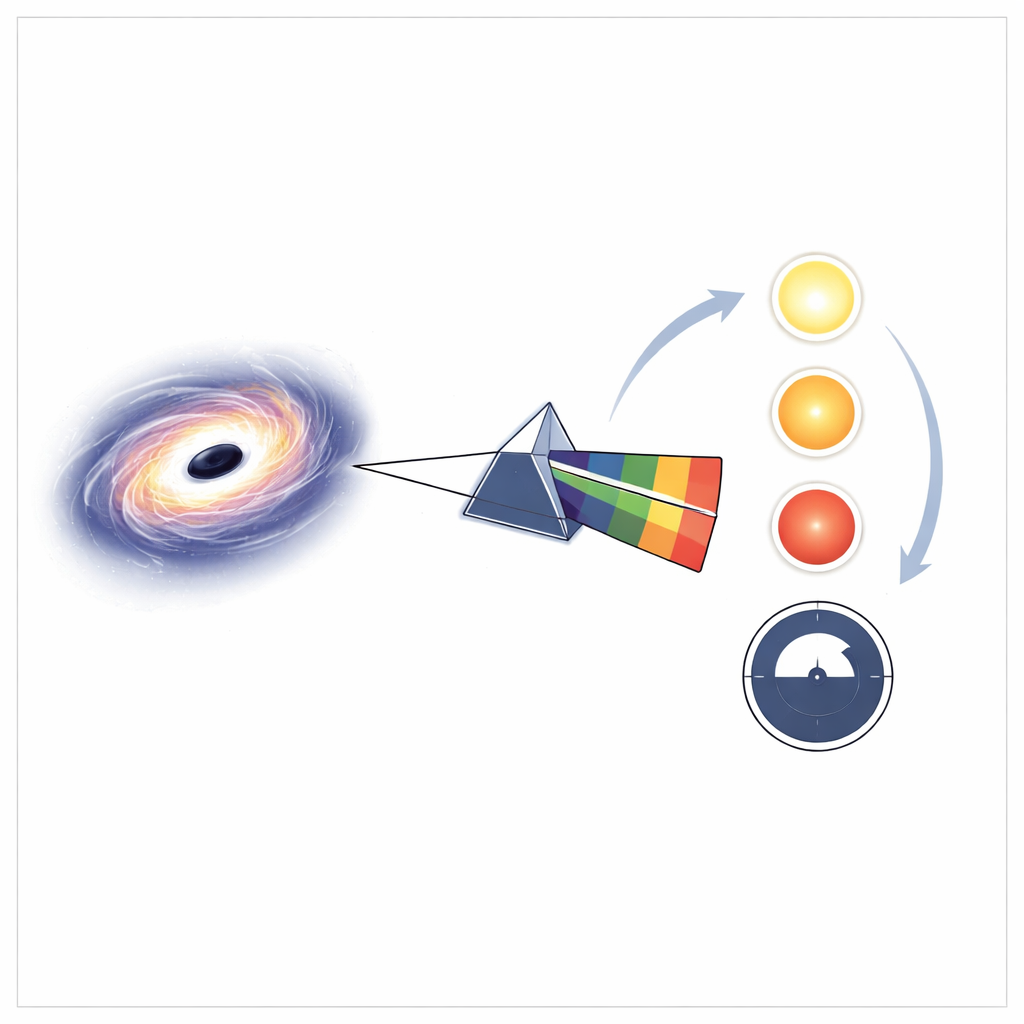
How black holes are usually weighed
The most widely used technique to estimate black hole masses in AGN relies on a kind of cosmic speed trap. Gas clouds close to the black hole race around at thousands of kilometers per second, emitting broad spectral lines in the process. The broader the line, the faster the gas is moving, and the stronger the black hole’s pull must be. To turn these velocities into a mass, astronomers also need an estimate of how far the gas is from the black hole. Instead of mapping this region for every object, they usually assume a simple rule of thumb: brighter AGN have larger gas regions. With a single snapshot spectrum, they plug the observed brightness and line width into a formula to get a "single-epoch" mass.
A decades-long recheck of cosmic scales
The authors put this everyday shortcut to a demanding test. They took a large, nearly complete sample of 323 nearby AGN first observed in the 6dF Galaxy Survey and re-observed them about 20 years later with a different telescope. Over such a timespan, the true black hole mass should not change, but the AGN brightness often does. By comparing pairs of spectra separated by two decades, they could ask: do the inferred masses stay the same, or do they wander? They also used a famous, intensely monitored AGN called NGC 5548, with 43 years of data, to build thousands of artificial 20‑year pairs mimicking the same experiment on a single object.
Black holes steady, mass estimates not so much
The team finds that the broad emission lines respond very differently from what the standard picture predicts. The overall brightness of the AGN, and the strength of the broad lines, typically change by about a factor of two over 20 years. Yet the widths of those broad lines—our proxy for gas speed—barely change. According to the usual "breathing" model, when an AGN brightens, the active gas region should puff outward and the line width should narrow to keep the inferred mass constant. Instead, the line widths show only modest, uncorrelated changes, a behaviour the authors call size inertia: the emission-weighted gas region does not seem to expand and contract in step with short-term brightness swings. As a result, the single-epoch masses based on rapidly varying light (from the continuum or broad lines) can differ by nearly half a dex between epochs—roughly a factor of three—purely because the AGN was caught in a different brightness state.
A quieter yardstick in the glow of distant gas
To find a more stable mass estimate, the authors turned to light from gas much farther out, known as the narrow-line region. This gas glows in specific features such as a greenish [OIII] emission line and sits hundreds of light-years from the black hole. Because light takes so long to traverse this region, it averages out the AGN’s ups and downs over decades, acting like a built‑in long‑exposure filter. The study shows that when black hole masses are computed using the inner gas velocities but the [OIII] luminosity as the measure of overall power, the repeatability after 20 years is the best of all tested methods. The scatter in mass estimates shrinks, and an otherwise puzzling dependence on how bright the AGN happens to be at the moment largely disappears.
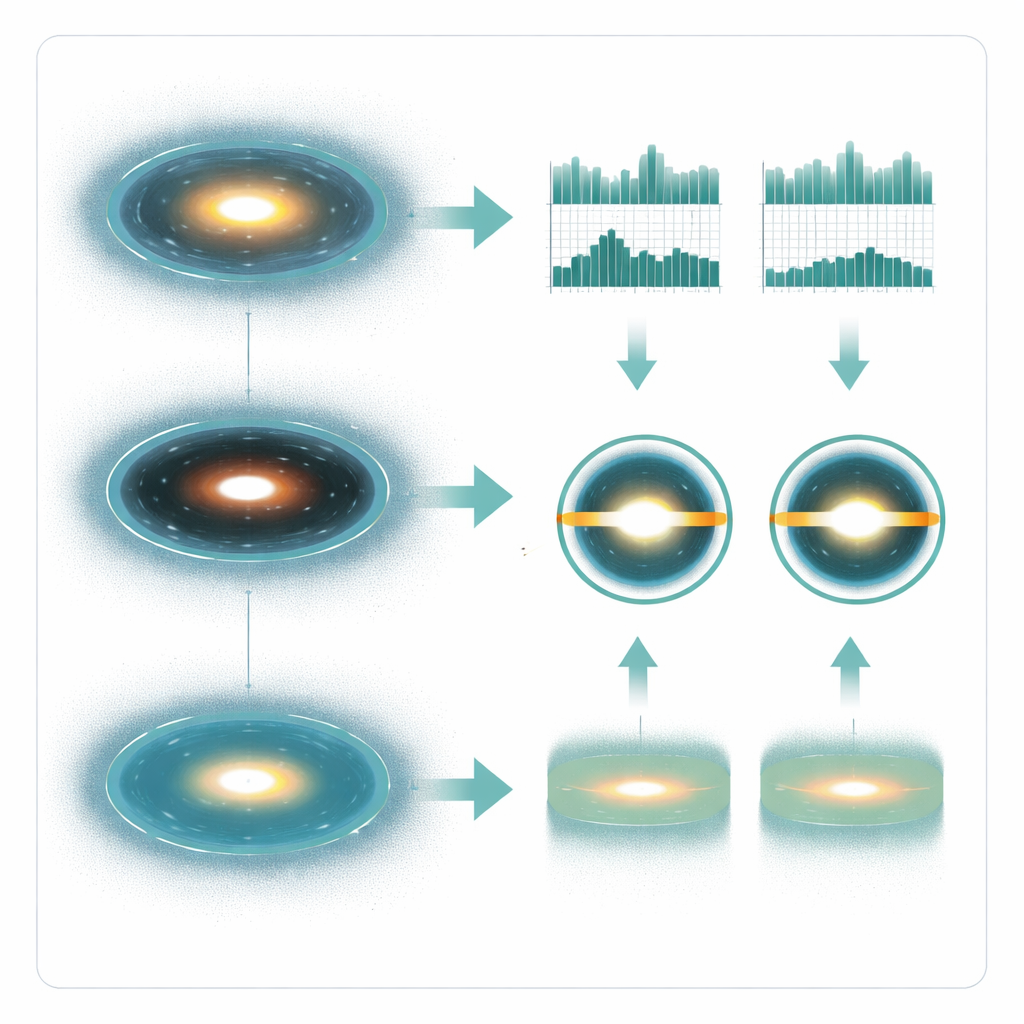
What this means for our picture of black holes
For non-specialists, the message is that our black hole bathroom scale has been sensitive to mood swings rather than long-term weight. Individual AGN flicker substantially over years to decades, but the gas region that dominates the broad lines does not readjust swiftly enough to keep traditional single-epoch mass estimates stable. Using a slower, more distant glow—like [OIII]—as the measure of average power produces mass estimates that are much more consistent over time. This does not change the existence of supermassive black holes, but it does refine how precisely we can weigh them and interpret their growth histories, especially when relying on one-off measurements of distant, energetic galaxies.
Citation: Amrutha, N., Wolf, C., Onken, C.A. et al. Strong long-term variability in active galactic nuclei affects virial black hole mass measurements. Nat Commun 17, 2385 (2026). https://doi.org/10.1038/s41467-026-69166-w
Keywords: active galactic nuclei, supermassive black holes, black hole mass measurement, AGN variability, emission line spectroscopy