Clear Sky Science · en
Anthropogenic climate change drives rising global heat stress and its spatial inequality
Why rising heat matters for everyday life
Across the world, scorching days and stifling nights are becoming harder to escape. This study asks two simple but urgent questions: how much worse is the planet’s heat stress getting, and who is bearing the brunt? By looking not just at temperature but at what the air actually feels like to a human body, the authors show that man-made climate change is sharply increasing dangerous heat — and that poorer countries are being hit much harder than richer ones. 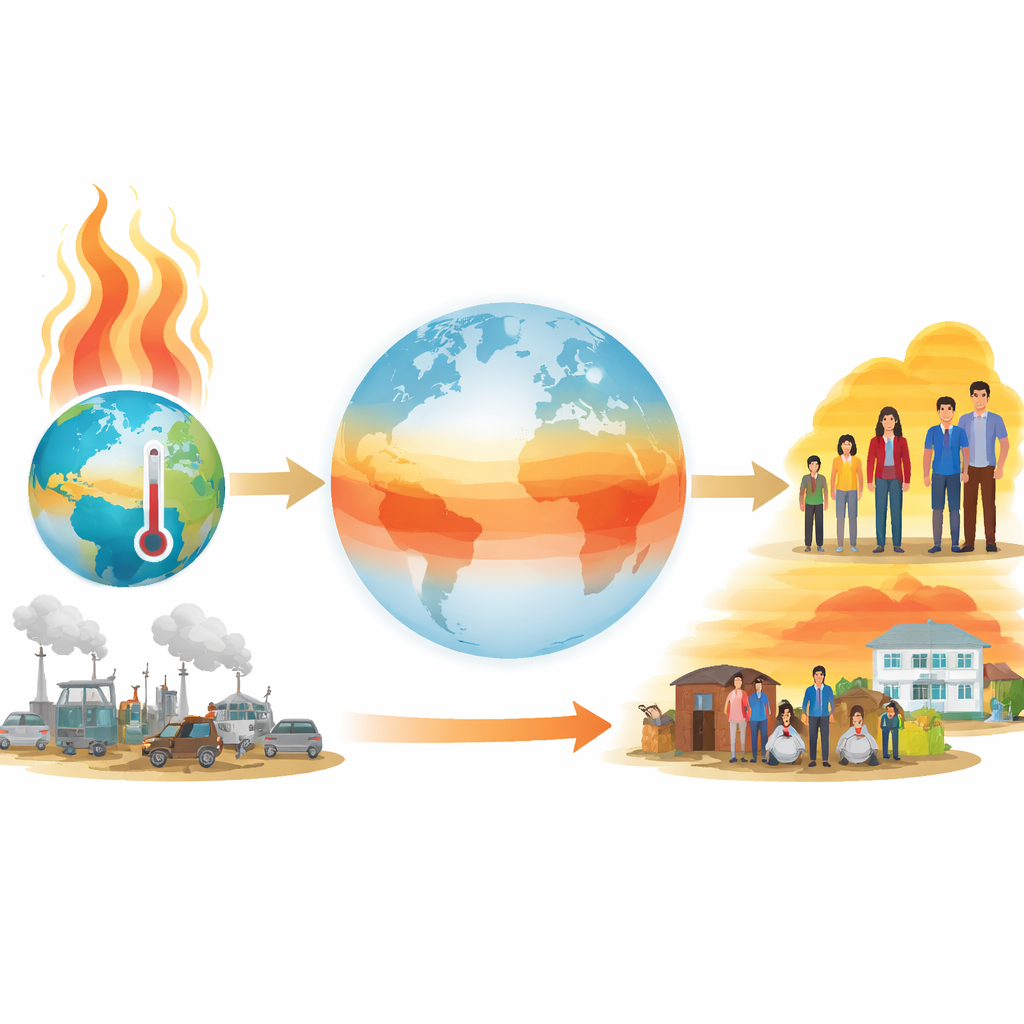
Feeling the heat, not just reading the thermometer
Most reports of global warming focus on air temperature alone, but our bodies respond to a mix of heat, humidity, wind, and sunlight. The authors use a measure called the Universal Thermal Climate Index, which blends all these ingredients into a single “feels-like” number. They examine four decades of global data, from 1981 to 2020, to count how often people are exposed to conditions that strain the body, and how intense that strain has become over time. They track both the average level of heat stress and the number of days when heat reaches especially extreme levels.
Four decades of steadily worsening heat
The analysis reveals that heat stress is rising on every inhabited continent. About 52% of the world’s land surface has seen a significant rise in average heat stress, and roughly 67% has experienced more days of extreme heat stress. The pace is quickening: since 2001, average heat stress has increased more than twice as fast as in the previous two decades, and extreme heat stress days have grown nearly three times as quickly. Hotspots include northern and eastern Australia, large parts of Africa, and tropical South America, where both the intensity and frequency of oppressive heat have surged. These patterns suggest that future warming is likely to bring especially sharp growth in the most punishing kinds of heat, not just a gentle shift in everyday temperatures. 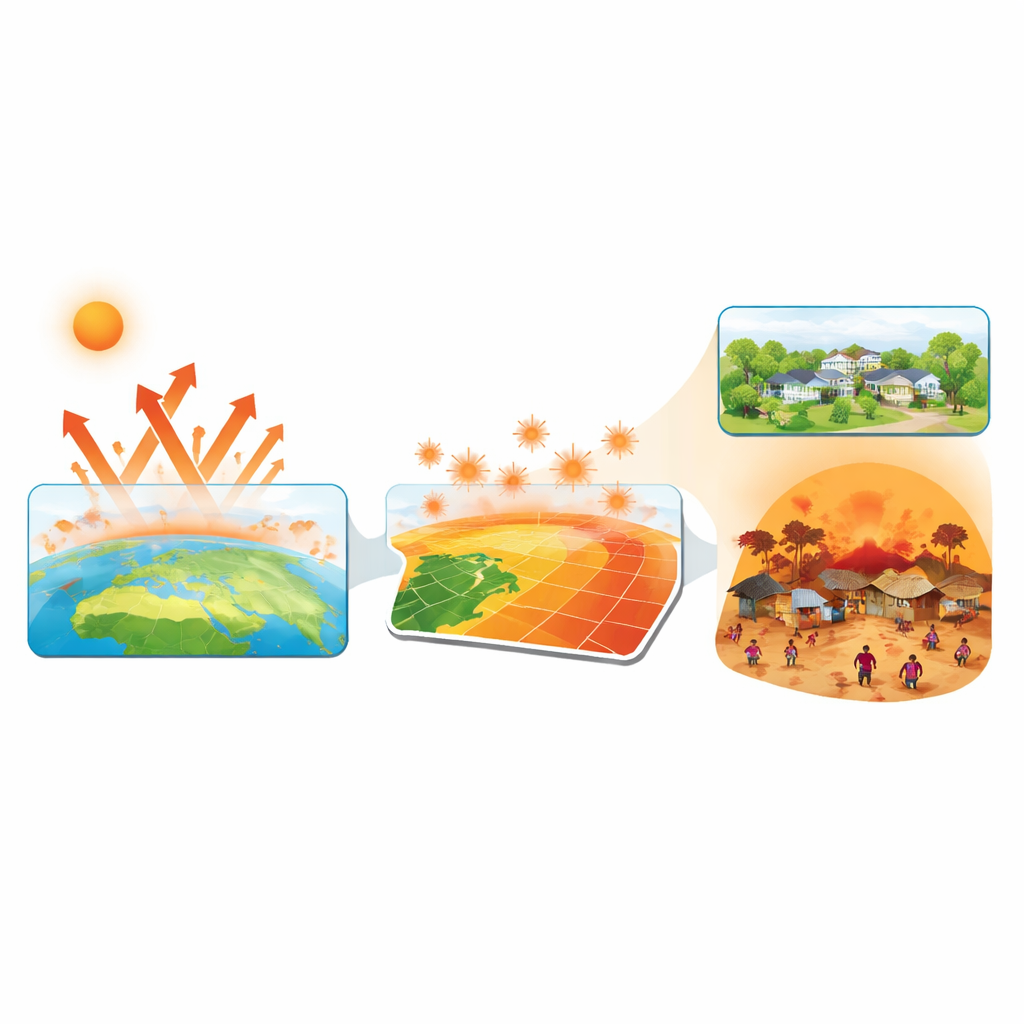
Separating human influence from natural swings
Climate naturally varies from year to year, but the study shows that natural ups and downs alone cannot explain the observed rise in heat stress. Using a machine-learning model and climate simulations, the authors construct separate worlds: one with both human and natural influences, one with only natural factors, and one representing just the human contribution. Comparing these, they find that human-caused climate change is the main driver of rising heat stress. Increases in both average heat stress and extreme heat days due to human influence are markedly larger than those due to natural changes. The land area where heat stress is rising because of human activity is nearly twice as large as the area where natural factors dominate. Most of the human-driven increases cluster between 30 degrees north and south of the equator, where billions of people live and work.
Unequal heat burdens between rich and poor
The study then asks how this extra heat is distributed across economies at different income levels. Grouping countries into high-, upper-middle-, lower-middle-, and low-income categories, the authors find a stark pattern. Under the human-driven scenario, low- and lower-middle-income economies see much faster growth in heat stress than wealthier economies, often two to three times higher. A statistical measure of inequality shows that human-caused climate change concentrates rising heat stress in poorer economies, while natural climate swings slightly soften this imbalance. Extreme heat days, in particular, show much stronger inequality than changes in average heat stress, signaling that the most dangerous events are increasingly concentrated where resources to cope are scarcest.
What this means for people and policy
For a layperson, the message is straightforward but sobering: our emissions are making the world’s heat more dangerous, and the harshest impacts are falling on those least able to protect themselves. Poorer countries in hot regions are seeing the steepest rise in days when just being outside can threaten health, work, and basic livelihoods. The authors argue that this deepening inequality turns climate change into a question of fairness as much as physics. Their findings support the need for rapid cuts in greenhouse gas emissions, alongside strong, targeted help for vulnerable countries — from better cooling, health care, and housing to city planning that anticipates a much hotter future.
Citation: Peng, J., Wang, Q., Yang, Z. et al. Anthropogenic climate change drives rising global heat stress and its spatial inequality. Nat Commun 17, 2310 (2026). https://doi.org/10.1038/s41467-026-69164-y
Keywords: heat stress, climate change, global inequality, extreme heat, environmental justice