Clear Sky Science · en
Electrolyte chemistry of adaptive hydrogen bonded domains for high voltage lithium metal batteries
Why this new battery recipe matters to you
Lithium metal batteries promise phone-sized devices that last for days and electric cars that travel farther on a single charge. Yet these batteries tend to die young or fail dangerously when charged to high voltages. This study introduces a new way to "cook" the liquid inside such batteries so that lithium ions move quickly and safely, allowing high energy and long life to coexist. It does this by reshaping how molecules huddle and interact in the liquid, using carefully designed hydrogen bonds.
Rethinking the liquid heart of the battery
In any rechargeable battery, the liquid electrolyte is the highway along which lithium ions travel between the negative and positive electrodes. In today’s high-energy designs, pushing the voltage higher than about 4.5 volts makes this highway crowded and unstable. Clumps of ions and solvent molecules grow large and sluggish, slowing ion motion, while the liquid itself decomposes at the surfaces of the electrodes. The authors ask a simple but powerful question: instead of just changing salt levels or adding random additives, can we deliberately sculpt tiny molecular neighborhoods that guide ions more efficiently and protect the electrodes?
Building tiny hydrogen-bonded neighborhoods
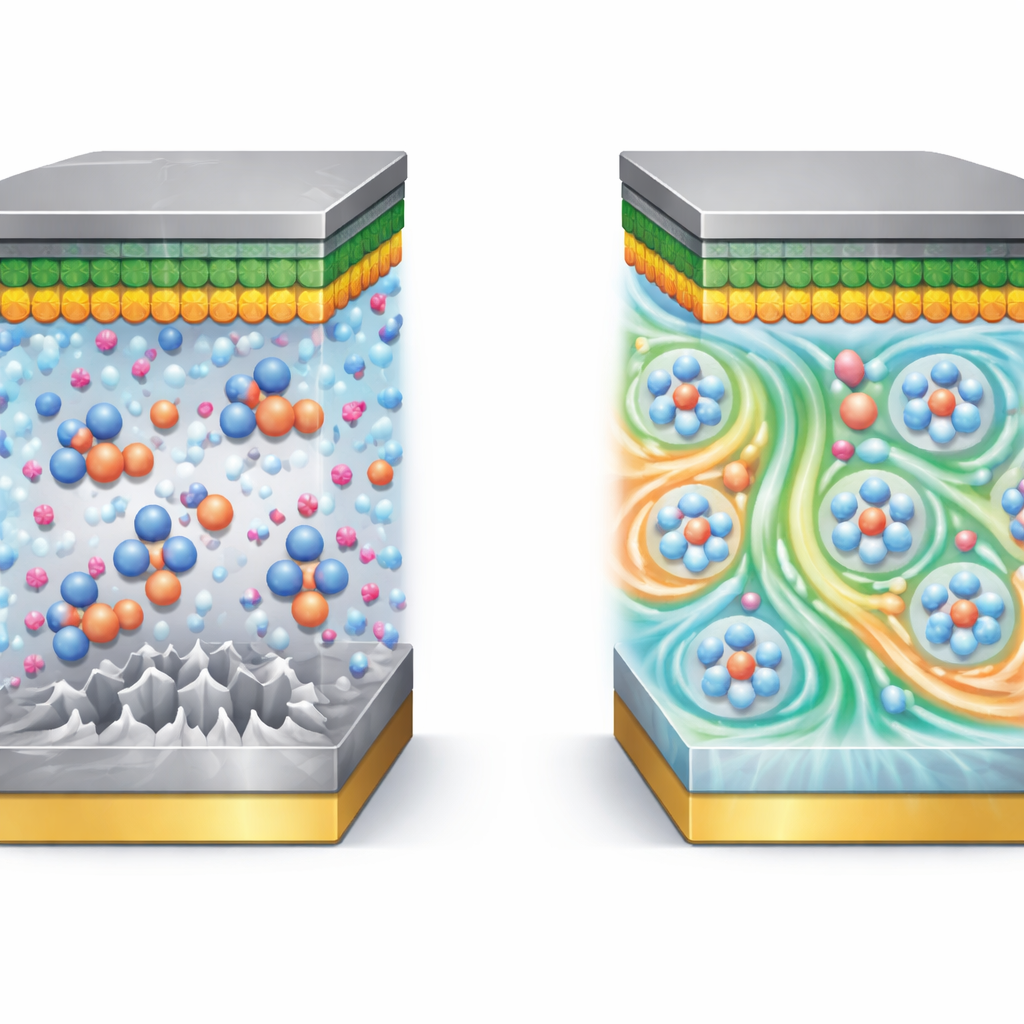
The team turned to a small organic molecule called 2-cyano-N-methylacetamide (ANM), chosen through extensive computer calculations of its electronic structure. ANM can donate hydrogen bonds in two ways: a more familiar type, where a slightly positive hydrogen atom interacts with an oxygen atom, and a “nonclassical” type, where a nitrogen atom engages a hydrogen attached to carbon. When mixed into a common carbonate-based electrolyte with a lithium salt, ANM forms compact, nanoscale hydrogen-bonded domains around the solvent molecules. These domains subtly weaken how strongly lithium ions cling to the surrounding solvent, inviting negatively charged anions into the innermost shell around lithium and shrinking the overall size of ion clusters.
Creating fast lanes for lithium ions
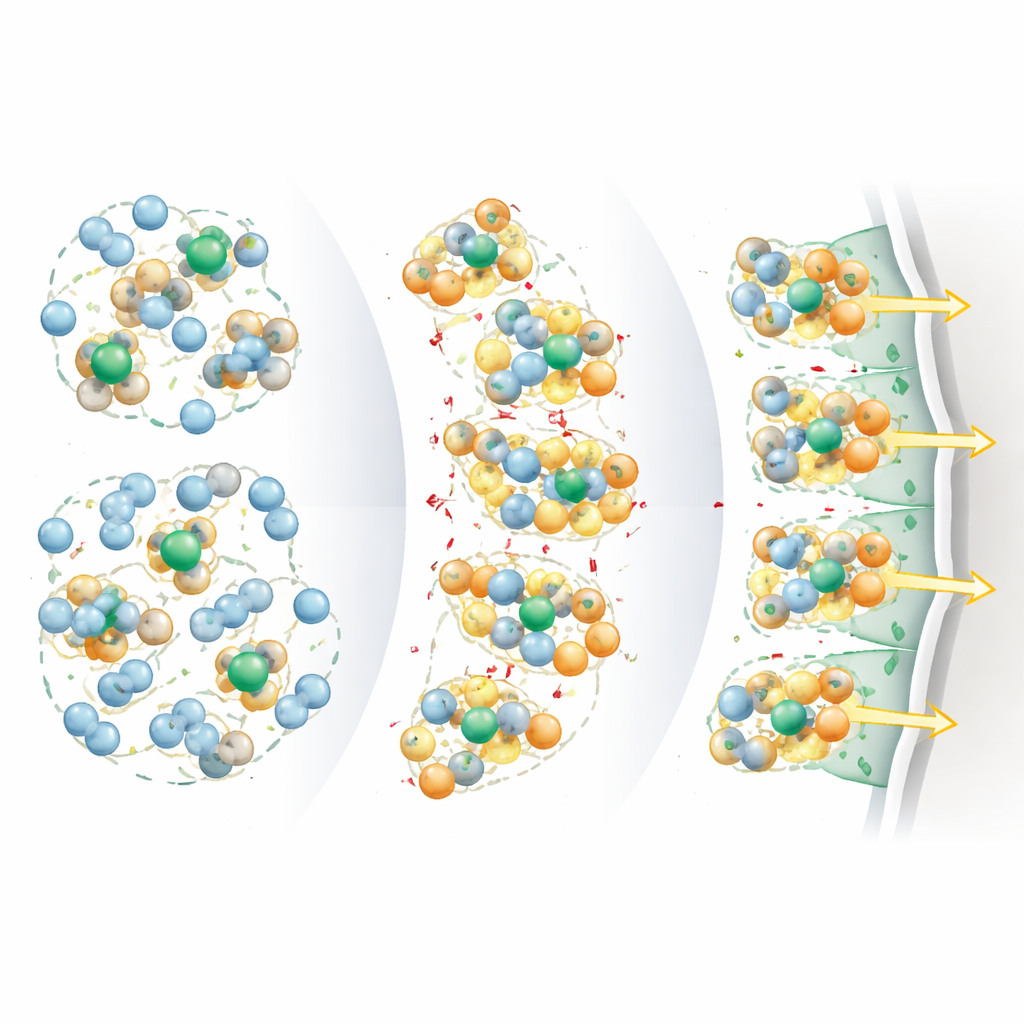
These re-organized clusters have two major benefits. First, the tighter, anion-rich solvation shells and smaller overall clusters create more direct, less twisted pathways for lithium ions to move through the liquid, boosting conductivity even though the solution is more viscous. Measurements show a significantly higher fraction of current carried by lithium ions and lower energy barriers for ions to cross the protective films at the electrodes. Second, because ANM anchors and orients nearby solvent molecules, it reduces their tendency to break down at very high voltages. Instead, the anions decompose first at the electrode surfaces, building thin, inorganic-rich interphases that are ion-conducting yet electronically insulating—exactly what is needed to suppress harmful side reactions and dendritic lithium growth.
Protecting both sides of the battery
On the lithium metal side, the ANM-based electrolyte encourages uniform lithium deposition, forming a robust, largely inorganic surface film rich in compounds such as lithium fluoride and lithium nitride. This coating supports fast ion transport while resisting further chemical attack, leading to smoother cycling and fewer needle-like lithium structures that can short-circuit the cell. On the high-voltage cathode side, particularly with demanding nickel-rich materials, the same electrolyte chemistry slows the breakdown of solvent molecules and reduces the loss of transition metals from the crystal lattice. Advanced X-ray and microscopy studies show that cathodes cycled in this electrolyte retain a more ordered structure, thinner and more uniform surface films, and fewer cracks, even when pushed to 4.7–4.8 volts.
From lab concept to practical performance
These molecular-level changes translate into striking device-level gains. Coin cells using the ANM-containing electrolyte and a high-loading nickel-rich cathode retain nearly four-fifths of their capacity after 400 cycles at 4.7 volts, with very high charge–discharge efficiency. The approach also scales to larger pouch cells with realistic electrode thicknesses, lean electrolyte amounts, and thin lithium metal. Under these harsh, application-like conditions, the cells deliver specific energies above 400 watt-hours per kilogram and maintain most of their capacity over dozens of high-voltage cycles, far outperforming cells using a conventional electrolyte mixture.
What this means for future batteries
By treating hydrogen bonding as a design tool rather than a side effect, this work proposes a new principle for crafting battery liquids: use adaptive hydrogen-bonded domains to shrink ion clusters, favor anion-rich shells, and build protective, inorganic surface films on both electrodes. In plain terms, the researchers have shown how subtle rearrangements of molecular friendships in the liquid can tame a very energetic battery chemistry. If extended and refined, this strategy could help bring safer, longer-lasting, high-voltage lithium metal batteries closer to everyday use in electronics, electric vehicles, and grid storage.
Citation: Yang, Z., Zeng, L., Ju, Z. et al. Electrolyte chemistry of adaptive hydrogen bonded domains for high voltage lithium metal batteries. Nat Commun 17, 2379 (2026). https://doi.org/10.1038/s41467-026-69160-2
Keywords: lithium metal batteries, electrolyte design, hydrogen bonding, high voltage cathodes, energy storage