Clear Sky Science · en
The human metabolome and machine learning improves predictions of the post-mortem interval
Why the timing of death matters
Knowing when someone died is a central puzzle in many criminal and unexplained death investigations. A precise estimate of the time since death, called the post-mortem interval, can confirm or challenge alibis, narrow down suspects, and help reconstruct what happened in a person’s final hours and days. Yet today’s tools, such as body temperature or chemical measurements in the eye, quickly lose reliability after the first day or two. This study explores whether invisible chemical traces in blood, combined with modern artificial intelligence, can extend that useful window—from a couple of days to nearly two months after death.
Limits of today’s forensic clues
Forensic experts traditionally rely on visible and physical signs such as skin discoloration, stiffness of the body, or cooling of the corpse, as well as potassium levels in the clear fluid of the eye. These clues work reasonably well early on but are subjective, strongly influenced by the environment, and usually stop being dependable after one to three days. For longer periods, investigators must turn to much cruder indicators such as insect activity, the state of decomposition, or even analysis of skeletonized remains. There is a clear need for quantitative methods that can bridge the gap between early, temperature-based estimates and very late, decomposition-based approaches.
The body’s chemical traces as a hidden clock
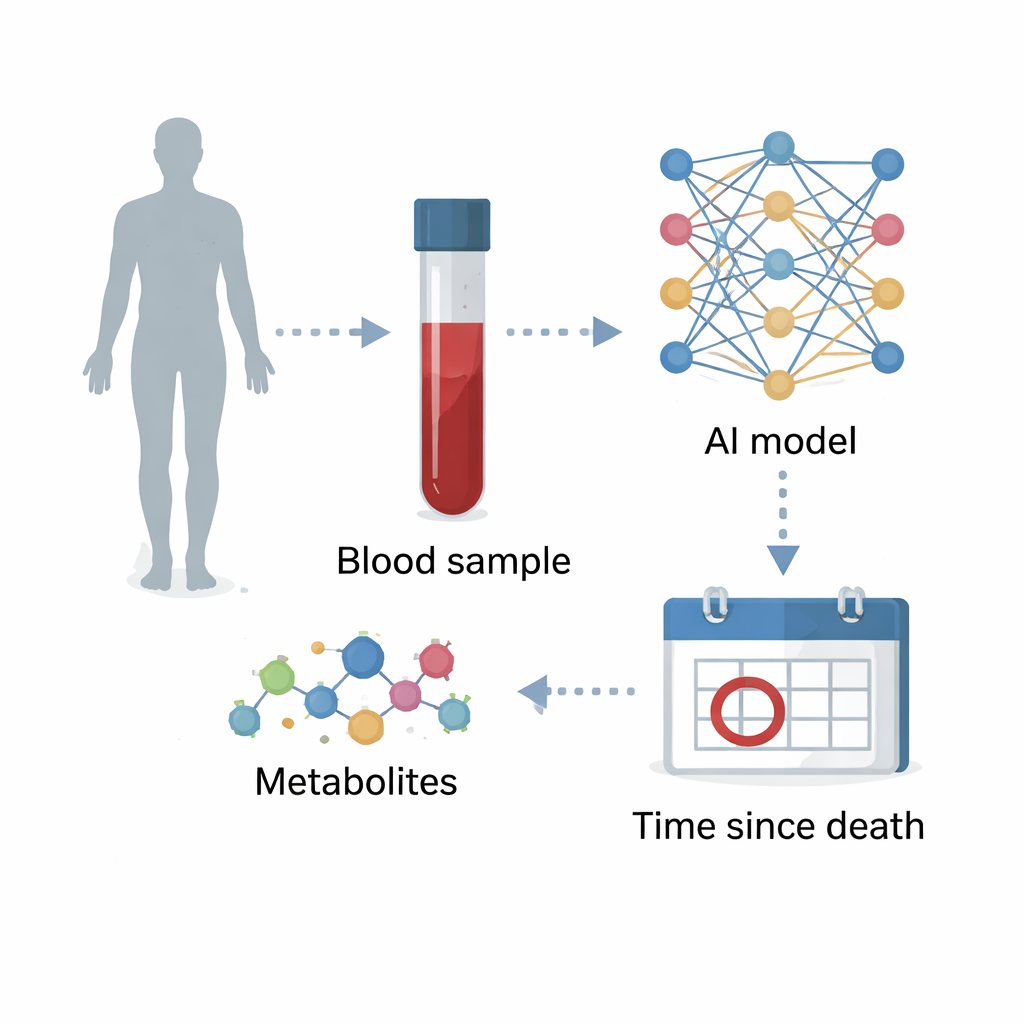
After death, the body’s small molecules—collectively called the metabolome—change in systematic ways as cells lose energy, membranes break down, and proteins are digested. The researchers took advantage of this by reusing existing toxicology data: high-resolution measurements of thousands of chemical features from femoral blood routinely collected during autopsies. In total, they analyzed 4,876 real forensic cases with known times between death and autopsy, mostly between one and thirteen days but extending up to 67 days. Instead of hunting for a single “magic” marker, they asked whether the whole pattern of many metabolites together could act as a chemical clock.
Teaching an AI to read the chemical clock
The team trained a feed-forward neural network, a type of machine learning model, to take in about 2,300 chemical signals and output the estimated days since death. After optimizing the model’s settings and using part of the cases for training and part for testing, the system predicted the post-mortem interval with an average error of about 1.5 days, and a median error just over one day, in unseen cases. This performance was better than six alternative approaches, including several standard statistical and machine learning methods. While predictions were most accurate for deaths in the middle of the time range and less precise for very short or very long intervals, the overall error was similar to the uncertainty already present in the recorded times of death themselves.
What the model reveals about decay inside the body
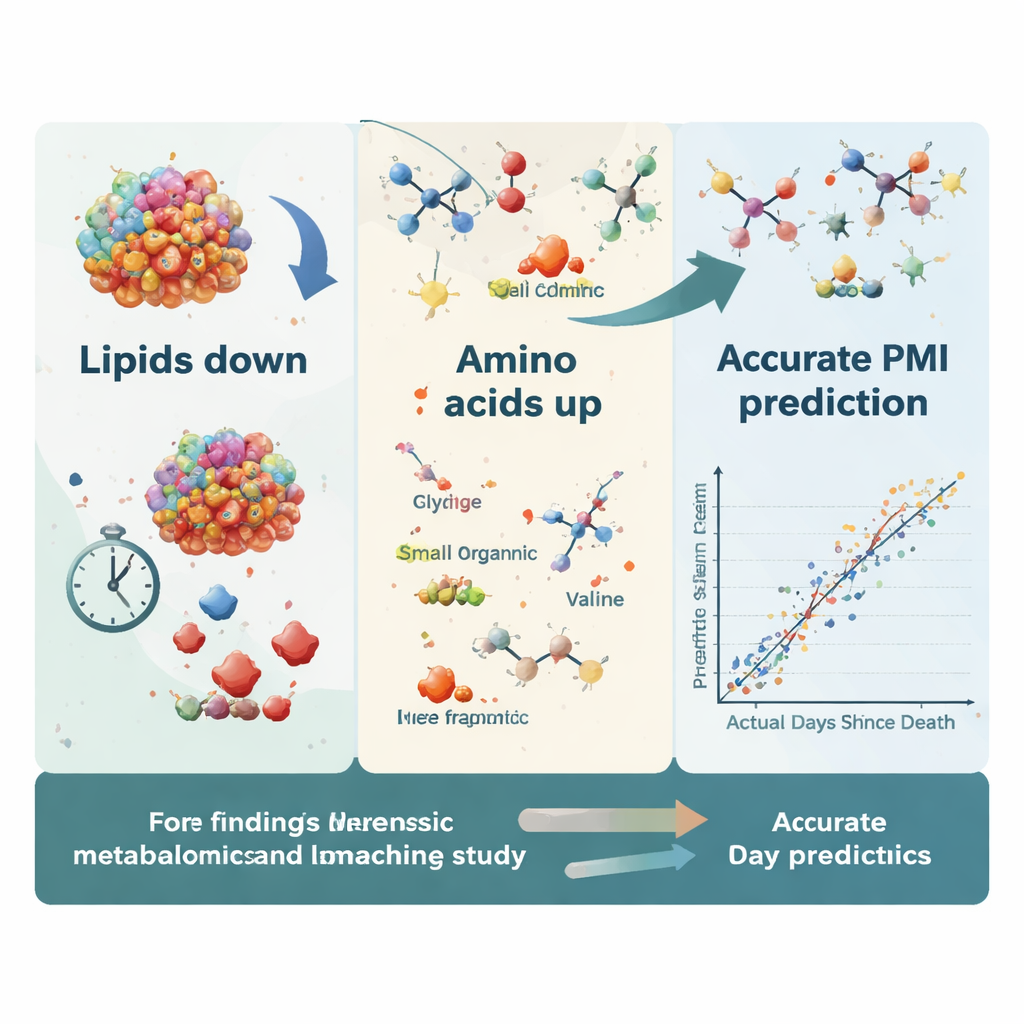
Because neural networks are often seen as black boxes, the authors looked more closely at which chemical changes the model used. By tracking how important metabolites tended to rise or fall with time, they discovered three broad patterns. Some molecules, especially certain lipids and acylcarnitines, steadily decreased, fitting with the breakdown of cell membranes and declining mitochondrial energy production. Others, notably amino acids and short protein fragments, increased, consistent with proteins being cut up as tissues degrade. A third group showed more complex curves over time. These trends mirror earlier animal and human studies and point to recognizable biological processes—lipid breakdown, mitochondrial failure, and protein digestion—progressively unfolding after death.
From big studies to practical tools
To test whether their approach could work beyond a single lab, the researchers applied the trained neural network to 512 new cases measured in a different year on another mass spectrometry instrument. Even without retraining, the model’s error remained around 1.8 days, suggesting that the chemical signal is robust enough to survive differences in equipment and timing. They also showed that simpler models trained on only a few hundred cases still achieved useful accuracy, implying that smaller forensic institutes could build their own prediction tools. Although environmental factors and cause of death can also shape the metabolome, and more balanced data at very short and long intervals are needed, the results indicate that routine toxicology data can be repurposed into a powerful aid for estimating time since death.
What this means for real investigations
For a non-specialist, the key takeaway is that the body’s own chemistry after death appears to act like a slow-moving clock, and that modern AI can read this clock with about a day’s precision over more than a week. This is not a perfect stopwatch, and it does not replace the judgment of forensic experts or other evidence. But as these methods are refined and validated in more settings, they could offer investigators a more objective, data-driven estimate of time since death, particularly in the critical window where today’s standard approaches begin to fail.
Citation: Magnusson, R., Söderberg, C., Ward, L.J. et al. The human metabolome and machine learning improves predictions of the post-mortem interval. Nat Commun 17, 1504 (2026). https://doi.org/10.1038/s41467-026-69158-w
Keywords: forensic science, time of death, metabolomics, machine learning, post-mortem interval